


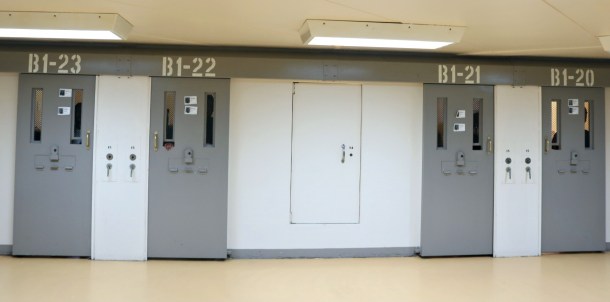
As the state scrambles to move its out-of-state prisoner population from Pennsylvania to Mississippi, Gov. Phil Scott said Thursday he would continue to push lawmakers to build capacity in Vermont’s prison system so that all inmates can eventually be held in-state.
The Scott administration’s primary plan to make space for prisoners — a 925-bed facility in Franklin County built by private prison company by CoreCivic and leased to the state — was roundly rejected by lawmakers in the last legislative session.
But he told reporters Thursday that he would be willing to work with lawmakers to refine the plan in the future.
“We are going to continue to talk about the plan that we put forward and we’re willing to have the conversations about how we can make it more enticing and better for legislative buy in,” Scott said.
A group of lawmakers meeting Thursday also discussed how the state could eliminate the burden of housing 228 of its inmates outside of Vermont. But the legislators focused on thinking through how the state could work to reduce its prison population, without making mention of the governor’s prison plan.
“Right now we’re at about 1,800 (prisoners), we have 1,600 beds in the state,” Rep. Alice Emmons, D-Springfield, chair of the Joint Legislative Justice Oversight Committee, said at a Statehouse meeting.
“That’s the reality of the situation,” Emmons added. “Let’s really put our energy into figuring out how we can bring our folks home.”
The flurry of discussion Thursday regarding Vermont’s prison population followed the announcement a day earlier that the state had inked a deal to sends its out-of-state inmates to a Mississippi facility run by CoreCivic, the country’s largest private prison contractor.
Since 1998, Vermont has been housing some of its prisoners out-of-state at various state, county and privately-owned prisons from as far away as Arizona and as close to home as Massachusetts—about 10 different facilities in total.
While the number of out of state of prisoners has declined from more than 700 at one point, the pressure in recent years to bring them back to Vermont has been mounting.
Since December 2016, this inmate population has been held at the Camp Hill State Correctional facility in Pennsylvania, in a stay which has been plagued by three deaths, and concerns from prisoners about poor treatment and access to medical care. A three-year contract with the prison was terminated early in February.
Lawmakers on Thursday said the state has taken many steps over the years to reduce Vermont’s prison populations with the goal of reaching a point where it would not need to ship inmates out of state. But reducing the population, they said, is further is complicated by concerns for public safety.
With fewer low-level offenders being held in Vermont prisons, and a larger share of prisoners convicted of felonies, the governor said the state will have less latitude in cutting the number of its prisoners.
The state Department of Corrections provided the legislative oversight committee Thursday with a breakdown of the state’s inmate population for one day last week which totaled 1,746.
Those numbers revealed that 913 inmates, or nearly 53 percent, were being held on serious felony charges, such as murder, aggravated assault and aggravated sex assault. Another 25 percent are jailed on felony charges against people and property, including crimes like robbery, burglary, arson and sex offenses.
Eight inmates were behind bars on misdemeanor property-related crimes, like unlawful trespass and retail theft, and six were held on misdemeanor drug offenses.
Committee members spoke of continuing to expand treatment courts to help keep people out of the prison system. They also talked of specialized courts to deal with substance abuse, mental health issues, and domestic violence offenses.
Sen. Dick Sears, D-Bennington, vice chair of the oversight committee, asked if the corrections system would benefit from having a nursing home to care for older offenders, freeing up prison beds in Vermont for other inmates.
“Would it make sense,” Sears asked, “for the state to buy a nursing home that’s not being used, or rent a wing of a nursing home, just to look at that particular group or aged offenders who are probably doing life sentences and are no longer really a danger.”
Lisa Menard, Vermont’s corrections commissioner, responded that she didn’t have exact figures, but didn’t believe many inmates would be in need of nursing home care. Instead, she said, an assisted-living facility may be more appropriate for the state’s older prisoners.
“They do not need the level of care,” Menard said. “There have had some, and we have tried very hard to get them in nursing homes with little success.”
Menard said she would get specific numbers for lawmakers on how many prisoners may be assisted-living eligible.
Emmons said at Thursday’s meeting that the state knew when it was seeking bids to house its out-of-state prisoners there would not be a lot choices.
“But, we wanted to get folks out of Camp Hill,” she said.
In an interview Thursday, Attorney General T.J. Donovan said he would not be inclined to support constructing a new prison facility, and hit on many of the same points as the lawmakers.
Donovan said it’s Vermont’s responsibility to house its inmates, and says that by actively stewarding criminal justice reform, the state can build capacity for those who are incarcerated elsewhere.
He said pushing ahead with already enacted bail reform and expungement policies, adding more transitional housing for newly-released prisoners, and considering compassionate release for some inmates will help accelerate the reduction of the state’s incarcerated population, which has been shrinking naturally over time.
“We’re talking about 250 people, that’s not a huge number,” Donovan said. “I think we do all those things, we can reduce our prison population, we can enhance our public safety and Vermont can fulfill its responsibility.”
While Donovan is opposed to private prisons, he said he doesn’t blame the Department of Corrections for signing a contract with CoreCivic in Mississippi.
“They were between a rock and hard place on this thing. Camp Hill was not going well,” he said. “They did their job, they had limited options.”
