

[A] new, multi-million-dollar technology hub could be coming to Springfield.
Bob Flint, the executive director of the Springfield Regional Development Corp., and Matt Dunne, founder of the Center on Rural Innovation, announced plans for the hub at an event Tuesday with Rep. Peter Welch, D-Vt., and Gov. Phil Scott.
The hub, called the Black River Innovation Campus, will train software developers and fund as many as eight startups a year, allowing them to take advantage of Springfield’s high-speed internet while living and working in town.
“This unique approach will also help retain and attract more youth in Vermont,” Scott said.
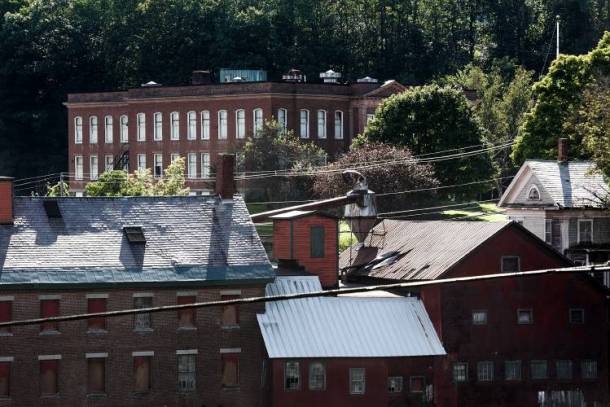
Flint and Dunne have been working on the initiative since October 2016. They plan to transform the former Park Street School, an 80,000-square-foot building that dates back to the 1890s, into the headquarters for BRIC, where the entrepreneurs will work and live, for free.
The school building will have 22 loft apartments above about 7,000 square feet of co-working space once renovations are complete. The building will also house a coffee shop, a recreation department and senior center. The auditorium and gymnasium will both be renovated.
Although there is no campus to speak of, yet, BRIC is moving ahead. The entrepreneurs will be housed in privately owned buildings in downtown Springfield until the school building is ready. The entire project will cost $15 million-$17 million. Dunne said that money would come from investor and bank financing and rental income. The project is also eligible for hefty tax credits.
The nonprofit is now hiring an executive director, and the organization’s board of directors will soon take applications from entrepreneurs who want to bring their ideas to Springfield, at least for a year. Dartmouth College will provide training and resources to the entrepreneurs while Reid Hoffman, the founder of LinkedIn, will offer mentorship and potentially investment.
“Springfield is back,” Welch said in a speech on Tuesday. He, like others, are hoping the innovation center will help turn around the economically-depressed town.
Springfield, which has some of the fastest internet speeds in the country thanks to VTel’s fiber optic network, is also home to a number of environmentally contaminated industrial buildings, left behind by a machine tool industry that collapsed in the 1980s, taking about 3,000 jobs down with it. Now, about 29 percent of the residents are on public assistance programs.

Meanwhile, Springfield has one of the highest tax rates in the state. Earlier this year, the combined town and education tax rate jumped to $3.65 per $100 of assessed property value due to a townwide reappraisal, which decreased the grand list value 13 percent.
The Springfield Redevelopment Corp. has been working to restore Springfield and the surrounding area for more than 20 years. Town officials say investments are key to growing the grand list and reducing the soaring tax burden.
“Downtown is our No.1 priority,” said Springfield Town Manager Tom Yennerell. “For us to experience redevelopment and growth in other areas in town, we need to redevelop the downtown first.”
The town recently established a revitalization fund to make Springfield more attractive to private investors. Springfield partnered with landscape company Greenman-Pedersen last June to create a Main Street Master Plan, which involves $7 million in improvements, including a new park, riverwalk, new sidewalks and improved landscaping over the next several years.
With the announcement, officials hope to once again deploy technology as an economic engine. “These are the pieces that we’ve been looking at for the past couple years to bring new business and increase the grand list,” said Select Board member Peter MacGillivray.
Dunne, a former state senator who made an unsuccessful bid for governor in 2016, founded his nonprofit Center on Rural Innovation following the 2016 election with the help of Hoffman, the LinkedIn founder, who provided initial funding.
Dunne plans to create innovation centers across rural America through his organization. Springfield, with its proximity to Dartmouth College and high speed internet, seemed like an obvious place to start.
“I’ve been engaged in Springfield my whole life,” he said.
Several private and public donors have provided about $1 million in initial funding for BRIC. It received a $215,000 grant from Ewing Marion Kauffman Foundation and $250,000 from the Siegel Family Endowment. The Vermont Training Program has provided another $120,000 to train qualified employees and VTel donated $240,000 worth of free internet and data storage.
“Everyone is patting each other on the back,” VTel President Michel Guite, speaking by phone, said of the excitement.
A computer science program at Springfield High School will be established as part of the plan. PurposeLab, a software product development studio in California, is helping to jump-start the initiative by providing paid training to 24 software developers in Springfield next year. Once the school is renovated, the idea is that there will also be space for these developers on campus.
“We’re hoping that this innovation implementation will help create an atmosphere where there will be better paying technology jobs to replace the manufacturing jobs we lost decades ago.” said Michael Martin, another Select Board member.
Clarification: The project does not need to raise $15 million by donations. That number is the cost of renovation but tax credits will reduce that amount, which will come from investor and bank financing and rental income.

