

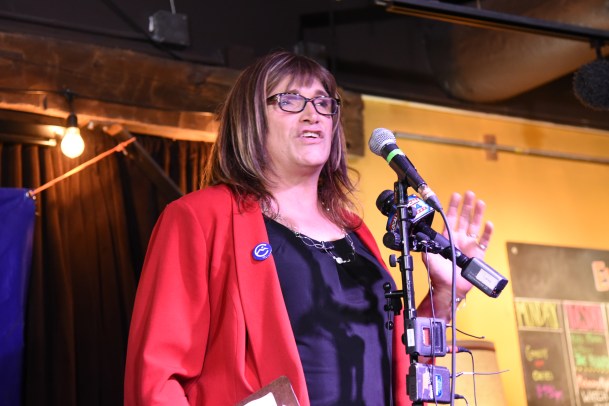
[W]ith the general election just seven weeks away, Christine Hallquist is facing pressure from Republicans to explain her tax policy, but she remains noncommittal on specifics.
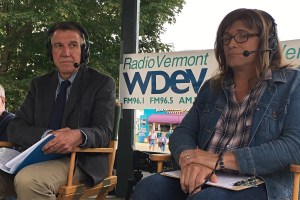
During the first gubernatorial debate Friday between Hallquist, the Democratic candidate, and Gov. Phil Scott on WDEV Radio, both the moderators and Scott asked Hallquist about her view on taxes.
But Hallquist, a former electricity executive, would not say whether she supports the idea of a carbon tax in Vermont. While Scott said unequivocally he would veto any carbon tax bill that came across his desk, Hallquist would only say it was an idea worth investigating — conceding it is a successful way to cut carbon emissions.
“When you look at public policy initiatives, a price on carbon is one of the most effective policy initiatives for mitigating carbon. Does that mean I support it?” Hallquist said. “I’m going to say not right away, that’s for sure, because I also, in my job we served 18 of the 25 poorest communities in Vermont, and we cannot make things any more difficult for people living on the economic margin. So I believe it deserves a deep dive just like any other new idea.”
Hallquist was also asked during the debate if she would support a payroll tax to cover paid family leave. Hallquist said she would support such a bill and “figure out how to fund it.”
“This whole tax issue, we will fund it responsibly however that needs to be done. I’m not afraid of having a tax to be civilized and do those things but we’ll figure ways to fund things in whatever the best way possible is, but that’s a collaborative decision,” Hallquist said. “That’s why the governor should be working collaboratively with the Legislature to figure out how to do the right thing.”
Hallquist’s campaign has also said that she is not against a more progressive tax structure, placing more of the state’s revenue burden on the rich, but she also won’t commit to being for it.
Cameron Russell, Hallquist’s campaign manager, said Hallquist does think the tax structure could be more equitable, but is not willing to make a decision on specific policy.
“We could have a tax structure based more on what people are able to pay, but that doesn’t mean Christine is willing to say we are going to raise taxes. Nobody should be saying we are going to be raising the taxes on the rich. That’s not a sweeping decision that should be made in the course of a year or two,” Russell said.
Going forward, Russell said, Hallquist will support paid family leave funded through a payroll tax.
While Hallquist has been tough to pin down on her tax policy, Scott has maintained the simple and stubborn position that defined his 2016 campaign and his nearly two years in office: no new taxes or fees on Vermonters under his watch.
Lt. Gov. David Zuckerman, a Progressive, said that while Hallquist is being politically careful not to make potentially unpopular tax commitments, she is at least discussing tax issues.
“Well that campaign is probably portrayed by the media and political thinkers as one to be won in the middle,” he said of the governor’s race. “So it would make sense to tack towards the middle.”
Zuckerman added, “I respect that Christine is trying to figure out a more progressive taxation policy while dancing with someone who has great sound-bite politics as the governor does.”
Sen. Randy Brock, R-Franklin, who has run multiple times for statewide office, said coming out in favor of certain tax policies was certain to scare off some moderate Republicans and undecided voters.
“Well, for one thing you will probably lose a lot of votes in rural Vermont,” he said, noting that a July VPR/Vermont PBS poll found jobs and the economy to be the priority issue among voters. “It was the financial issues and when you start thinking about things like carbon tax, that’s a big financial issue.”
In the VPR-PBS Poll, taxes (11 percent) rated as the third most important problem facing Vermont behind the economy, jobs and cost of living (27 percent) and drugs and opiate addiction (19 percent).
As the fall campaign heats up, taxes continue to be the preferred Republican line of attack against Hallquist.
After Scott said Hallquist seemed to rely on raising “taxes to solve every problem” during the debate on Friday, the Republican Governors Association went on the attack on Monday.
The RGA wrote Hallquist had stopped “her attempt to distort the facts” and had “admitted that she would raise taxes” if she became governor.
Last month, a member of the RGA’s communications department tweeted that Hallquist “wanted nearly $100 million in new taxes and supports a $32 trillion” single-payer health care system.
.@christineforvt wants nearly $100 million in new taxes and supports a $32 trillion Single-Payer healthcare system. No matter how hard she tries to mislead voters, Hallquist can’t hide her record as a tax-hiker from the people of Vermont. #VTGov #vtpoli
— John Burke (@JBurkeNation) August 16, 2018
The Hallquist campaign said these numbers are incorrect and seem to have come “out of thin air.”
Sen. Anthony Pollina, P-D/Washington, said he believes the rhetoric over taxes is robbing Vermonters of the chance to have a real discussion about possible revenue sources that could benefit the state’s economy and its residents.
“We are denying Vermonters access to an important debate by not allowing taxes to be seriously talked about during the campaigns. We need candidates who are willing to put plans on the table in detail and let the voters decide,” Pollina said.
“I would encourage Hallquist to be more specific in her plans, but I would encourage Phil Scott to discuss what raising revenue actually means for Vermont,” he said.
