

Editor’s note: This story by Christine Wisniewski was published in the Bennington Banner on Sept. 13.
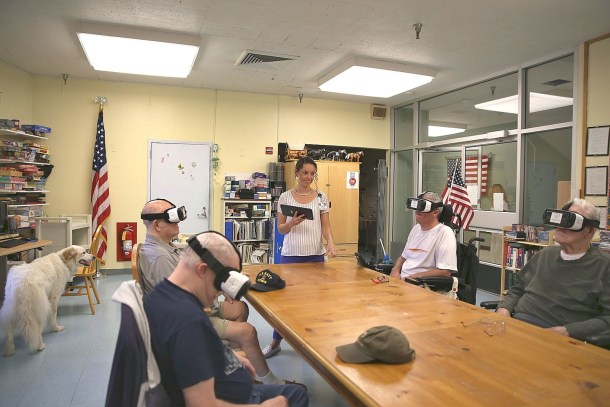
[B]ENNINGTON — In a roughly half an hour, four residents at the Vermont Veterans’ Home traveled the globe without getting up from their chairs.
The first stop was Paris.
“I’m right underneath the Eiffel Tower!” exclaimed resident Ray Meaney, a former petty officer third class in the Navy.
The residents also experienced Cambodia, Yosemite National Park, the Cook Islands and other exotic places they had never experienced before.
Since virtual reality headsets made their appearance at the Vermont Veterans’ Home in February, veterans have been able to travel to new places, revisit their old homes and vacation spots and play interactive games with one another. Now, virtual reality is part of the activity calendar along with bingo and chess.
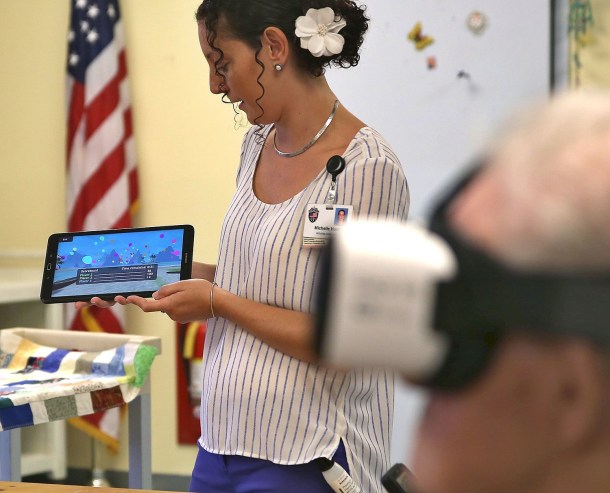
Michelle Hunt, an activities aide at the Veterans’ Home, jumped at the chance to become the go-to person for VR activities. She helps residents with their headsets and controls the experiences through a tablet.
“It’s really taken off,” she said.
Veterans’ Home Chief Operating Officer and Deputy Administrator Al Faxon described the seemingly endless benefits that these headsets have provided to veteran residents this past year. One veteran, he said, was astounded that the headset allowed him to go rock climbing in Yosemite when he thought he would never rock climb again.
Other residents can visit their old homes or vacation spots thanks to the 360 degree “Street View” provided by Google Maps. Or, a resident who always wanted to see Angkor Wat in Cambodia can be transported there in a matter of seconds.
When the Veterans’ Home got its first VR headset, staff and residents “test drove” the technology and gave positive feedback. Now, they own six sets that can be used individually or in groups.
“We have folks here who are in their 90s and have iPads, so it was kind of natural to look for technology to help them and bring them places,” Faxon said.
One of the main reasons the Veterans’ Home decided to bring VR to its residents was to make life more enjoyable.
“Nobody chooses to go to a nursing home,” Faxon said. “We wanted to make life more exciting. Maybe you can’t do exactly what you did [before] but if you can do a piece of what you did in life, you keep going. And we want you to keep going.”
While the Veterans’ Home likes to take residents on field trips, it can be difficult to coordinate especially for those with mobility issues. Eventually, the idea of taking residents on virtual field trips came about when virtual reality came about.
Faxon compared the headsets to reading a book, where people can immerse themselves in foreign and fantasy lands while sitting in their room.
“We can transport them anywhere,” he said.
Faxon says there are many residents who can’t wait to try out the headsets, and those who have tried it before are excited to do it again.
The Veterans’ Home is also looking at 360 degree camera technology that allows veterans to participate in events even if they can’t physically be there. For example, the camera could be set up at a wedding and the veteran can experience the entire ceremony through his headset.
“They can still participate in their own way,” Faxon said.
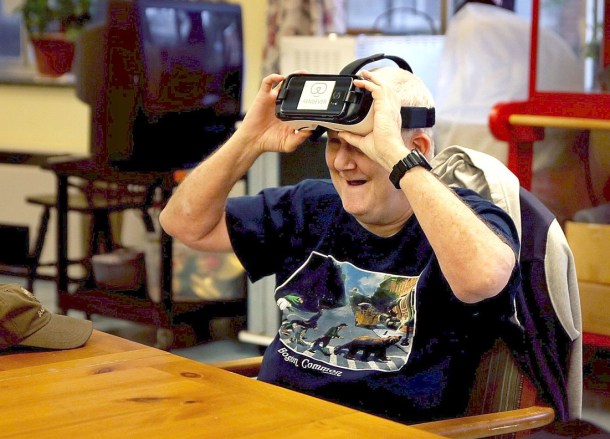
The VR headsets strap over the eyes and block out all light to fully immerse the user. An Android cellphone is attached to each headset and acts as the screen, which delivers the experience.
These phones, which are only used for virtual reality purposes, are controlled by a tablet operated by Hunt. She can personalize each user’s experience from this tablet, choosing from dozens of places and experiences.
Each VR session does not last more than a half hour, since using the headsets too long can cause motion sickness or dizziness.
The Veterans’ Home pays for a monthly subscription which delivers the content. Since the tablet can only hold so many virtual reality pictures and videos, Hunt can choose which experiences to download. There are constant updates which provide new places and experiences.
The subscription is paid for out of the operating budget, but the headsets were paid for with donations.
The headsets are made by Rendever, which specifically tailors the virtual reality experience to seniors. The company’s goal is to help reduce loneliness and depression in seniors and nursing home patients through the use of VR.
To get the full effect of VR, the user must turn their head up, down, right and left to see the whole picture. While wearing these headsets, the user truly feels immersed in the setting.
In addition to static and moving pictures, the headsets are also capable of running interactive games. One game’s objective is to pop as many balloons as possible by the user turning their head to look directly at the balloons.
For those with a need for speed, there are also motorcycle and skydiving simulators.
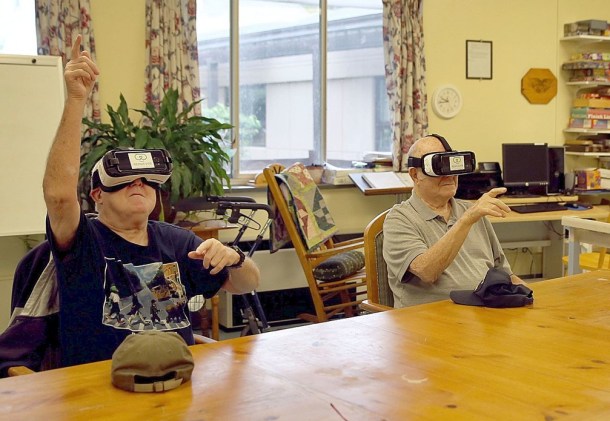
Aside from being a fun activity, the headsets can help residents with dementia, encourage residents to socialize, and help those in physical therapy.
Faxon told the story of one resident with dementia who was having particularly high anxiety one day, and the VR headset helped him to calm down almost instantly.
These headsets can be used while a resident is receiving medical care. Instead of sitting in a chair averting their eyes from a needle, residents can escape to a peaceful beach or sit on top of a mountain.
Another benefit of VR is that it encourages residents to move. Even if it’s tiny movements like turning their head, these movements can help senior residents with their range of motion.
Those exercising can strap on a headset to motivate themselves. For example, if someone is performing arm exercises they can “pedal” themselves down a VR street or beach. When they stop moving, so does the picture on the headset.
The social aspect of virtual reality is also crucial to a nursing home.
“The best part is, they talk,” Faxon said, adding that he frequently hears residents discussing their VR adventures with one another.
“I think it opens up a lot for everyday life,” Hunt said. “They get out of the nursing home without getting out.”
At the end of the session, Hunt instructed the four veterans to remove their headsets after their whirlwind globe tour.
“Back to reality!” she said.
