

Editor’s note: Mark Bushnell is a Vermont journalist and historian. He is the author of “Hidden History of Vermont” and “It Happened in Vermont.”
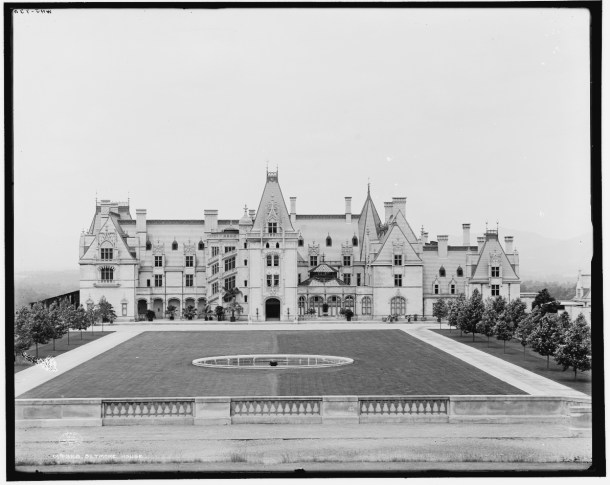
[T]o call this house large is an understatement. Actually, to call it a “house” is also a bit misleading, too. The word doesn’t conjure up the right image. Think instead of a massive edifice that sits on four acres. That’s not the lot size, mind you; that’s the building’s footprint. The lot size was 125,000 acres.
The building measures between 135,000 and 175,000 square feet — for some reason tallies differ, but what’s an extra 40,000 square feet? The building is 780 feet long. Inside are 250 rooms, including 34 bedrooms, 43 bathrooms, 65 fireplaces, an indoor pool, a gymnasium and a bowling alley. In some places, the ceiling is 75 feet high. And the dining room table could accommodate 76 people, most of whom would have been guests. The building was constructed for a single man and his mother, who died shortly after it was completed.
The man was George Vanderbilt. His giant home — actually, only a seasonal residence — was built in Asheville, North Carolina, during the late 1800s and dubbed The Biltmore. He could hardly have built more. It remains the largest home ever constructed in the United States.
It was built at a time when great industrialists and their offspring had more money than they could possibly spend, try as they might. Vanderbilt, whose family had become fabulously wealthy in the shipping and railroad industries, had come into an inheritance that was the equivalent of about $300 million today. Inheritance and income taxes weren’t a concern for Vanderbilt, since there weren’t any.
For many other Americans, however, this was also an era of grinding poverty. Cities were booming with an influx of people, both the native born and the recently arrived, looking for work in one of the countless factories of the Industrial Revolution. Working conditions were often dangerous and wages reliably low. Regulations about such matters were still decades away.

The thin top layer of the upper crust was busy building mansions in places like New York City and Newport, Rhode Island. And if they wanted to build one in the proper style, to keep up with the Vanderbilts, the person to see was a Vermonter. Richard Morris Hunt, a native of Brattleboro, was the preeminent architect of what became known, not flatteringly, as the Gilded Age.
But Hunt wasn’t part of the aristocracy, at least not on a par with his clients. By Vermont standards, however, he was from a prominent and prosperous family. Hunt was born in 1827 into a family of politicians. His father was a U.S. congressman; his grandfather had been lieutenant governor of Vermont. He was also related to another congressman and even a member of the Continental Congress, Gouverneur Morris. But his generation had a more artistic bent. One of Hunt’s brothers, Leavitt, was a photographer of note and another, William, was a renowned landscape painter.
Though he spent his early childhood years in Vermont, Hunt came of age in Europe. When his father died unexpectedly, his mother moved the family to Switzerland. They later moved to Paris, where William studied painting and Richard became the first American admitted to the architecture program at the famed Ecole des Beaux-Arts.
When Hunt returned to the United States in 1855, he initially settled in New York City. He brought with him a belief that architects deserved the respect accorded other top white-collar professions, like they received in Europe. At the time, the United States didn’t even have a school of architecture, so Hunt started running his own out of his office, modeling it after the fine art ateliers of France. He also helped found, and then served as president of, the American Institute of Architects, which created an accreditation system for architects and promoted the profession.
In 1860, Hunt made a fortuitous move to Newport, where he married Catherine Howland, a wealthy heiress. In Newport, he made social connections that would lead to numerous commissions for some of the nation’s richest families. He designed for them a series of grand homes, modeled after 16th century chateaus he had seen in France. Many of these pseudo-chateaus lined New York’s Fifth Avenue and gave it its character.
He was also hired to help lead major building projects around the city, including the Tribune Building (one of the city’s earliest skyscrapers), the pedestal for the Statue of Liberty and the center wing and Great Hall of the Metropolitan Museum of Art. Today, of all his New York projects, only the pedestal and the sections of the museum remain. Perhaps it’s because these great public buildings are gone that Hunt is remembered mostly as the builder of mansions.
If you’ve ever visited Newport, you’ll know that these immense, opulent, seasonal homes blanket a large section of the city. In the early 1800s, Newport had been a sleepy place, dotted with modest cottages used as summer getaways for city dwellers. But the Gilded Age made a few Americans very rich and many of these rich hired Hunt to design manor houses for them in Newport. Since these homes were just for summertime use, their owners referred to them as “cottages.” You might think they were being ironic, but they were apparently paying tribute to Newport’s older, decidedly more modest, summer community.

Of all Newport’s lavish homes, The Breakers, an Italianate manse Hunt designed for Cornelius Vanderbilt, is the most famous. It may be less than half the size of his nephew George’s Biltmore, but The Breakers is similarly out of normal human scale in both its size and luxury. Its Great Hall is large enough to fit a three-bedroom home today. And its elaborate carvings, carpentry and carpets helped bring the total cost of construction up to the equivalent of about $300 million, or slightly more than nephew George is said to have spent on his estate.
Hunt’s success might have had a lot to do with his strong design sense, and his knowing the right people, but there might have been another factor: his personality. Contemporary accounts suggest that Hunt was a memorable figure, brimming with charm and energy.
Ralph Waldo Emerson described meeting him one day in March 1869 and coming away impressed.
“In my visit to New York,” Emerson wrote, “I saw one remarkable person new to me, Richard Hunt, the architect. His conversation was spirited beyond any that I could easily remember, loaded with matter, and expressed with the vigour and fury of a member of the Harvard boat or ball club relating adventures of one of their matches; inspired, meantime, throughout, with fine theories of the possibilities of art.”
Emerson was also struck by the simple way Hunt spoke about lofty subjects. Perhaps it was a remnant of his early years in Vermont.
“(T)he tone of his voice and the accent of his conversation so strongly reminded me of my rural neighbour Sam Staples as to be in ludicrous contrast with the Egyptian and Greek grandeurs he was hinting and portraying,” Emerson wrote. “I could only think of the immense advantage which a thinking soul possesses when horsed on a robust and vivacious temperament.”
