

BENNINGTON — Gov. Phil Scott and two dozen top administration officials spread across Bennington County Thursday as part of the governor’s Capitol for a Day initiative to tour all 14 Vermont counties.
In the Bennington area during the morning and the Northshire for the afternoon, cabinet secretaries and other personnel from a range of departments and agencies fanned out to visit area businesses and attend meetings with academic, business and community groups or organizations.
They heard residents’ concerns and provided updates on such topics as the state’s response to PFOA contamination of well water, workforce development, tax regulation and public education issues.
Crowded schedule
The crowded schedule included a ribbon-cutting ceremony for the reconstructed runway at the William H. Morse State Airport, a Bennington Area Chamber of Commerce luncheon in Manchester, a wellness workshop at the state office building in Bennington, a roundtable discussion on legislative issues and taxes, and a discussion of emergency response issues in Manchester, among several others.
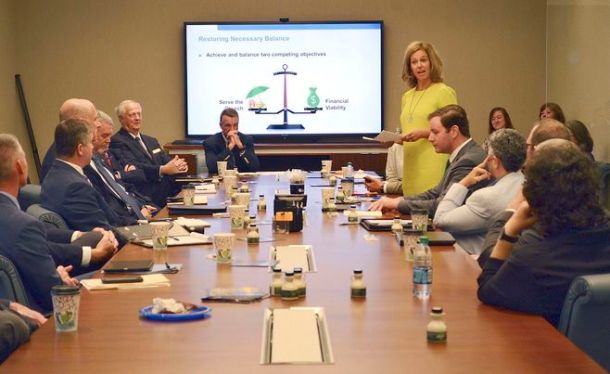
“This is our fifth stop on the tour,” Scott said during a morning kickoff cabinet meeting in the offices of Church Insurance Company in Bennington, a nonprofit that provides insurance services for more than 6,000 Episcopalian churches in the U.S.
He said the idea to visit every county grew from an effort during his gubernatorial campaign to visit numerous businesses around Vermont. As lieutenant governor, Scott started his “Vermont Everyday Job” initiative, where he would work for a day alongside employees at businesses around the state.
“That really gave me a sense of what was happening in Vermont,” Scott said. “I think it’s important to get outside Montpelier to find out what people are thinking.”
The cabinet chiefs and other officials and staff members were in the county Thursday for meetings — some held simultaneously at various locations — that continued from the 8 a.m. session in Bennington through a 5 p.m. stop at the redeveloped Seesaw’s Lodge in Peru.
“I want to thank the residents of Bennington County for such a great day and for sharing their stories, challenges and where they see opportunities. That’s what these Capitol for a Day tours are about,” Scott in a statement issued Thursday evening. “We had so many interesting meetings and heard a lot of helpful feedback.”
He added that “many of the challenges the region faces stem from our aging demographics. And we see this across the state, which is why my administration is focused on keeping and bringing more working families to Vermont and growing our workforce.”
$4 million project, PFOA concerns

At the Morse State Airport, Scott joined Transportation Secretary Joe Flynn and a number of other officials to formally cut the ribbon on the 3,704-foot runway, which was reconstructed from its base up during a federal- and state-funded project that began in early May and was completed in early August.
The governor highlighted the economic impact of the state’s regional airports, through the businesses located there and commercial and private flight activity in and out of Bennington. He said there were some 14,300 landings and takeoffs last year at the local airport, about 40 percent involving local pilots, some of whom base aircraft at the site.
Scott also praised the work of general contractor Markowski Excavating Inc., of Florence, a company that also recently managed a major project at the Rutland airport.
During a meeting with residents of the Apple Hill neighborhood who have wells contaminated with PFOA (perfluorooctanoic acid), officials were questioned about ongoing talks with Saint-Gobain Performance Plastics over the extension of municipal water lines to the area east of Route 7A, and about long-term medical monitoring for diseases associated with PFOA.
Saint-Gobain, considered by the state the responsible party for contamination that emanated from former ChemFab Corp. factories in town, has agreed to fund new water lines for contaminated sites roughly west of the highway but is balking at a similar agreement for those to the east, including Apple Hill.
The company contends there are other likely sources of PFOA in that section of town, such as a former town landfill.
Scott and Peter Walke, deputy secretary of the Agency of Natural Resources, reiterated that the state remains committed to taking the company to court if no agreement can be reached concerning the eastern contamination zone.
Scott said the state would, if necessary, “take every legal action” required, but added that the negotiations involve “a delicate balance.” He said that’s because officials would prefer the company reach an agreement with the state, as it did in the western zone, rather than withdraw from negotiations and prepare for a protracted legal battle.
In addition, Walke said “nothing is being slowed down right now” on design work for new water lines to the area, because the funding to design the project was included in the state budget at the request of local lawmakers, with the expectation that Saint-Gobain would eventually reimburse those costs.
Al Gobeille, secretary of the Agency of Health and Human Services, and Health Commissioner Dr. Mark Levine answered questions about medical monitoring for those who were exposed to PFOA in drinking water, as the chemical is associated with certain cancers and other diseases or conditions.
They stressed that there is no known level of PFOA exposure or blood level reading that is definitely linked to a particular disease, but that anyone — including people no longer living in the area — with documented exposure should have long-term medical monitoring for signs of problems.
Much of that monitoring, they said, doesn’t require a specialist and can be overseen by a person’s primary physician. The state has been providing information on those topics for those in the medical profession here, the officials said, since shortly after PFOA was first detected in local wells in early 2016.
At the Turning Point Center in Bennington, Levine sat down with the organization’s executive director, Kenneth Sigsbury, to talk about advances in addressing the county’s opioid crisis.
Sigsbury detailed how Southwestern Vermont Medical Center and Turning Point are working together to help those who arrive in the emergency room after an overdose.
He also discussed Turning Point’s long-range goal of establishing a residence for people recovering from substance abuse.
Northshire stops
In the Northshire, Scott was welcomed to a luncheon hosted by the Bennington Area Chamber of Commerce at The Inn at Manchester, sat in on a meeting of area emergency management, firefighters and EMS leaders at the Manchester public safety building, and took a tour of the Manchester Community Library before ending his day at the rebuilt Seesaw’s in Peru.

At the luncheon and at the EMS meeting, Scott discussed the importance of attracting and retaining trained workers — professionals and tradespersons — to the state’s economy.
At the EMS meeting, leaders met with Scott, deputy commissioner of public safety Chris Herrick, emergency management director Erica Bornemann and fire safety director Michael Desrochers about the difficulty of attracting and retaining firefighters. Local officials including Bennington Police Chief Paul Doucette, Arlington Fire Chief Jamie Paustian and former Manchester Fire Chief Philip “Grub” Bourn discussed the possibility of starting trainees in high school, and potentially offering tax incentives to firefighters to maintain the ranks.
The importance of tourism to the state economy bookended Scott’s time in the Northshire. During an open question and answer session, Manchester Designer Outlets president Lana Hauben, noting the state pulled in $593 million in rooms and meals taxes, asked why the state’s tourism budget is only $3 million.
“If tourism is so important why can’t we get some help?” she asked.
Mountain Media LLC president and Stratton Magazine publisher Carolyn Blitz asked Scott about the state offering tax credits for filmmakers, noting that Vermont is competing with other states for film productions.
Scott seemed intrigued by that possibility.
“It’s not just making a movie here — it also promotes us and markets us. It’s a win-win,” he said.
Scott’s day ended at Seesaw’s in Peru, where about 50 people watched him cut a ceremonial ribbon marking the rebirth of that historic ski lodge with innkeeper Kim Prins. The historic ski lodge was recently rebuilt and restored from its original materials by its new ownership partners, including Kim and Ryan Prins, Jay Eastman and David DiDomenico.
“It’s great to celebrate part of Vermont’s tourism history,” Scott said.
Staff members from the Bennington Banner and Manchester Journal contributed to this report.
