

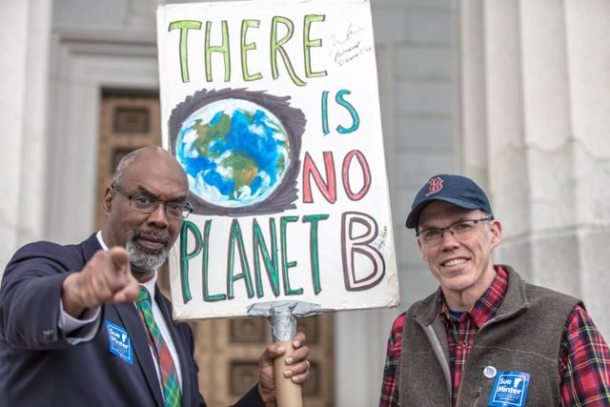
Editor’s note: David Moats, an author and journalist who lives in Salisbury, is a regular columnist for VTDigger. He is editorial page editor emeritus of the Rutland Herald, where he won the 2001 Pulitzer Prize for a series of editorials on Vermont’s civil union law.
[T]he weather was so extremely hot and dry that wildfires raged across the western United States, causing smoke to drift all the way to the East Coast. High temperature set new records. Wildlife was forced to alter its usual patterns of behavior.
That was 1988, an inflection point when scientists were ready to confirm in clear and unequivocal terms that human-caused climate change was upon us. Thirty years later the globe is experiencing a summer that is driving home a message that was already clear in 1988.
Vermont is one small “fragment” of the global picture, according to meteorologist Alan Betts of Pittsford, but what Vermont is experiencing is in line with the record temperatures wracking the globe. An example: temperatures above 90 degrees in northern Finland, above the Arctic Circle.
“Just watched a 12-story tall iceberg crash off the front of a glacier near Nausurassaq — one of the most remarkable and scary things I’ve ever seen. The ice is alive and on the move here.”
That was an email message sent last week by Bill McKibben from the Greenland ice shelf. The melting of the Greenland ice shelf is one of the most significant harbingers of what is likely to be a disastrous rise in sea levels, imperiling cities around the world. McKibben, the author and activist who lives in Ripton and teaches at Middlebury College, was there on a reporting trip.
McKibben was there also in 1988. That was when NASA scientist James Hansen gave clear and convincing testimony to a Senate committee asserting conclusions based on research carried out over many years. As a New York Times Magazine article recounted last month, Hansen reported “with 99 percent confidence” that the climate was already in the midst of significant change.
It was not a particularly controversial assertion. A conservative senator from Louisiana, Bennett Johnston, said, “We have only one planet. If we screw it up, we have no place to go.”
The New York Times headline about Hansen’s testimony said: “Global Warming Has Begun, Expert Tells Senate.”
McKibben said it was Hansen’s testimony that captured his imagination back then, and it led to his pioneering book, “The End of Nature,” the first general interest book detailing the facts about the warming climate and the danger facing humanity.
Now it is 30 years later, and McKibben is in Greenland. Meanwhile, the trends seen in 1988 have accelerated. For the continental United States, May was the hottest May ever. June and July were the third hottest ever. Montreal set an all-time record high of 98 degrees on July 2. Elena Mananenkova, deputy head of the World Meteorological Organization told The New York Times, “This is not a future scenario. It is happening now.”
Nor was it a future scenario in 1988 when James Hansen’s testimony caught McKibben’s. It was happening then. At the time, the administration of President George H.W. Bush seemed poised to sign on to an agenda of action on climate change. The article in The New York Times Magazine presents John Sununu, Bush’s chief of staff, as a sort of villain, stepping in to kill significant action to address the issue, but according to McKibben, we would be mistaken to believe that progress on climate change would ever happen without a major national conversation.
That conservation followed as new awareness dawned in the late 1980s, but soon it became hijacked by the oil companies, which previously had been willing to acknowledge the reality of climate change. After 1988, the science describing climate change was purposely clouded by oil companies and conservative politicians, who employed practices like those used to obfuscate the truth about the danger of tobacco. It was never going to be easy to take on the vested interests of the fossil fuel companies, but since the time of Hansen’s testimony in 1988, 30 years of potential progress have been lost.
Vermonters, meanwhile, have been enduring a summer of unusual weather. Jason Shafer, professor of atmospheric sciences at Northern Vermont University at Lyndon, reports that the average temperature recorded at the Fairbanks Museum in St. Johnsbury between June 1 and Aug. 27 was the warmest since 2005 and the 11th warmest period ever. Burlington had its second warmest period, according to records extending to 1941. Temperatures in the state varied. Rutland’s average temperature was only the 53rd warmest, according to records going back to 1916.
Meanwhile, hot dry weather in the West created conditions leading to the largest wildfire in California’s history. Wildfires and hot weather have raged in Greece and Japan. And glaciers are crumbling in Greenland.
For anyone concerned about these trends, it is infuriating that similar stories about the extremes attributable to climate change were being written 30 years ago. The difference is that the extremes have become more extreme.
“We’ve lost three decades — likely the crucial three decades,” McKibben wrote from the shrinking Greenland ice shelf. “You can tell how worried I am by the title of my next book, which will mark the 30th anniversary of my first: ‘Falter: Has the Human Game Begun to Play Itself Out?’”
In Vermont long stretches of extremely hot and humid weather have characterized the summer weather this year, combined with relatively dry conditions. Vermonters, like people around the globe, are thinking of the weather not as a natural force, but as a human artifact. Human intervention in the form of carbon dioxide emitted over more than a century have set in motion unpredictable human-caused forces. That is what McKibben meant when he titled his first book “The End of Nature.”
The United States under President Donald Trump has abdicated its role in addressing this crisis. The tragedy is that before the issue became subject to the pushback of economic self-interest and political exploitation, people in business, the sciences and government — Republican and Democrat — had a grip on the threat that humanity faced. The threat is still there.
And the need for action is ever more urgent. McKibben’s worries have always been leavened by what seems to be an optimism that he can’t shake. As he said in a recent email message: “It’s true that 30 years ago would have been the best time to fight climate change. But, as with planting fruit trees, the second best time is right now.”
