


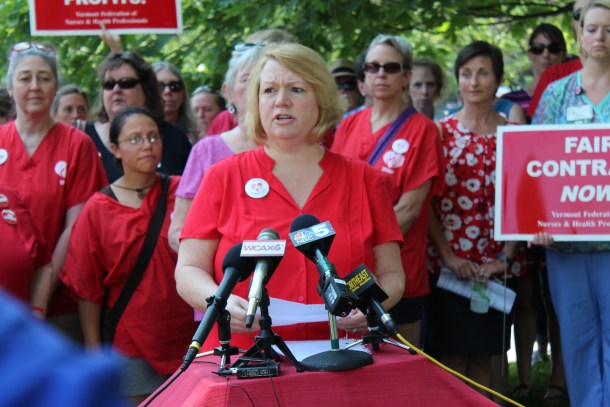
WILLISTON – A week after the resignation of a key union leader, University of Vermont Medical Center nurses are regrouping and say they will continue their contract battle with the state’s largest hospital.
Union leaders say they’ve received strong support from within their ranks to keep negotiating for higher wages and more staff.
And on Thursday, UVM nurses took three steps to show their resolve: They started a new public relations offensive against hospital executive pay; elected a new lead negotiator; and announced meetings next week to “plan a path forward.”
In a video released on Facebook, union President Laurie Aunchman listed concessions won thus far and sought to encourage members as the contract battle enters its sixth month.
“Thank you for all that you do,” Aunchman said. “And never forget – when we fight, we win.”
The Vermont Federation of Nurses and Health Professionals represents about 1,800 licensed practical nurses, registered nurses and nurse practitioners at UVM Medical Center. The union’s last contract expired July 9.
Nurses went on a 48-hour strike July 12. There has been some progress reported in negotiating sessions since then, but continued disputes over wages and staffing have been obstacles to a new deal.
The union says nurses aren’t paid enough, which hampers recruitment and retention. That leads to safety concerns, gaps in care and long wait times, they contend.
Hospital leaders say their vacancy and turnover rates are not abnormal, and they say their wage offer is fair – a 15 percent raise over three years, with bigger increases for certain types of nurses. The union’s latest demand is 22 percent.

The two sides have not talked since Aug. 18. But the nurses’ union has made headlines with the resignation of former lead negotiator Julie MacMillan, who said she was quitting the talks due to differences with union leadership about whether a compromise could have been reached.
When she met with reporters on Thursday, Deb Snell – who is president of AFT Vermont, the nurses’ union parent organization – disputed MacMillan’s concerns about a lack of member input on the hospital’s latest offer.
“During four separate meetings (with members), over 90 percent voted to continue the fight,” Snell said. “They understand that we need to get nurses in this hospital.”
Later in the day, the union selected Molly Wallner to serve as the bargaining committee’s new lead negotiator. The decision was announced in a video in which Aunchman said the hospital’s contractual offers thus far are “because of the strength and unity of our membership.”
“However, we remain committed to the pursuit of the kind of wages that address the recruitment and retention crisis that comes as a result of Vermont’s status as 47th in the nation for nurses’ wages,” Aunchman said. “We have yet to receive a last, best and final offer from management and look forward to setting up (negotiation) dates.”
Aunchman also said there will be meetings with more than 150 nurses from the union’s “member action team” on Thursday “whereby we will plan a path forward.”
Aside from direct negotiations, nurses also have sought to apply public pressure to hospital management. They’ve received support from a number of politicians and other labor organizations; protested the hospital’s proposed budget; and pulled their union’s funds from New England Federal Credit union because two hospital trustees also are credit union administrators.

Additionally, the union has railed against executive pay at UVM Medical Center and UVM Health Network, where Chief Executive Officer John Brumsted earned more than $2.1 million in total compensation in 2016.
On Thursday, Snell announced a new petition drive seeking a “vote of no confidence” targeting Brumsted, UVM Medical President Eileen Whalen and the hospital’s trustees – in part due to “exorbitant executive salaries.”
Asked about whether the union expected the petition to have an impact at this stage in the negotiations, Snell said, “We wouldn’t be doing it otherwise.”
“We think that the community has been hearing what the nurses have been saying,” she said. “They supported us during our strike. We’ve continued to have amazing community support. We believe they understand our message better than any message the hospital’s been putting out.”
Hospital administrators responded with a statement calling for union members to be given an opportunity to vote on management’s latest offer (union leaders said they hadn’t determined whether they would hold such a vote).
“After many months and more than 25 bargaining sessions with our nurses’ union to arrive at a contract that both sides can feel good about, we owe it to our nurses, our other colleagues, our community and especially our patients to focus our collective energies on reaching an agreement,” administrators said.
“We are disappointed union leaders are focused on (Thursday’s) press conference and issues that do not get us closer to resolution.”
