


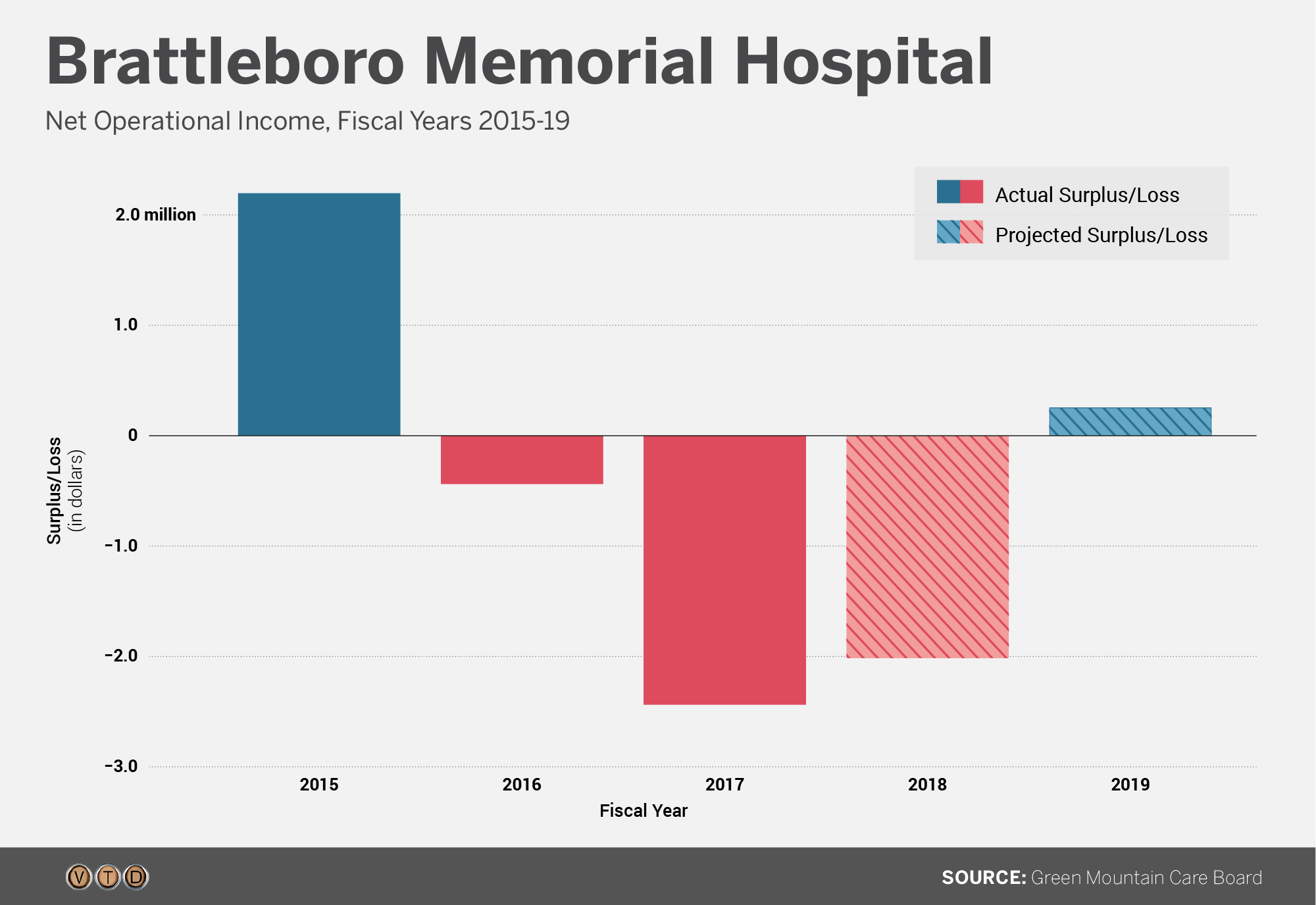
[A]dministrators at Brattleboro Memorial Hospital are predicting a $2 million operating loss in the fiscal year that ends Sept. 30, and they say a physician shortage played a big role in that number.
But administrators also acknowledge that this isn’t a one-time problem: Fiscal 2018 will be the third straight year that the 61-bed hospital has posted an operating loss, and next year’s budget predicts a slim positive operating margin of just 0.3 percent.
In a presentation to the Green Mountain Care Board this week, hospital President and Chief Executive Officer Steve Gordon said issues like demographics, community needs and health care reimbursement are contributing to Brattleboro Memorial’s financial issues.
He also outlined some potential solutions including successful physician recruitment; Vermont’s shifting health care payment landscape; and the possible expansion of Brattleboro’s partnership with Dartmouth-Hitchcock Medical Center.
“There’s not one silver bullet here,” Gordon said.
Brattleboro Memorial had a nearly $2.2 million operating surplus in fiscal 2015, according to care board documents. That was a positive operating margin of 2.8 percent.
But things have been trending downward since then. The hospital posted a $437,372 operating loss in fiscal year 2016 and a $2.44 million loss the following year.
There’s a procedural accounting discrepancy that results in two versions of Brattleboro Memorial’s fiscal 2018 budget: The hospital’s spending plan included a small operating surplus of $360,069, while the care board’s version predicted a $963,130 loss.
Neither prediction has turned out to be correct. With about a month to go in the fiscal year, Brattleboro Memorial administrators say they’re looking at an operating loss of a little over $2 million, despite the fact that they’ve undertaken more than $2 million in cost-cutting.
The hospital’s expenses are still trending upward. To help counteract that in fiscal 2019, Brattleboro Memorial is seeking patient-revenue growth that’s above the care board’s target as well as a 4.9 percent increase in rates charged to insurers.
Care board documents also note that the hospital’s admission costs are going up in the next fiscal year, which starts Oct. 1.
All of those factors prompted care board member Maureen Usifer to sum up the situation this way: “Everything’s really going in the wrong direction.”
In fiscal 2019, “you’re still not making much money,” Usifer told Brattleboro Memorial leaders at a meeting Monday at Castleton University. “So it really is a puzzle: How do you change this whole model? Because it’s not going to be sustainable.”
“That’s the million-dollar question,” Gordon replied. “How do you change it when you have such needs in our community?”
Those needs, administrators said in a presentation to the care board, are one of Brattleboro Memorial’s big risks because they’ve been “stretching hospital resources.”
Gordon mentioned initiatives including a collaboration to embed a nurse in local homeless shelters; a proposed dental clinic in conjunction with the United Way; and the addition of a psychiatric nurse practitioner in the hospital’s emergency department to help with a growing number of patients who require mental health and addiction treatment.
Gordon said Brattleboro Memorial’s participation in the new all-payer model of health care payment can help with some nontraditional hospital initiatives. But such programs often don’t fit well into the standard, fee-for-service model.
“All of the things we’re doing in our community to address the needs of our community don’t create immediate gratification or short-term returns,” Gordon said.
Community needs aside, a bigger factor in Brattleboro Memorial’s fiscal 2018 bottom line was a lack of doctors.

Gordon said the hospital lost several primary care physicians and an orthopedic surgeon, leading to a drop in office visits and operating room procedures – and a corresponding drop in revenues.
Like other Vermont hospitals, Brattleboro Memorial also relies on temporary nurses to fill some vacancies. Administrators said the number of contract nurses at the hospital has fluctuated during fiscal 2018, but the cost for those services is expected to add up to $1.3 million.
Birth rates are another source of alarm. Administrators are expecting 260-275 deliveries this year, down from more than 300 the previous year.
If that trend continues, maintaining the hospital’s delivery-related services will be “a huge concern,” Gordon said.
There are, however, factors that mitigate the stress on Brattleboro Memorial – both currently, and into the future.
One of those is the hospital’s nonoperating revenue. Such revenues, which Gordon attributed to “substantial gains” on investments, have been consistent enough to cancel out operating losses and keep Brattleboro Memorial’s bottom line in the black for fiscal 2016 and 2017.
That’s expected to again be the case in fiscal 2018. But Gordon cautioned that “we can’t depend upon that. That could change overnight – the market. So we’ve got to get the ship righted in terms of reducing our losses at the hospital.”
A recent resurgence in physician numbers could help accomplish that. Administrators say they’ve added four new primary care doctors since June, and they’re accepting new patients every day.
Brattleboro Memorial also is examining the potential for expanding an operational partnership with Lebanon, N.H.-based Dartmouth-Hitchcock and its Keene, N.H.-based affiliate, Cheshire Medical Center.
Brattleboro’s emergency department already is staffed in partnership with Cheshire, and its radiology department is affiliated with Dartmouth. There are also are affiliations in specialties like oncology, podiatry, rheumatology, pathology and otolaryngology (ear, nose and throat.)
Gordon said administrators at the three hospitals have begun discussing “the future of our relationship” and how it might be expanded. He did not rule out the possibility that Brattleboro Memorial could formally affiliate with Dartmouth at some point, but he also said discussions “haven’t really gotten to that level.”
“I don’t know where it’s going to go,” Gordon said. “But I think that is one of the opportunities for us to look at as a small hospital. What is the future for us if we were part of a larger system, and what does that mean?”
In response to questions about the Brattleboro talks, Dartmouth-Hitchcock spokesperson Rick Adams didn’t specify what administrators are or are not considering.
“We continue to explore ways to expand our shared commitment to the region, building on the clinical and administrative successes that have been accomplished under the strategic partnership,” Adams said.
