

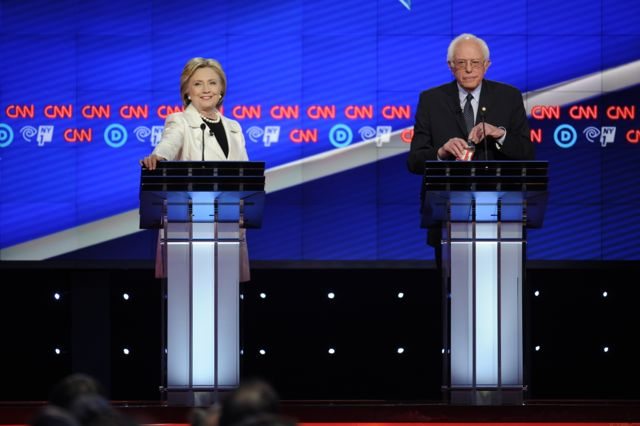
[I]n a decision praised by Sen. Bernie Sanders, I-Vt., Democratic Party officials have agreed to reduce the influence of superdelegates, whose role created controversy in the party’s 2016 primary process that led to the selection of Hillary Clinton over Sanders.
“Today’s decision by the DNC is an important step forward in making the Democratic Party more open, democratic and responsive to the input of ordinary Americans,” Sanders said in a statement. “This has been a long and arduous process, and I want to thank (party chairman) Tom Perez and all of those who made it happen.”
Superdelegates will keep their power to support any candidate regardless of how citizens vote, but will largely be blocked from participating in the first ballot at the party convention. The new plan was approved Saturday at the Democratic National Committee’s summer meetings.
Primary contenders are awarded a certain number of pledged delegates for each state, based on the percentage of the vote they earn. Pledged delegates must back the candidate voters choose, but a small contingent of unpledged delegates, known as superdelegates, are able to vote freely.
Superdelegates account for about 15 percent of all convention delegates.
Matthew Dickinson, a professor of political science at Middlebury College, attributes that shift, in part, to the results of the presidential election.
“They’re clearly reacting to both the loss in 2016 by the nominee and the complaints from Sanders supporters that the game was rigged,” he said. “The argument from the Sanders supporters that without the superdelegates, he would have been the nominee, it resonated with them.”
Even though Sanders won over 85 percent of the vote in Vermont’s 2016 Democratic presidential primary, only half of the state’s superdelegates backed him at the party convention, when it was clear that Clinton had secured the nomination.
U.S. Sen. Patrick Leahy, D-Vt., then-Gov. Peter Shumlin and former Gov. Howard Dean were the notable Vermont politicians who lent their support for Clinton.
The DNC passed a “Unity Commission” resolution at its 2016 nominating convention, calling for the creation of a committee to look at changes to the nomination process.

Under the changes, superdelegates will only be able to exert influence in rare situations, such as in contested conventions, which might require multiple rounds of ballots.
Dickinson said the move is consistent with the evolution of the presidential nominating process in general, which has shifted over time to be more influenced by the electorate rather than party leadership.
The move signifies the greatest modification of superdelegates since the concept’s inception in 1984. Dickinson said the creation was spurred in part because of the perception that the Democratic Party was nominating candidates that were “getting killed” in the general election.
The party’s nominee in 1972, George McGovern, only won one state — Massachusetts — and the District of Columbia in the general election against Richard Nixon, for 17 electoral votes.
President Jimmy Carter lost his 1980 re-election bid to Ronald Reagan by a large margin, carrying only five states and D.C.
Dickinson said the idea of the superdelegate was subsequently implemented to add a “common voice” for more moderate candidates.
He said superdelegates have never been a decisive voice in any election, and never in a position to act against the will of the people.
In 2008, most superdelegates backed Clinton and later switched over to support the eventual Democratic nominee, Barack Obama, in a display of unity.
Dickinson described the reform as largely a “symbolic” measure to appease Sanders activists and unify the party for future elections.
“It reflects the power of Sanders and his movement,” he said. “They couldn’t ignore the sentiment expressed by Sanders and a lot of his supporters.”
