

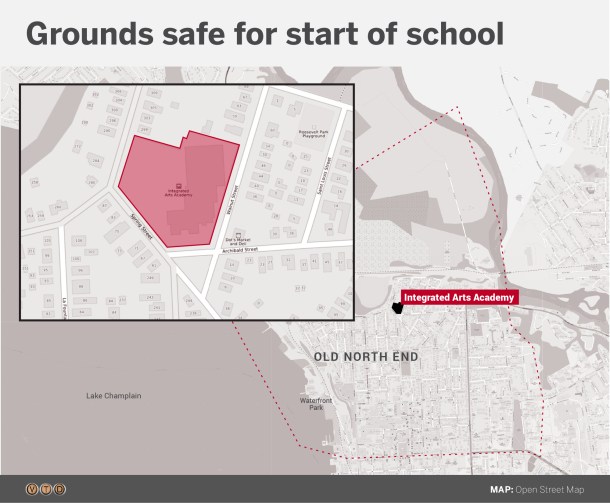
[A]n elementary school in Burlington’s Old North End has tested below federal levels for cancer-causing chemicals.
Two chemicals commonly used in dry-cleaning were discovered last July during a test as part of a property transfer inspection on Elmwood Avenue. Following that discovery, EPA and state DEC officials sampled for carcinogens perchloroethylene (PCE) and trichloroethylene (TCE) at the Integrated Arts Academy, an elementary school located near the northern end of Elmwood.
“We are thrilled that teachers, staff, and students will be able to start the new school year knowing that our building is, and has been, safe,” said Yaw Obeng, superintendent of the Burlington School District, in a statement last week.
No TCE was detected on school grounds, according to a letter the Vermont Department of Environmental Conservation and the Department of Health sent out last Wednesday. Air tests did show “very low levels” of PCE present in two samples taken inside the school.
Long-term exposure to PCE and TCE can increase risk of developing cancer, as well as cause neurological damage, autoimmune diseases and fetal damage for pregnant women.
The EPA and DEC took air samples in four locations on school property, including in the outdoor play area. Michael Nahmias, an environmental analyst with the DEC, said that additional sampling will take place in the school to determine if chemical levels increase when school is in session.
“That’s a little bit different … when the doors are constantly opening and closing, and kids are running around,” he said. Monitoring will also occur during the “heating season,” Nahmias added.
The levels of PCE in the basement of the school are slightly higher than the state’s air quality standard — .63 micrograms per meter cubed — for that chemical. Nahmias noted that this is a residential standard, which is a lower threshold than for a school or workplace based on exposure time.
The Vermont Department of Health set higher levels — 5 micrograms per meter cubed for teachers and staff and 17 micrograms per meter cubed for students — for the chemical based on a risk assessment calculating long-term exposure at the school. PCE levels did not exceed those standards in any of the air samples at the academy.
Although the source of the contamination has not been confirmed, a former dry cleaning company located on Elmwood Avenue was deemed a “potential contributor,” according to Trish Coppolino, environmental program manager with DEC. If not properly stored, the chemicals can seep into the ground and enter buildings through the foundation.
The EPA and DEC are conducting additional testing this week along Elmwood Avenue to better understand the extent of the contamination in the neighborhood, Emily Bender, spokesperson for the EPA, said in an email Tuesday.
“We are trying to identify a possible source or sources for the PCE and TCE contamination that we have already seen in the soil gas,” she added.
Elevated PCE and TCE levels in the home that yielded the initial alert in July were fixed by installing vents that redirect soil vapors.
