

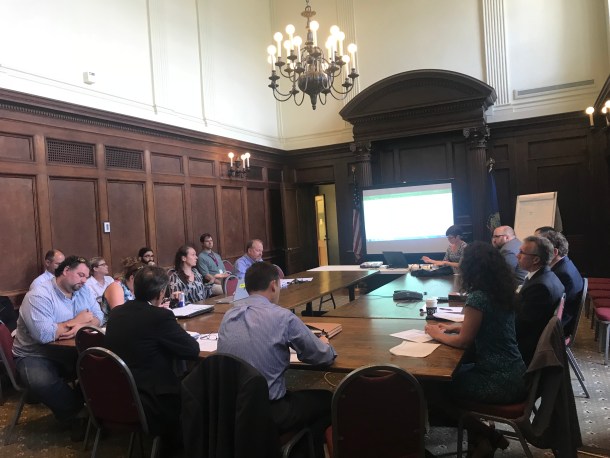
[M]embers of the governor’s Advisory Commission on Marijuana’s subcommittee on taxation and regulation met for two hours on Monday to discuss marijuana sales tax policy, including a proposal for a local option tax for towns with marijuana businesses.
Vermont legalized recreational marijuana this year, but non-medical sale remains illegal. Gov. Phil Scott has appointed a panel to look into a system to tax and regulate cannabis and report back ahead of next year’s legislative session, when a proposal is almost certain to come before lawmakers.
Gwynn Zakov, the municipal policy advocate at the Vermont League of Cities and Towns, proposed following the model of other states that have legalized marijuana, where revenue flows into towns in the form of a local option tax.
Some towns in Vermont already have a local option tax that charges a 1 percent sales tax, a 1 percent meals tax, and a 1 percent alcohol tax within its jurisdiction.
Zakov proposed a new local option tax structure that would allow towns that have marijuana businesses to impose a local tax rate on cannabis sales, similar to other controlled substances.
“Is one percent enough? An ask of three or four or five percent might be more reasonable, but we don’t want to tax it too much,” Zakov said in the meeting.
In an interview with VTDigger, Zakov said that these local option tax proposals are based on what other states, like Colorado, have done.

“This would align more with what other states are doing, and there’s nothing lower than a 1 percent,” Zakov said, “but it’s also dependent on what the state tax level is at.”
A commercial marijuana market could generate tax revenues of between $10 million and $25 million per year, according to state projections based on the systems currently operating in Colorado, Washington and Oregon. That does not include local options taxes, which exist in all three states.
Andrew Stein, research economist at the Vermont Department of Taxes, said he was worried about towns not bringing in enough revenue from marijuana sales to cover the administrative costs of implementing the local tax.
“The general concern I raised was to administer this new tax would require new administrative resources and there are a limited amount of towns that would create enough revenue that would pay for those administrative costs,” Stein said in an interview.
Proposals on whether to impose a 25 percent excise tax on the price of marijuana or a 6 percent state sales tax were also discussed on Monday, but without much consensus.
There was general agreement from the subcommittee that any retail tax would be charged at the point of sale to the consumer, but questions remain about what the rate would be.
Stein said that an excise tax would give the state more flexibility in what it could do with the revenue, as opposed to state sales tax — 100 percent of which would go into the education fund.
The tax revenue would likely go toward funding programs focused on education, health and law enforcement, said Craig Bolio, deputy commissioner of the Department of Taxes.
“It’s probably easiest to do that through a special fund,” he said. “The purpose of the revenue is to primarily fund those programs. If there is additional revenue then great.”
But that will only happen if a tax and regulate bill is signed by the governor. During Republican primary debates, Scott said he would oppose such a system unless various concerns about the safety of full legalization were addressed beforehand.
The marijuana commission will draft its report in the coming weeks and discuss it during a meeting on Sept. 28 at the Department of Taxes in Montpelier.
A last-minute effort to pass a tax and regulate bill was quashed in the House. However, some of the Republicans who opposed legalization said that, having lost that battle, it made sense to have a system in which the industry generated revenue for the state.
