

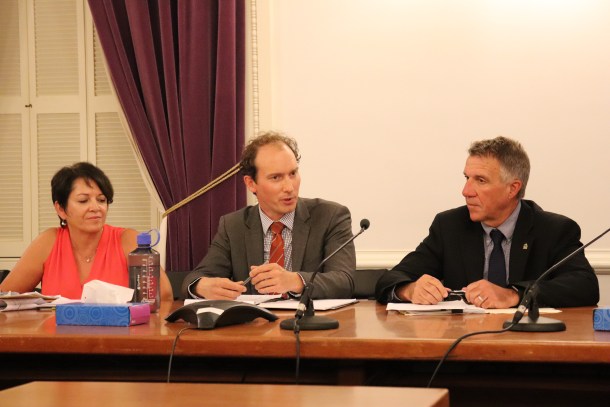
[G]ov. Phil Scott met with his climate action commission Monday to hear ways Vermont can curb carbon emissions while spurring economic development and energy affordability. It marked the first time the governor met with the full board he appointed last year.
Commissioners described ways to wean the state off fossil fuels in the transportation and heating sector, store carbon in forests and farmland, and develop a “climate economy” that will attract millennials and entrepreneurs. The meeting took place in an almost empty room in the Statehouse, three weeks after the initial release of their recommendations report.
Several commissioners went beyond the 53 recommendations in the report, advocating that without a carbon emissions cap like Quebec and California, Vermont would not buck the trend of rising emissions. While the state has renewable standards for electricity, no such standards exist to reduce fossil fuel use in transportation or heating.
“If we do not move to capping emissions for additional sectors of our energy economy beyond electricity … we are likely to continue falling far short of our stated commitments,” said Jared Duval, executive director of Energy Action Network.
“In short, markets don’t move without market signals and the policies and regulations to set the rules of the road,” he said.
The governor did not commit to specific actions during the meeting, but said that he and his administration would further review the report and incorporate recommendations into next year’s budget. Scott added that he felt Vermonters, many of whom support local agriculture, would similarly support increased energy independence. “That’s what we’ll be looking for, are areas that give us the most benefit that Vermonters will appreciate and rally behind.”
The governor cautioned the measures would take time to implement, an approach he signaled some would find unacceptable.
“It may not be all in one year, but year after year we’ll build upon those successes,” he added. “As a centrist myself, as a moderate, I’m accustomed to being criticized from both the left and the right, and I suspect this will be the same.”
While some advocated for capping emissions, there was no talk of a carbon tax. In January, Scott rejected the commission’s recommendation that the state obtain an impartial review of carbon tax strategies to curb emissions. The governor said only the federal government is in a position to study a carbon tax.
In its report, the commission made reference to the difficulty of reaching the goal and made reference to the possible need for a regulatory approach, including a carbon tax.
“This will require hard choices. We can reform and equalize our tax system to induce behavior change, we can mandate change through statutory or regulatory action, we can let the market efficiently allocate prices through a system like cap and invest or carbon pricing, or we can accept that we will not meet our goals through voluntary action in the current market where the price of carbon is not properly accounted for in the costs of our goods and services,” the report said.
Peter Walke, deputy secretary of the Agency of Natural Resources, who chairs the 21-member commission, noted that the recommendations are up for public comment until the end of September.
Scott’s spokesperson, Rebecca Kelley, said after the meeting that Scott will await public comments before choosing items to act on. She said increasing access to electric vehicles and improving energy efficiency in buildings will likely be “continued areas of focus.”
By law, Vermont is required by 2028 to reduce greenhouse gas emissions to 50 percent of what emissions were in 1990. Emissions have increased in recent years, however, with the most recent data from 2015 showing emissions 16 percent higher than the 1990 target.
The governor formed the climate action commission last July to determine ways Vermont can meet its greenhouse gas and renewable energy goals while creating jobs and promoting energy affordability.
Transportation makes up the largest chunk — 43 percent in 2015 — of the state’s greenhouse gas emissions. Linda McGinnis, a commissioner who is a senior fellow at the Energy Action Network, suggested that Vermont could lower its transportation emissions by promoting electric vehicles and improving access to public transportation and rideshares. She added that paying to fuel vehicles constitutes 50 percent of what average Vermonters spends on energy.
The “kicker,” said McGinnis, is that Vermont has available funding to “jumpstart the transformation” of this sector. She suggested the state direct the $3.6 million going to the general fund from the latest VW settlement to plug-in hybrid incentives.
McGinnis even requested that Scott race an electric car to set an example for those reluctant to switch to electric vehicles. Although he did not commit to racing an electric vehicle at Thunder Road, Scott did express interest in setting up a lease program to enable Vermonters to take advantage of the rapid pace of development in electric vehicle technology. He also supported the rollout of rapid charging stations along scenic roads in Vermont.
“If we want to keep welcoming Canadians to our state, we’re going to have to provide an infrastructure so they can charge those vehicles,” said Scott, highlighting Quebec’s push toward electric vehicles.
Marie Audet, co-owner of Blue Spruce Farm, suggested that the state and farmers expand ongoing agricultural water quality projects to account for carbon storage. Practices like cover cropping reduce phosphorus pollution to waterways but also improve soil health and sequester carbon, she noted. Audet suggested the state determine how much carbon is currently being stored on farms and in forests and set a goal for increased storage.
Vermont can reduce carbon emissions and lower energy bills for heat by doubling the funding for low income home efficiency retrofits, installing more cold climate heat pumps and promoting advanced wood heat. This will also redirect money flowing out of state for fossil fuels to local businesses, he noted. Scott responded that he has “always been a big fan of biomass.”
Revitalizing downtown corridors and developing a “climate economy” were touted as ways to lower greenhouse gas emissions and meet Scott’s longstanding objective to attract millennials and entrepreneurs to Vermont. Building on the expertise of in-state businesses like Dynapower and Packetized Energy, the state could become a hub for grid modernization and biomass businesses, said Michael Schirling, secretary of the Agency of Commerce and Community Development.
At the end of the meeting, Johanna Miller, energy and climate director for Vermont Natural Resources Council, commended the governor for signing gun legislation last session despite steep opposition from some members of his party.
“It is also my hope that you think of this issue in the same way you thought about – and led – on gun reform,” said Miller.
“Doing something serious about climate change is also about protecting our kids.”
Climate change action could stimulate economic growth for Vermont, she added, citing Quebec as an example. From 1990-2015, Quebec had lowered its greenhouse gas emissions by 8.8 percent while experiencing a 15 percent population growth and a 60 percent growth in GDP, said Miller.
In an interview after the meeting, Miller said that she hoped for more clarity from the governor and his administration on how they would choose which recommendations to act on first. “What’s the sieve that they’re going to filter these recommendations through?” she asked.
The day after Scott met with his climate action commission, new EPA head Andrew Wheeler proposed a reversal of Obama-era pollution controls on coal-fired power plants.
Scott announced Tuesday that his administration opposes the federal rollback of these emissions standards. “In my view allowing increased emissions in electricity production is counterproductive and simply not an option for our state, or our nation,” he announced in a statement Tuesday.
“My administration will oppose the proposed federal changes, and I will speak with our Attorney General T.J. Donovan to discuss options for challenging this proposal.”
