


[V]ermont’s Democrats and their candidate for governor called reporters to the Statehouse Monday to rail against Gov. Phil Scott for accepting campaign money from Purdue Pharma, one of the biggest contributors to the country’s opioid crisis.
The governor’s campaign accused the Vermont Democratic Party of politicizing a public health issue and committing hypocrisy, given that their own candidates have openly accepted thousands from drug manufacturers and national political groups backed by Purdue.
The governor’s latest campaign finance filings, made public last week, show that the pharmaceutical giant, which produces the opioid painkiller OxyContin, made a $1,000 donation to Scott’s campaign on Aug. 12.
Purdue Pharma has been the subject of reports, lawsuits and investigations — one involving Vermont’s own attorney general — that allege the company played a central role in intensifying the opioid crisis by marketing OxyContin as a safe way to treat pain.
“They got thousands and thousands of Americans addicted to opioids and the blood is on their hands,” Terje Anderson, the chair of the Vermont Democratic Party, said of Purdue during a press conference Monday morning.
“I don’t know why Gov. Scott would accept money from a company like this. He might as well accept money from a drug dealer on the corner,” he said
Hallquist, who clinched the Democratic nomination governor in last week’s primary, said the governor’s decision to take money was revealing.
“I do honestly believe, follow the money. Follow the money tells you what a person’s values are,” she said.

Minutes before the press event started Monday morning, Scott’s campaign sent out an email blast calling the Democratic party’s criticism of Scott “hypocritical” because it “failed to mention that pharmaceutical manufacturers have contributed thousands of dollars to the Vermont Democrats, and millions of dollars at the national level.”
In an interview Wednesday, Brittney Wilson, Scott’s campaign manager, said that by focusing on the Purdue donation, Democrats are attempting to use the opioid epidemic to score political points. Accepting campaign donations from companies like Purdue won’t have any bearing on how Scott governs, she added.
“Contributions are received and people send in contributions because they either agree with the governor or his policy positions, not the other way around,” Wilson said.
“The Democrats must believe that every contribution equals an expectation and I think that’s wrong and I think that elected officials and real leaders know better than that,” she said.
After Hallquist and her Democratic colleagues finished speaking Monday morning, they attempted to conclude the press conference without taking questions from reporters. Facing resistance from the gathered press corps, they quickly changed their tune and fielded questions.
Hallquist and Anderson were pressed about Rep. Peter Welch, D-Vt., who has come under fire for championing legislation that some say made it more difficult for the DEA to regulate prescription painkillers.
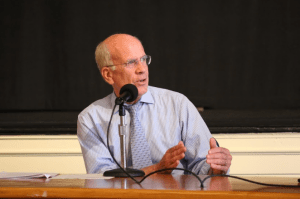
Welch had received $79,000 in campaign contributions from companies that backed the measure, according to the Washington Post, and invested his own money in pharmaceutical companies that were actively seeking to influence the bill, which became law in 2016.
Hallquist and Anderson were also quizzed about the Democratic Governors Association, a national organization that received $50,000 from Purdue in 2016, the same year the association poured $1.4 million into Democrat Sue Minter’s campaign for governor.
“I certainly look forward to talking to them about that issue,” Hallquist said, responding to a question about Welch and the DGA. “I’m certainly focused on Vermont politics and I’m certainly focused on my own and Vermont Democratic Party’s ethics moving forward.”
Anderson said the controversial bill that both Welch and pharmaceutical companies supported had “massive bipartisan support,” was viewed as an “important reform” and didn’t face any opposition from law enforcement when it was being proposed in Congress.
“So implying there was quid pro quo I think is the issue there, that clearly wasn’t what it was,” he said in an interview after the press conference.
Anderson said that he doesn’t believe the DGA will spend money on this year’s governor’s race. If they did, he said the party would “seriously consider” turning their money down.
“Our biggest concern with both the DGA and the RGA is that they’re dark money,” he said, referring to the Republicans Governors Association, which has already put more than a million dollars this year into a pro-Scott political action committee called “A Stronger Vermont.”
“They’re structured in a way that they don’t have to disclose their donors and we think that’s a bad way of doing politics,” he said.
Pressed about the Scott’s campaign claims that the Democratic Party’s criticism is hypocritical, Anderson asked if any Democrats had been linked to Purdue money.
“Have they named anyone who’s taken money directly from Purdue Pharmaceuticals? That’s what we’re going after today. This is a company whose being sued by states around the country for their role in propagating the opioid epidemic,” he said.
In September, Vermont joined coalition of 40 other states to investigate a litany of opioid manufacturers and distributors including Purdue Pharma. Since then, 27 states have sued Purdue for its alleged role in exacerbating the opioid crisis, most recently New York.
Vermont has yet to take legal action against the drug company, but last week Vermont’s deputy attorney general, Joshua Diamond, said his office is still “considering all legal options.”
Lola Duffort contributed reporting
