


[K]eith Stern left his own primary watch party early on Tuesday night. It was clear that he had lost to incumbent Gov. Phil Scott, and the Springfield grocer had to get up at 1 a.m. Wednesday to pick up a load of produce in Boston to bring back to his store on the Vermont-New Hampshire border.
“I’m back to being a produce guy, it looks like,” Stern said before heading home.
Gov. Phil Scott will also be going back to work Wednesday morning, but the question now is whether he’ll still have a job come November, when he is set to face Democratic challenger Christine Hallquist, the country’s first openly transgender gubernatorial candidate.
Though Scott easily beat Stern Tuesday night, the results put a chink in what seemed just a few months ago like impenetrable armor, especially in a state that almost always gives governors a second two-year term.
Stern had the backing of angry, motivated firearms rights enthusiasts and won about 32.8 percent of the vote, with 97 percent of precincts reporting.
Scott garnered 67.2 percent of the ballots cast.
Hallquist, who was the favorite going in to the primary, won 40 percent of Democratic votes, with her top two challengers coming in around 18 percent each.
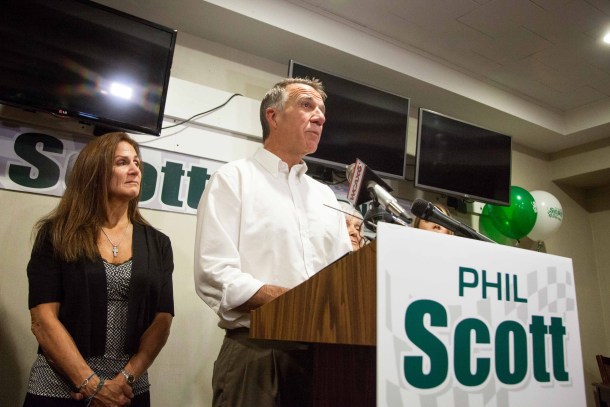
The governor did not bother to host a victory party Tuesday night. The only supporters at the no-frills press event held in a nondescript conference room at the Comfort Inn in Berlin were family, close friends and a handful of campaign staffers and cabinet members.
For much of the evening, the governor sat in a private glass-enclosed conference room on the second story of the hotel. Reporters were refused access until 10 p.m.
At a low-key press conference, the first-term Republican governor said he expected Stern to pull in even more votes than he did.
“I thought the results would be closer than they were, to be quite honest with you,” Scott told reporters. “I didn’t know how it was going to go, but I’m very grateful for the results and for those who stood up and went to the polls.”
Scott made an effort to mollify gun rights critics who rallied behind Stern and vowed to unseat the governor in the primary.
He thanked Republicans who supported him through “thick and thin,” and “all those who have set aside partisanship to engage in the primary.”
“I went into this primary with my eyes wide open,” Scott said, “and I know there are some who are still upset with me who may not welcome tonight’s result, but there is so much more that unites us than sets us apart.”
The governor asked Stern supporters to give him credit for economic policies that have made the state more affordable. Scott says he has created 4,500 jobs, spurred $100 million in construction activity through investments in housing and saved Vermonters $30 million in income taxes and $71 million in property tax hikes.
“No one agrees with their friends all the time, but as our success shows, we can make a lot of good progress when we have clear priorities and pull in the same direction,” Scott said.
Vowing to run a “positive, issues-based campaign,” Scott fell back on well-worn rhetoric in which he promised “to grow the economy, make Vermont more affordable and protect the vulnerable.”
“Campaigns are about choices,” Scott said. “As this campaign goes on, Vermonters will recognize there is very clear choice in the November election.”
Stern, who has owned Stern’s Quality Produce in White River Junction for the past 35 years, said he’d go back to being a “full-time produce guy” after months of campaigning around the state.
“I’m not running again after this year — not at all,” Stern said Wednesday evening, before the results rolled in. “I’m not going to be an active candidate anymore.”
Stern ran for U.S. Senate as an independent in 2004 and 2006, and for the U.S. House in 2010 as a Republican. But he says that this latest foray into politics was his most serious bid for office.
Stern started planning to run for governor not long after Gov. Phil Scott took office, when he heard that the new Republican governor intended to merely keep taxes level, rather than reduce them by slashing state spending.

“I volunteered to help save this state with my ideas and ability to lead,” Stern said, adding that he’d do what he could to make sure Scott wouldn’t be re-elected.
But he conceded that campaigning was not his strength.
“This is outside my comfort level,” he said. “I’m an unassuming guy.”
Stern raised about $69,520 for his campaign, of which $47,900 was a loan from himself.
Scott had raised $213,076 as of the most recent filing deadline, and a national Republican political action committee spent tens of thousands on pro-Scott ads ahead of the primary, and has hundreds of thousands more in the bank.
“I’m going up against a guy with $1 million,” Stern said.
For about 15 minutes early Tuesday night, until towns in central Vermont started reporting, Stern was neck-and-neck with Scott, and he even won the town of Wells, one of the first precincts to report results.
Those at the watch party urged the candidate to hold off on condeding until all the votes were in, and he had not called Scott by the time he left the party, shortly after 9:30 p.m. It wasn’t clear whether he had called the governor as of midnight Tuesday.
Michelle Pingree, who spent the day campaigning for Stern in Plymouth, said she was disappointed with the results, and frustrated that Scott had survived despite his support for gun control and what she called a soft stance on taxes.
“It’s going to be the same old, same old,” she said.

