


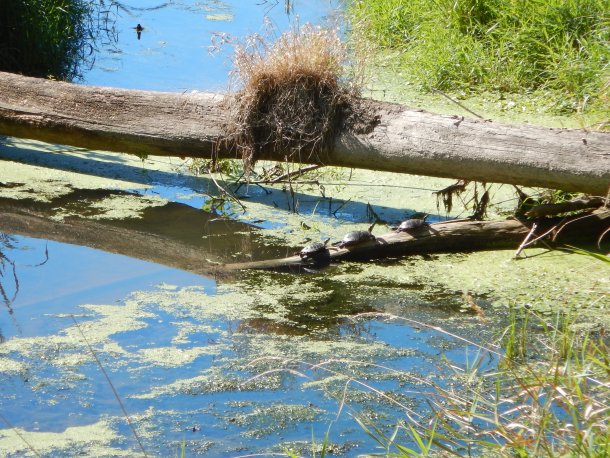
A 270-acre biodiversity hotspot in Shelburne has received the state’s highest class of wetlands protection.
An environmental advocacy group, Vermont Natural Resources Council, filed a petition in March to have the LaPlatte River Marsh designated a Class I wetland, said Jon Groveman, the organization’s policy and water program director. There are only six other wetlands with this designation in Vermont. The new classification goes into effect next week.
A large portion of the newly minted “best in show” wetlands fall within a preserve owned by The Nature Conservancy, said Rose Paul, director of critical lands and conservation science for TNC. She noted that the area contains a “mosaic” of natural communities, like floodplain forests, in wetlands within the river mouth and on the frequently flooded land along the water’s edge.
The lower LaPlatte is home to two fish — the stonecat and the channel darter — that are at the edge of their eastern range in Vermont, holdovers from a one-time connection between Lake Champlain and the Mississippi River after the glaciers melted, said Paul. The sedge skipper — a yellow-flecked brown butterfly — and more than two hundred species of birds have also been found in the wetlands.
As “the last stop for the water of the LaPlatte River before it hits Lake Champlain,” the wetlands filter nutrients out of the river — which flows through agricultural land — that would otherwise end up in the lake, noted Paul.
Laura LaPierre, wetlands program manager for the state Agency of Natural Resources, said that to achieve the Class I distinction, a wetland must be deemed “exceptional or irreplaceable” for one of 10 ecological values, including flood protection, wildlife habitat and erosion control. ANR determined the LaPlatte River Marsh was exceptional for 10 and irreplaceable for nine, she said.
Although much of the wetland area is already conserved by The Nature Conservancy, the Class I designation increases the buffer surrounding the wetland from 50 to 100 feet, said Groveman. The wetlands are located near houses and town buildings, so the larger buffer further prevents development from further encroaching on the wetland, he said.
“You risk death by a thousand cuts if you don’t take steps to protect these special areas,” said Groveman.
LaPierre said that anyone seeking to alter land within that buffer has to apply for a permit and must prove that “the activity would not harm this irreplaceable resource.” The wetlands themselves could only be developed for public health or safety concerns, she said.
The petition to reclassify the wetlands underwent an extensive review process, including multiple public meetings, said Groveman. VNRC contracted scientists from Arrowwood Consulting to prepare a report on the natural area’s ecology before filing the petition — something Groveman noted would be a costly undertaking for a local group or individual.
Dean Pierce, director of planning and zoning for the town of Shelburne, said that the town had some initial trepidations about the impact the classification would have on town buildings, like a wastewater treatment plant, that now fall within the buffer area. ANR assured the town that maintenance to existing structures was allowed, he said.
“The town came to realize that just because facilities might be within the buffer, it didn’t mean we had to take them out.”
LaPierre noted that the wetlands provide a training ground for budding ecologists and a respite for paddlers and walkers arriving off heavily trafficked Shelburne Road. “As soon as you dive down into the LaPlatte wetlands with a canoe, you feel like you’re in the middle of nowhere.”
