


This story by John Lippman was published by the Valley News on Aug. 6.
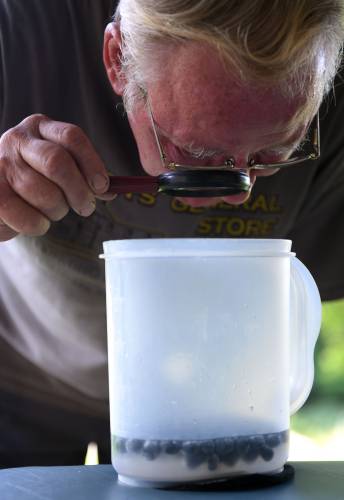
[T]HETFORD — Every day Roy Ward walks out to his orchard of blueberry bushes and picks about 100 berries, mashes them and then puts the mush into a salt water solution. He then waits 15 minutes. If white larvae emerges from the simple test, Ward knows he has a problem.
“Last year we picked 12 days before it hit with a vengeance and, boom, we were done,” said Ward, owner of Ward Berry Farm, a pick-your-own farm in Thetford.
So far, Ward has been lucky and hasn’t detected signs of spotted wing drosophila among his blueberry bushes. But with the northern New England blueberry picking season now underway, he and other farmers are on high alert for the appearance of the dreaded fruit fly that can ruin their crop by turning the berries into what looks like moldy meat.
“Not yet,” Ward said of seeing spotted wing drosophila larvae in his blueberries, although that is little assurance he will be spared this season. “It can happen quick,” he said of the infestation.
Spotted wing drosophila is a relatively new species of fruit fly — there are some 40 different kinds of fruit flies buzzing around the state of New Hampshire — first detected in New England seven years ago after making its way from the West Coast and, before then, from its origination in East Asia.
Unlike other fruit flies which are attracted to ripened and spoiled fruit, the SWD will attack fruit on the vine with a special “hacksaw” shaped ovipositor, an organ used to lay eggs, that can pierce the fruit’s unripened skin. The female will then inject her eggs into the fruit, which will hatch into larvae in one to three days.
“Any dark, inky berry they just love,” said Paul Franklin, owner of Riverview Farm in Plainfield, which grows 3 acres of raspberries and 2 acres of blueberries for PYO pickers. He’s sprayed his orchards as a preventive measure, he said, and so far it’s worked. The next worry is the upcoming fall raspberry season, which is particularly vulnerable to spotted wing drosophila.
“Ours look fine right now, but we’re monitoring it,” Franklin said.
Last week, Noda Farm in Meriden, New Hampshire, sounded an alert when it posted on its website that “we have seen a few signs of Spotted Wing Drosophilia in our field … we hope we are wrong, but if we are right, our season may be cut short.”
The warning urged pickers not to take any chances by waiting, but to get out to the farm this past weekend if anyone wanted to take their pick at Noda.
At the same time, Kesaya Noda and her husband, Chris Dye, owners of Noda Farm, said the blueberry yield at their Bean Road farm has been one of the best in memory.
“We had on opening day, so far as I know, never a bigger crop,” Nye said. “Leaving aside the possibility that there are problems we are not aware of, it’s an absolutely gorgeous field.”
Dye said he was motivated to post the warning after he walked through his orchard last week and felt “a few ominously soft berries” that alerted his concern.
Although Dye said he hasn’t tested his orchard for the presence of spotted wing drosophila — “I know it’s a little odd” — he remembers what happened last year.
“We got pretty well through the season but then we had to shut down,” Dye said. “All I know of that you can do is spray and we aren’t willing to do that … you do what you can and hope for the best.”
“So far we seem to be holding our own,” he said, “thank God.”
In 2012, a year after spotted wing drosophila first was detected in the state, the fly caused more than $1.5 million in crop losses, the University of New Hampshire Cooperative Extension has estimated.
Anna Wallingford, extension state specialist in entomology and integrated pest management, said spotted wing drosophila thrive in a combination of humidity and moderate heat — just the kind weather the region has been experiencing the past few weeks.
For PYO pickers, Wallingford recommends either eating the berries right away or putting them in the refrigerator, which will “halt the development of the egg.”
“We first started seeing this fly in 2011 and 2012 in the Northeast and it’s kind of gotten worse every year,” she said. “They are probably here to stay.”
Pooh Sprague, owner of Edgewater Farm in Plainfield, said he’s been noticing spotted wing drosophila showing up in their traps, which he has placed in the orchard to monitor the bug.
He said the flies have not yet reached the “threshold” that would lead him to begin spraying, but he is reviewing the situation daily.
“This weather system brought us much-needed rain, which was followed by hot weather,” but that the same time those are perfecting conditions to accelerate the reproduction cycle of SWD, which “in this weather occurs in three days.”
“We got through the blueberry season last year and are hoping to get through it this year,” Sprague said. “But last year we lost the fall raspberry crop in the middle of it.”
While the prospect of fruit fly eggs residing microscopically inside a blueberry or raspberry may not be appealing, Riverview Farm’s Franklin said it doesn’t present a health risk if eaten.
“It won’t harm you,” he said. “It’s more the yuck factor.”
