



[B]ENNINGTON — Environmental officials say a report prepared by Bennington College faculty members lends support to their view that former ChemFab Corp. factories here were the principal contributor to widespread PFOA contamination of soils and private wells.
The conclusions in the research report “didn’t come as a surprise to me,” said Peter Walke, deputy secretary of the state Agency of Natural Resources. “I think this is a clear indication of what we have maintained all along.”
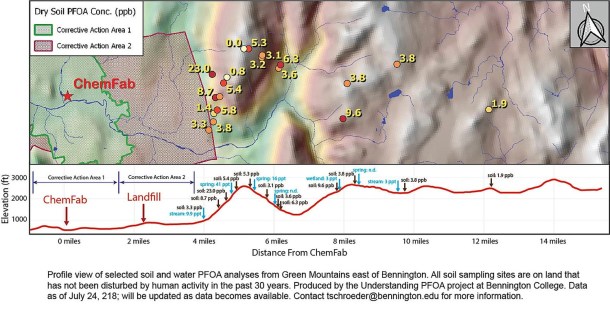
In the report released this week, David Bond, Janet Foley and Tim Schroeder said their research focused on airborne emissions from the company’s former factory in North Bennington, not far from the college campus. They addressed the question of how far emissions from fabric-coating operations involving Teflon dried at high temperature traveled from the plant on Route 67A.
“Downwind of the ChemFab plant, our research has begun to identify a distinct plume of soil with elevated levels of PFOA (perfluorooctanoic acid) stretching over 10 miles eastward,” the faculty members said in a summary of the report.
Like state engineers and state-commissioned consultants, the college’s research shows that “the vast majority of the PFOA contamination” emanated from exhaust stacks of the former ChemFab plants, Walke said.
While acknowledging the existence of background PFOA throughout the area — the lower amounts generally found in soils in many areas around the nation — Walke said the state has determined that the overwhelming and most significant local deposits of PFOA came from the former factories.
Talks with Saint-Gobain
The issue is an important factor in talks between the state and Saint-Gobain Performance Plastics, the party the ANR has identified as responsible for addressing the pollution.
Saint-Gobain last year agreed to provide up to $20 million to extend municipal water lines to properties with affected wells in about half of a state-identified contamination zone around the factories, but talks now are focused on the properties east of Route 7A.
However, an engineering report commissioned by Saint-Gobain cast doubt on whether the former plants were the significant contributor to the contamination east of the highway, and talks have explored whether a settlement agreement is possible. State officials say they will take legal action if necessary to ensure the company provides a long-term source of clean drinking water to the area.
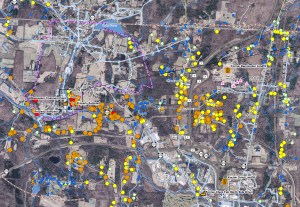
“Our research suggests Saint-Gobain has been insisting on a microscopic view of what really might be a wide-angle problem,” Bond said Thursday. “When you zoom out, you begin to see just how extensive PFOA contamination may actually be. The results seem clear; the plume of elevated soil levels of PFOA in the Green Mountains points back to Saint-Gobain.”
The faculty report said the Saint-Gobain “line is clear,” in that the company believes the PFOA from the factory was “confined to areas immediately surrounding the plant,” where new water lines are being extended.
But the researchers said that for contaminated neighborhoods outside that immediate area “Saint-Gobain has been far more miserly.”
In contrast, the researchers said they found that “there seems to be a massive plume of elevated PFOA levels in the soil extending eastward from ChemFab and into the Green Mountains.”
State officials believe PFOA spread through the air while the factories operated built up in soils and worked its way into groundwater, affecting local wells.
In 2000, Saint-Gobain acquired ChemFab, which began on Northside Drive in Bennington in 1968 and moved to a new plant on Water Street in North Bennington in 1977. The local operation was moved in 2002 to New Hampshire.
The contamination was not identified in local wells and soil until early 2016, after similar PFOA contamination had been discovered around factory sites in Hoosick Falls, N.Y., and surrounding locations.
Reached on Thursday, Dina Pokedoff, a spokeswoman for the company, said in an email, “Saint-Gobain Performance Plastics is currently reviewing the recently released report authored by three Bennington College professors. It is important that the emerging body of work on PFAS be based on reliable science. In our ongoing discussions with the state, we have been relying on the Conceptual Site Model prepared by Barr Engineering to investigate PFAS in soil and groundwater.”
She added, “Since learning about the presence of PFOA in Bennington, Saint-Gobain made it a priority to take a leadership position and be a positive partner in the community. We continue to work with the state of Vermont in accordance with the consent order, which Saint-Gobain voluntarily signed with the state in July 2017.
UVM study planned
Walke said the state also is interested in determining where contamination from PFOA and related compounds is located around Vermont, and in determining an accurate background level present everywhere.
The state has commissioned the University of Vermont of explore that issue, and Walke said he expects some information to emerge in draft form in the fall. The data could help determine not only the background levels but also the feasibility of cleanup approaches and methods to deal with the ubiquitous presence of PFAS (per- and polyfluoroalkyl substances) throughout the environment.

The related substances have been used in industrial operations and consumer products since the 1940s. And they are spread worldwide, as evidenced from the determination that nearly every human on the globe has at least a trace of PFOA or a related substance in their blood.
Elevated levels have been associated in medical studies with high cholesterol, ulcerative colitis, thyroid disease, testicular cancer, kidney cancer and pregnancy-induced hypertension.
“We here at the state strongly suspected that what Bennington College has found is the condition in the area of Bennington and throughout the state, nation and world,” said state Sen. Dick Sears, D-Bennington.
Sears also referred to a recent federal report on PFAS background sources, adding, “This is why we asked Saint-Gobain to have their consultant take soils samples outside the Bennington valley area. Based on this work we issued a grant to UVM to take approximately 70 soil samples around Vermont to determine the background PFAS soil levels in Vermont. We hope to see the results of this work this fall.”
Walke said discussions with Saint-Gobain over the eastern half of the PFOA contamination zone continue, adding, “It is getting to the point where we need an answer” to whether the company will negotiate toward an agreement to provide clean water to the remaining properties.
He said the community will be updated by state officials “regardless of the outcome.”

