

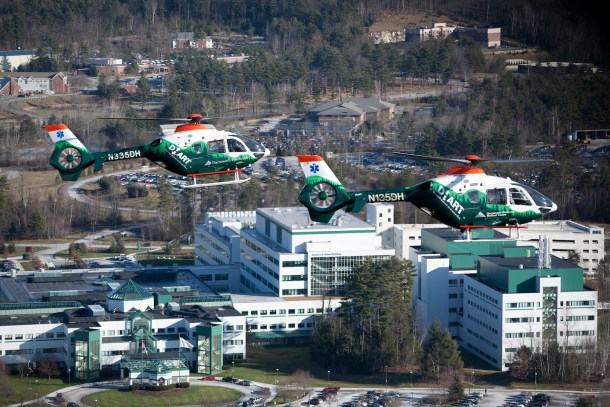
[A] collaboration between two medical giants means Burlington will host a much faster mode of transportation for critically ill patients.
University of Vermont Health Network on Tuesday said a new medical-helicopter partnership with New Hampshire-based Dartmouth-Hitchcock is ready to take flight: Training runs start this week, and patient transfers are expected to begin in August.
The Dartmouth-Hitchcock Advanced Response Team helicopter will be based at Burlington International Airport and used for inter-hospital transfers of “the sickest of the sick,” said Dr. Ryan Clouser, an intensive-care physician at UVM Medical Center.
“We’re really excited,” Clouser said. “I think it’s going to save lives.”
Clouser serves as medical officer of the Regional Transport System, a multiyear UVM Health Network initiative aimed at improving the efficiency and safety of getting patients from one hospital to another.
Two new projects are taking shape as a result of that initiative.
One is a Regional Transfer Center that’s now operational. Based at UVM Medical Center, the 24-hour, seven-days-a-week facility will “coordinate all patient transfers to UVM Health Network affiliates from 13 hospitals in a 40,000-square-mile area in New York and Vermont,” administrators said.
That represents a big workload: There are approximately 6,500 patient transfers annually in the network’s service area.
The new regional center is described as a “one call does it all” setup for when patients need to be transferred for a different or higher level of care. That allows doctors and hospital staff to focus on patient care rather than transportation logistics.

“It creates efficiency,” Clouser said Tuesday. “It improves communication. It streamlines communication.”
“We’re basically just taking what’s already in place and putting it all together in the same room,” he added.
The arrival of Dartmouth’s medical helicopter is another part of the enhanced Regional Transport System.
Health network officials said about 97 percent of inter-hospital transfers currently happen via ambulance. And Clouser said the network’s ground transportation service will remain essential.
“We’ve had a long-standing history here of a really highly trained, highly skilled critical care transport team,” he said. “They do these amazing, long-haul, critical-care transports and do a great job.”
But there are times when air transport is preferable or necessary. A small number of helicopter transfers do happen in the UVM Health Network area, but that service is not always available, Clouser said.
The new Dartmouth-Hitchcock helicopter will change that dynamic. Burlington International Airport will serve as the Dartmouth-Hitchcock Advanced Response Team’s third air base, joining bases in Lebanon and Manchester, N.H.
Dartmouth is providing a helicopter and pilots, while UVM Medical Center will provide clinicians for on-board care. The Vermont hospital is not buying or leasing the helicopter, administrators said.
Kyle Madigan, director of Dartmouth’s advanced response team, said the service has been around for more than two decades. In a statement accompanying UVM Health Network’s announcement, Madigan said he is looking forward to “providing an expanded reach of air medical services to the patients of northern Vermont and northern New York.”
Health network administrators said the helicopter will be used only “when medically necessary.” Clouser underscored that, saying the idea is “speed of transport and minimizing time out of hospital for, really, the sickest of the sick.”
He also said UVM Medical Center won’t necessarily be the destination for air-transport patient transfers. Patients in northern New York, for example, could be flown to receive more-advanced care at Champlain Valley Physicians Hospital in Plattsburgh, N.Y.
The biggest benefit, Clouser said, will be the helicopter’s availability in this area. “Having a team of highly trained nurses and medics ready to go, who are specifically here for our region – I think it’s such a great thing for the patients we care for,” he said.
Health system administrators said more patient-transport changes are in the works as part of the transport system revamp. That could include “establishing uniform standards for education and certification of transport staff.”
“It’s really restructuring the whole transportation system, from the ground to the air, and ensuring everyone’s getting the highest-quality care possible,” Clouser said.
