

[T]he state’s emergency board, the body that sets official revenue forecasts, moved Friday to increase the state’s revenue forecast by about $50 million over the next two years.
State economists believe that a soaring economy and federal tax reform will drive the boost in tax dollars.
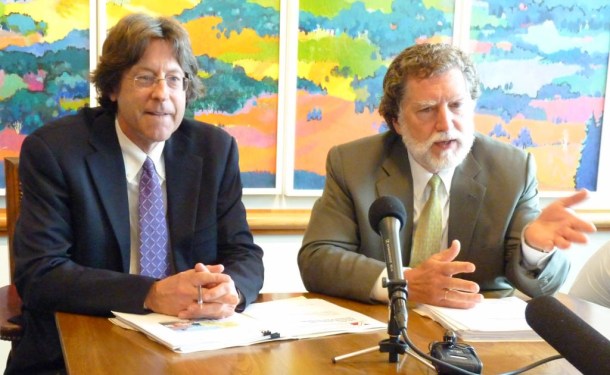
The board, composed of senior lawmakers and the governor, hiked the anticipated general fund tax revenue forecast by $33 million for fiscal year 2019 and $18 million for fiscal year 2020. Their decision followed the recommendations of Tom Kavet, an economist for the Legislature, and Jeff Carr, the economist for Gov. Phil Scott’s administration.
Kavet and Carr said they expect factors including corporate repatriation of funds from abroad and a recent Supreme Court ruling clearing the way for Vermont to collect taxes on internet sales from out-of-state companies to contribute to the expansion of state coffers.
But they also noted that nationwide, the economy is seeing a “cyclical peak” — driven by federal deficit spending and tax cuts — which will almost certainly be followed by a downturn in the coming years.
“When we’re at those cyclical peaks or troughs, they don’t last very long,” Kavet told the state’s Joint Fiscal Committee Friday morning. “Right now, you can enjoy the added revenue that can come from this.”
Vermont has already seen a tax revenue windfall in recent months, in large part because of tax reform enacted by President Donald Trump. At the closeout of the 2018 fiscal year in July, the state secretary of administration reported the state’s tax revenue surplus came in at a total of $65 million.
Personal income taxes accounted for more than $38 million of the surplus.
Fiscal analysts believe the boost in income taxes came from taxpayers making significant payments related to mergers and acquisitions of companies, and Vermonters seeing increased capital gains in the wake of the federal tax changes and a strong year for the stock market.
Corporate income taxes contributed to roughly $17 million of the total surplus, most of which likely stemmed from corporate repatriation — companies bringing funds held overseas back to the U.S. and paying a tax on that transfer. The federal tax law, passed in December, temporarily offers a lower tax rate for corporations moving their money back home.
A report by Kavet says an even larger tax windfall from repatriation may be in the offing this fiscal year. He credited repatriation for $15-20 million of expected taxes in the updated revenue forecast.
It’s possible that Vermont could see an even larger repatriation boost — upwards of $100 million, Kavet said.
It’s also possible that corporations will be taking states to court over collecting the repatriation tax in the coming months, Kavet said, in which case the Vermont may be liable to payback the money it’s already reaped.
“It could be raining money,” Kavet said, “or there could be legal action and clawback.”
A boost in e-commerce “sales and use” tax receipts is likely to bring in $4-5 million more revenue this year, according to the economists, who said that figure could triple or quadruple in subsequent years.
In May, the Supreme Court’s ruling in the case South Dakota v. Wayfair, overturned a decision that had barred states from collecting a sales tax from companies without a brick-and-mortar presence within its border.
This tax will go into the education fund after lawmakers moved the sales and use levy out of the general fund during the legislative session.
While Vermont may not see the personal income tax boost it saw earlier this year, economists still expect them to stay hot in the coming fiscal years.
Kavet’s report said that “general improvement in the economy and continued strong equity market gains will support $15-$20 million more” in personal income taxes over the next two years.
But the good times won’t last forever. Increasing inflation and rising federal interest rates expected in response to the dramatic economic growth will likely bring an end to the boom, Kavet said.
“It’s those interest rate moves that historically have been things that cause a recovery to end,” Kavet said. “It’s just important to keep an eye on that.”
Lawmakers agreed, and said it’s importance to anticipate the downturn by building up the state’s reserves and creating a cushion for tax refund obligations.
“Usually the hotter it gets, the harder it falls,” said Sen. Anne Cummings, D-Washington, who chairs the Senate Finance Committee.

