

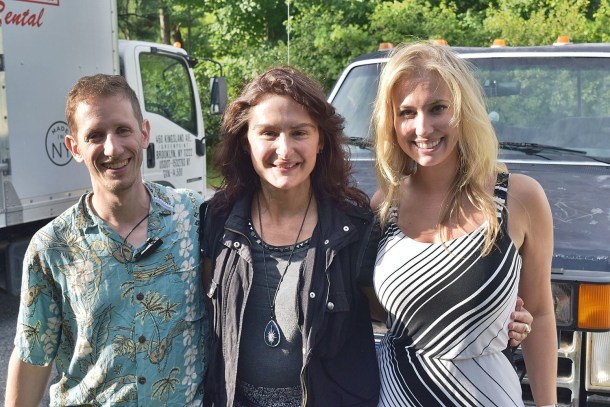
This story by Greg Sukiennik of the Manchester Journal was published in the Bennington Banner on July 27.
[M]ANCHESTER — The viability of Vermont as a place to make films and television series got a thorough test drive the past month, as the cast and crew of the independent film “Stormchaser” took up residence in the Northshire and used its homes, vacant buildings, landscapes and roads as backdrops for the action.
The film’s producers and The Vermont Production Council, a Manchester-based organization dedicated to promoting film and television in the Green Mountain State, are hoping the film helps build the state’s reputation as a destination for filmmakers. They’d like to see it kick-start the development of financial incentives and production resources that will convince TV and film productions to bring projects here.
“Stormchaser” had originally targeted upstate New York, which offers tax incentives, as location. But “Stormchaser” writer, executive producer and director Gretl Claggett, and producer Pamela Cederquist, had established a connection with the Vermont Production Council through ITVFest executive director Philip Gilpin Jr. and decided on the Green Mountain State instead. Both women were here last fall for the Jacob Kruger Writing Retreat, held during the festival.
“We were able to find locations and find a little bit of fundraising, so they’re shooting and spending all their money here now,” Gilpin said Saturday, as the crew got ready for its last day of shooting at a vacant commercial building in Taconic Business Park. The production was here for weeks, as advance location scouts were followed by the cast and crew.
Feature films have been made in Southern Vermont before, but it’s been a while. “Baby Boom,” starring Diane Keaton and Sam Shepard, brought Manchester, Peru and Weston to the silver screen in 1987; and a year later, “Funny Farm” starred the town of Townshend along with Chevy Chase.
The producers of “Stormchaser” are committed to helping The Vermont Production Council show what the state can offer the industry, as a visually striking four-season backdrop and as a viable location that offers everything filmmakers need, from actors and extras to tradespeople and technical resources. Financing remains a concern, however, as Vermont does not offer tax incentives that are provided by other area states. For example, “Super Troopers 2,” a film released in April about the misadventures of a fictional Vermont police department, was largely shot in Massachusetts.
“We hope to incentivize something to happen to make Vermont a more appealing location, so we can bring more projects here,” said producer Sarah Donnelly, who owns her own production company, Palikari Pictures. “I have another film that we are talking about bringing here which would be with higher budget and name talent, and I would definitely consider Vermont as a filming location.”
“Right now there are no grants or anything in place [in Vermont],” she said.
Vermont might not have a tax credit to draw Hollywood, but it does have two things the producers of “Stormchasers” much appreciated: welcoming and accommodating residents and a limitless supply of natural beauty. The film’s producers said residents offered their services as drivers and their homes as shooting locations.
They said local hotels and inns worked with the producers to limit housing costs. And they couldn’t say enough nice things about caterer Debbie Sheldon.
“It’s beautiful at every turn. People are more than welcoming and it has been a dream to shoot here,” producer and assistant director Etan Harwayne said. “The natural beauty of the area makes for incredible footage.”
Donnelly and Harwayne both pointed to a driving scene they filmed on Route 30 one evening last week in Pawlet as memorable. Donnelly called it “spectacularly beautiful.”
“It was one of the prettiest ever things I’ve ever seen,” Harwayne said. “The sun was just going down. In front of us [in the distance] was an incredible lightning storm. To our right was one of the brightest crescent moons I’ve ever seen. And behind us a sunset you can’t see anywhere else except Montana.”
Casting call: equipment, trade skills
As for Vermont’s drawbacks? Some are specific to the equipment needs of the film industry, and some are well-known workforce development issues affecting the economy statewide.
Think of a film crew as a small army on the move. There’s a script and a schedule, but there are also unforeseen circumstances — schedules gone awry, equipment issues, personnel issues, bad weather — that require the team to improvise. In this case, the needs are human and technical resources.
“What I think we need to have is better accessibility to vendors ready and willing to participate in the filmmaking process,” Donnelly said. “We would love to be able to do nothing but hire Vermont locals.”
“We need two things,” Gilpin added. “We need trained crew that live locally. We have some, but we don’t have enough to handle a year-round production yet. That’s education and workforce development.” That includes professional trades such as electricians, plumbers, art designers and caterers, he added.
The second need? “Equipment. Some entrepreneurs in the area need to realize that there’s enough films coming through that it makes sense to open up an equipment rental house for cameras and lenses,” Gilpin said. “Once you have enough trained crew and enough equipment you can shoot anything.”
And much like the kingdom lost for want of a nail, equipment is crucial, especially for independent films shooting on location, Harwayne said. “If you forget even a screw, because they’re proprietary, you have to go back to the rental house, and here that’s just not possible,” he explained.
“A lot of people from outside the industry would love to live and work here. They’ just need to know there’s enough productions happening for them to make the leap,” Gilpin said. “We’re breaking that chicken and egg phase.”
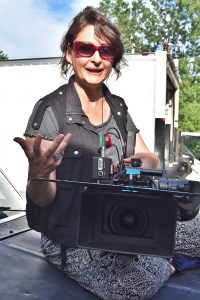
While the crew was working long hours and faced a long drive north to St. Albans after Saturday night’s shoot, spirits remained high. Claggett may have several festival awards to her credit for her critically acclaimed debut film “Happy Hour,” but she gleefully scampered atop the hood of the used pickup truck that plays a central role in her film to pose for a photo. “I found it on Craigslist at 2 a.m. in Massachusetts,” she said proudly of the slightly rusted 1986 Ford F-150. Like the main character of the film, it’s a battle-tested survivor.
What’s the film about? Claggett describes it as “Blood Simple” or “Raising Arizona” meets “Glengarry Glen Ross” meets “Twister.” The protagonist, Bonnie Blue, works for a company that sells roofing and siding in the wake of destructive storms. Her prized possession is her father’s pickup truck, “Bluebell,” in which she and her dad used to go storm chasing. Through the film, Claggett said, the main character finds her voice, and along the way “there’s a love story, there’s social commentary, there’s disaster capitalism, there’s environmental issues.”
As the impromptu photo shoot dispersed, Gilpin offered an observation about the enthusiasm on display.
“You’ll notice that everyone here is under the age of 40, if not 30,” he said. “Vermont has a jobs crisis and a youth retention crisis? This is the solution.”
