


[B]en & Jerry’s says it has reached a milestone in its efforts to hold supplying farms accountable for the conditions of those who work there, including migrant laborers.
The company said at a press conference on Wednesday that 72 dairy farms have now enrolled in the Milk with Dignity program, enough to supply all of the milk it needs for its entire U.S. operations.
Those farms contribute to a cooperative of more than 300 that supplies Ben & Jerry’s, meaning only a fraction of the milk it uses is actually from members of the program.
The Milk with Dignity program was designed by Migrant Justice, a group that advocates for migrant laborers in Vermont and elsewhere. Ben & Jerry’s pays an undisclosed premium to farms that commit to ensuring basic housing standards for workers, compliance with Vermont’s minimum wage, paid sick days and other basic labor standards.
Ben & Jerry’s, which is owned by multinational conglomerate Unilever, entered the program in October last year.
“We’re trying to present programs that are beneficial to farms but also create economic incentives that make it beneficial to participate,” Rob Michalak, Ben & Jerry’s global director of social impact, said at Wednesday’s event.
Ben & Jerry’s struggle to get a handle on the labor practices of its suppliers, in particular the poor working and living standards of migrant farm workers, has received international coverage. Migrant Justice has been as outspoken as anyone about those issues.
But the advocacy group has also worked with the ice cream giant to develop solutions to a problem that is common to farms around America, but notable for Ben & Jerry’s largely because of its public commitment to being a socially responsible company.
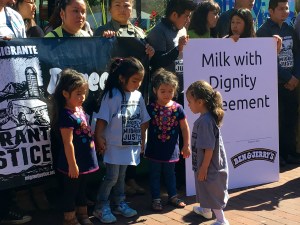
The benefits of the program were not only touted by Ben & Jerry’s, but also by Enrique Balcazar, an architect of the program and farm worker organizer, who spoke through an interpreter.
“Being here today to talk about the advances of this program since signing this agreement with Ben & Jerry’s last year is a special day for me.” he said. “I am here speaking on behalf of the men and women who are milking cows across the state today and who are benefiting from this program.”
The farms who enroll in the program — and receive financial benefits for their participation — sign a code of conduct with Ben & Jerry’s. Their workers are also engaged in the program, and asked to call a hotline if the labor standards set out in the program are not being followed.
The hotline has received 48 inquiries since the company began the program, 18 of which did not require action. Data on what the inquiries were, and what action was taken on those that required it, was not made available.
There are currently 72 farms in the St. Albans Cooperative Creamery that are enrolled in the program. At least 60 are located in Vermont, with 220 farm workers in the state taking part in the program.
The milk coming from the cooperative’s 300-plus members is not segregated, meaning Ben & Jerry’s has no way of tracking exactly how much milk is coming from the farms taking part in the program.
As the dairy industry continues to grapple with market prices on milk that barely cover or fall below the costs of production, Ben & Jerry’s hopes programs like Milk with Dignity can help relieve some of the financial burden off these farms.
It also hopes more major dairy buyers will sign on. Ben & Jerry’s remains the only business to have adopted Milk with Dignity.
“We invite other companies to join us,” said Cheryl Pinto, Ben & Jerry’s values led sourcing manager. “Let’s take this from a pioneering innovative program to mainstream standards practice.”
Migrant Justice is optimistic that will become a reality sooner rather than later.
“We have begun a couple conversations with other dairy companies which are very initial,” Balcazar said, “but are very exciting for us as farm workers because it shows there is an interest from more companies.”
