


[W]ith just a few weeks left before voters cast their ballots in party primaries, most Vermonters have never heard of the Democratic contenders, or Gov. Phil Scott’s sole contender in the Republican race, according to a new poll from Vermont’s public broadcasters.
The governor continues to have surprisingly low approval ratings within his own party — lower than among Democrats or independents — but has more than double the name recognition rating of his top competitor.
Across all parties, 94 percent of respondents said they had heard of Scott, as opposed to 41 percent who have heard of Christine Hallquist, the most recognized Democrat in a field of four, according to the poll by Vermont Public Radio and Vermont PBS.
The survey’s margin of error is 4 points, and becomes less accurate for party and demographic breakdowns.
Hallquist, a former energy coop executive, was well ahead of fellow Democratic candidates Brenda Siegel (29 percent name recognition), James Ehlers (27 percent) and Ethan Sonneborn (25 percent). Among Democrats, these numbers are just 2-4 points higher across the board. Keith Stern, the lone Republican challenger against Scott, was recognized by 28 percent of respondents, and 32 percent of Republicans.

The overall name recognition numbers are far below where primary candidates were at nearly a year out from the 2016 governor’s race, according to a poll conducted by the now defunct Castleton Polling Institute. (Richard Clark, who oversaw that poll, also conducted the new VPR-Vermont PBS poll).
In the August 2015 poll, looking ahead to the 2016 elections, former Speaker of the House Shap Smith led Democrats with a 61 percent name recognition, followed by tech executive and state politician Matt Dunne (57 percent) and former Transportation Secretary Sue Minter (38 percent.)
Scott, who was previously the lieutenant governor, had 77 percent name recognition at that point, on par with current lieutenant governor, David Zuckerman, who is at 72 percent, according to the new poll.
Clark, a political science professor at Castleton, said 2016 did not offer an ideal comparison to 2018 because there was no incumbent running.
“The last time we had an incumbent, the voter turnout was 9 percent,” Clark said of the primaries, “2014 would be a fair comparison based on the number of votes cast and the number of registered voters in the August primary.”
This year’s name recognition numbers show that the public hasn’t yet tuned in to the August primary, Clark said.
“They really aren’t aware,” he said.

The Democrats running for governor, or those running their campaigns, said they are not worried about the numbers.
“Not shocking and not worrying,” said Sarah Anders, Ehlers’ communications director. “It’s surprising that folks haven’t heard more about any of the candidates in the primaries, but the more James talks to folks the more excited they are. And we are working to get his name out there.”
Hallquist’s campaign manager, Cameron Russell, was happy with a 12 point lead in name recognition over the closest competitor, Brenda Siegel.
“We’re feeling pretty full steam ahead,” he said. “We’re having a lot of good numbers back from people who say they are going to support Christine. But we are not taking anything for granted.”
Having joined the race in early May — the same month as Ehlers, and a month after Hallquist — Siegel said she sees her 29 percent name recognition as a positive.
“We have a strong field game and that’s going well,” Siegel said. “I’m very happy with the name recognition that I’ve gotten in such a short time.”
Scott’s GOP problems
Although nearly all Vermonters polled knew the governor’s name, it was the second recent survey showing that Scott is polling well below where he was in 2016, largely due to low favorability among his base.
The new survey puts Scott’s favorability at 45 percent, a 6 point drop from an ACLU poll released in May and a significant fall from the 70 percent favorability he had in the lead-up to the 2016 race.

However, the governor’s campaign manager said his camp was not overly concerned. Brittney Wilson said conclusions should not be drawn from one poll, as there are myriad ways terminology and methodology can skew outcomes.
“Anecdotally it’s not uncommon for incumbents to have approval ratings drop. The concerning part to me is the folks that have no opinion or are unsure on approval of the governor,” Wilson said, “It’s a concern and an opportunity.”
On the Democratic gubernatorial candidates’ lack of name recognition, Wilson said the governor was not focusing on the Democrats, but “None of them have been on the ballot before, so it’s not all that surprising.”
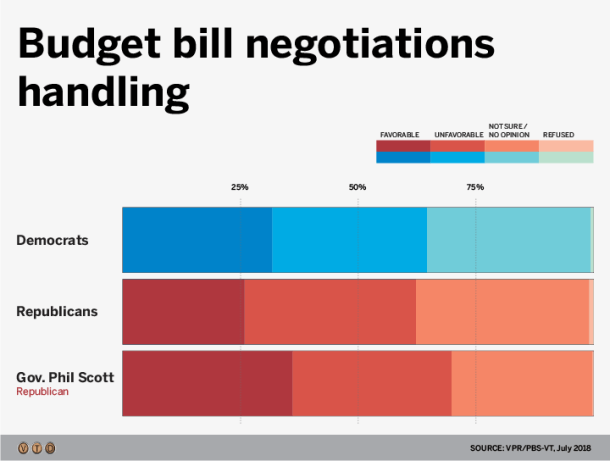
The study also for the first time gauged public opinion of the budget showdown during the special session in Montpelier.
A slightly higher number of respondents disapproved of the governor’s handling of the negotiations (34 percent) compared to Democrats in the Legislature (32 percent), however the governor also had higher approval on the issue — 36 percent compared to 32 percent for the Democrats. Just 26 percent of respondents approved of how Republicans in the Legislature handled the budget talks, while 36 percent disapproved.
The poll also asked for general favorability of Vermont’s delegation to Washington, though it did not ask about their competitors for those races.
Sen. Bernie Sanders, an independent, led the congressional delegation with a 66 percent approval rating while Sen. Patrick Leahy (53 percent) and Rep. Peter Welch (47 percent), both Democrats, lagged behind.
Clark said questions regarding challengers were omitted mainly to keep the survey down to 10 minutes.
“I don’t think it’s the great concern of the day,” Clark said. “In terms of this poll, the great concern is checking in to see where we are before the primary.”
Correction: Richard Clark’s name was misspelled multiple times in a previous version of this article.
