


Christine Hallquist won’t be taking any more corporate campaign donations in her bid to become Vermont’s governor, but she also won’t be giving back more than $16,000 in corporate donations she already accepted — at least not yet.
Cameron Russell, Hallquist’s campaign manager, said the decision was both political and consistent with his candidate’s progressive principles.
“It was a strategic and moral decision because that is what is truly representative of Christine,” he said in an interview on Wednesday.
Hallquist has already taken in more than $16,000 in donations from three companies: real estate firm Barrett Singer, animal food manufacturer Green Mountain Animal and the Vermont Telephone Company (Vtel).
Russell said that Hallquist has personal connections to all of the businesses and had not realized how much of a liability it would be to take donations from them.
“When we started the race, Christine didn’t fully understand the implications of quote unquote corporate cash, and three personal connections of hers donated through businesses,” he said.
Russell said the campaign has been sending back checks from companies since the last donation they accepted on May 4. Although the campaign would like to give the money back as a matter of principle, Russell said paying the campaign’s unionized staff was the first priority.
“If we can return it we will,” he said, “but the fact of the matter is I’m going to make sure our staff gets paid first.”
Russell said that if Hallquist makes it through the primary and continues fundraising ahead of the general election, the campaign may be able to return to corporate contributions.
In a statement released Sunday following her campaign finance filing, Hallquist boasted that the campaign “received support from more individual contributors than any other Vermont candidate this cycle.”
Hallquist recently won the support of Justice Democrats, a progressive political group that has helped propel the campaign of Alexandria Ocasio-Cortez for a U.S. House of Representatives seat in New York City.
Russell said the national group was satisfied with the campaign’s pledge to stop taking corporate contributions. “They were like OK, as long as you are making a commitment moving forward not to accept it,” he said.
Hallquist’s campaign informed VTDigger of its decision to stop taking corporate cash on Tuesday, following the publication of an article on the latest round of campaign finance filings, which showed that Hallquist has a healthy lead over Democratic rival James Ehlers.
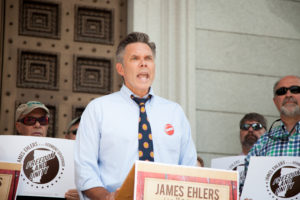
Ehlers sent out a press release on Wednesday calling on both Hallquist and Gov. Phil Scott to stop taking corporate donations and return what they have already received.
“People are sick of politics that result from being paid by corporate interests,” Ehlers said in the statement, pointing to Scott’s opposition of bills during his two years in office that would damage corporate interests.
“When corporations contribute to politicians, they expect a return on investment. This is a fundamentally unjust bargain that no future governor should make,” Ehlers said.
Scott is well ahead in the gubernatorial fundraising race, thanks in no small part to corporate contributions. He had raised $214,000 as of the latest filings due in the middle of the month, ahead of Hallquist with $132,000 and Ehlers with about $50,000.
A number of Scott’s larger donations have come from corporations including Johnson & Johnson, Monsanto, Vermont-based GW Plastics, and pharmaceutical giant Eli Lilly’s political action committee.
Scott’s campaign manager, Brittney Wilson, said the governor did not see any problem with taking corporate money.
“The Governor cannot be bought, but if our Democratic opponents feel like they needs to put protections in place to ensure they’re not, that’s their decision,” she said in an email. “We’re going to continue to follow the campaign finance laws as they are written.”
Progressives led an effort to pass a new law in the last session that would have banned candidates from taking corporate contributions, but it did not make it past the House committee process.
Brenda Siegel and Ethan Sonneborn, the other candidates in the Democratic primary, both said they would not take corporate contributions if they were offered.
Scott’s only competitor in the Republican primary is Keith Stern, a grocery store owner running on a pro-gun rights platform. Stern’s communications director, Rebecca Bailey, said he didn’t have a firm position on the issue.
“Keith has not been approached or received any money from any PACs or corporate donors,” she said via email. “As for accepting from them, we haven’t discussed it since we didn’t see it happening. I think is it safe to say that it would depend on who the PAC or corporate donor is.”
Xander Landen contributed reporting

