


[W]hen a dental clinic opened in January at Southwestern Vermont Medical Center, administrators had no trouble attracting clients.
The Bennington facility is on pace for 6,000 patient visits this year. That’s 20 percent more than expected.
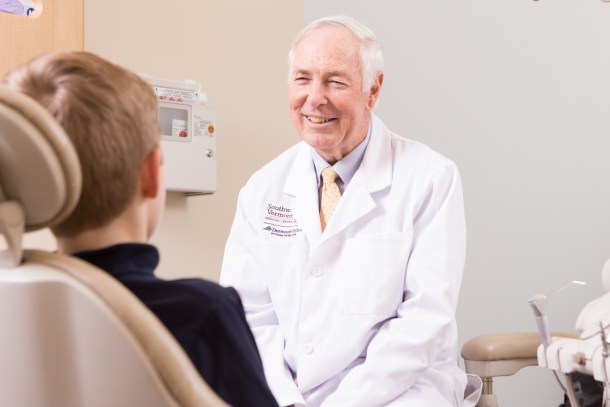
A dentist at the clinic, Dr. Michael Brady, said the hospital “underestimated the demand.”
The need for dental services in the southwest region is emblematic of a statewide problem. Officials and experts say Vermonters are not getting the dental care they need, in part due to a lack of adequate insurance and a lack of access to preventative services in some areas.
There are some changes happening that could make a positive difference. But the pace of change is slow amid what some have called a “silent epidemic” of tooth decay.
“The dental access issue is a very complicated issue, and there are no easy or simple solutions,” said Vaughn Collins, executive director of the Vermont State Dental Society. “Most of the causes are structural and systemic and deal with ability to pay.”
There are some key statistics that tell a troubling story about dental care in Vermont, including:
- A newly released state health assessment says 96 percent of adults and 99 percent of children have health insurance, but only 57 percent of Vermonters maintain “dental insurance that covers routine care.”
- The situation is worse for certain age groups: The assessment says only 30 percent of Vermonters age 65 and older and just 50 percent of of the 25-34 age group has dental insurance.
- Even when Vermonters have dental insurance, many aren’t using it. The state Health Department says only 28 percent of Medicaid-enrolled adults age 21 and older received any dental services in 2017.
- There are big dental-care disparities based on income and educational attainment.
People who live under the federal poverty level have more tooth extractions and visit the dentist less frequently, according to the health assessment. And those who have no college education are more than twice as likely to have had a tooth pulled than those who have a college degree.
Dental care directly related to overall health
Advocates say dental health issues have not gotten the attention they deserve.
Borrowing a term from a 2000 U.S. surgeon general’s report, state Oral Health Director Robin Miller summed up the situation this way: “For so many years, we’ve referred to oral disease as a silent epidemic.”
The reasons behind the problem, Miller and others say, are varied.
On one level, it’s a cultural and social issue because dental health has been perceived as “separate from medical health,” Miller said.
That’s true even among health care policy experts. Elizabeth Cote, director of the Office of Primary Care and the Area Health Education Centers program at University of Vermont’s Larner College of Medicine, said no one discussed dental health, for example, at a recent Green Mountain Care Board meeting during a lengthy discussion about workforce problems.
“I’m concerned at the lack of attention that oral health and dental health gets in these conversations about primary health care. It’s so segmented,” Cote said.
Residents ignore dental care at their own peril, some say. The state health assessment says oral infections have been linked to development of diabetes, heart disease and stroke.
“I think a lot of Vermonters don’t know about the connection between oral health and medical health,” Miller said.
Lack of Medicaid, Medicare coverage exacerbates the problem
Even those who make that connection, however, may face insurance-related barriers to dental care.
Medicare, for example, does not cover any dental services.
And while Medicaid offers dental coverage, there are complications. There is a $510 annual cap on dental care for adults, and that doesn’t go very far if significant procedures are required.
“I’ve heard anecdotally that people will not go (for preventative care) because they want to save that $500 in case they’re in pain,” Miller said.
Dr. Cassandra Coakley, a Montpelier dentist and president-elect of the state dental society, has firsthand experience with that cap. She said there have been discussions about changing state policy so that tooth extractions don’t count against the Medicaid limit.
That “could move a patient out of the vicious cycle of pain and infection,” Coakley said.
The other problem with Medicaid is a low reimbursement rate: Dentists say Medicaid pays only about 50 percent of their costs, so they can’t afford to maintain a high number of Medicaid patients.
The issue is borne out in a 2017 census of Vermont dentists: While 96 percent of primary care dentists said they are accepting new patients, only 60 percent said they would take new Medicaid patients.
The same survey noted that 67 percent of Vermont dentists practice at single-site, privately owned clinics – meaning there is no larger organization to absorb the shortfall in Medicaid reimbursement.
“We’re independent small-business owners,” Coakley said.
Providers unevenly distributed in Vermont
Small business owners are unevenly spread throughout Vermont, leading to another factor in the dental-care debate: There is a lack of adequate dental services in some places.
The 2017 Health Department census found that Vermont has 381 dentists, of whom 313 offer primary care. Both numbers are up from a decade ago.
But the state health assessment shows big differences in where those dentists practice: Some places have more than 4.5 full-time-equivalent dentists per 10,000 people, while others have fewer than 1.5 full-time equivalents.
The “vast majority” of the state’s dentists are in Chittenden County, Miller said.
The dental workforce also is aging, which could exacerbate access issues in the near future. The 2017 census found that 35 percent of Vermont dentists are 60 or older – up from 26 percent in 2007.
Collins said Vermont dentists are the oldest, on average, in the nation. And Coakley, who’s been practicing for two decades, said the problem isn’t new.
“I’ve seen more dentists retire than I’ve seen new dentists come in to replace them,” she said.
The dental society has been working to combat that exodus with a state-supported recruiting effort. Vermont also has a loan-repayment program for dentists, and it emphasizes work in underserved areas.
“I need to bring in probably 10 to 15 dentists per year to maintain a level workforce,” Collins said. “And we’ve been keeping up with that pace.”
A successful recruiting effort is just one of the bright spots that officials point to when discussing the future of dental care in Vermont.
Other reasons for optimism include new funding. The state recently received $728,356 in federal grant money that, over two years, will primarily be invested in new dental-workforce initiatives at three federally qualified health centers – Little Rivers Health Care, Northern Tier Center for Health and Battenkill Valley Health Center.
Another potentially positive workforce development is the pending introduction of dental therapists in Vermont. Those “mid-level” providers, who would work under the general supervision of a dentist, were approved in a 2016 state statute.
While there remains some skepticism about dental therapists, the Health Department is optimistic. “It has potential to impact accessibility and the diversity of the dental care workforce,” Miller said.
At this point, it’s only potential because no dental therapists have been trained. Dr. Cheyanne Warren, who’s directing the dental therapy program for Vermont Technical College, is hoping the school can begin enrolling dental therapy students in 2020.
The big obstacles at this point are accreditation and funding. “The startup costs around dental education are expensive,” Warren said.
Once the program gets under way, there will be room for 10 students initially. It will be a three-year course of study, or 15 months for those who already are dental hygienists.
Dental-care advocates have been looking at other ways to expand services, often in ways that stretch beyond traditional dentist offices.
The expansion of school-based clinics — like the program offered by South Royalton-based HealthHUB — is one example.
The new Southwestern Vermont Medical Center clinic is another example. The facility is focused on an underserved population: So far, Brady said, Medicaid makes up about 65 percent of the clinic’s business.
“The demand comes across the mountain, even – from the Brattleboro area and from Wilmington,” Brady said. He added that, even with 40 years’ experience as a dentist, he “hadn’t understood the adult needs … especially young adults.”
“It was really forward-looking for the hospital to do this,” Brady said.
A short drive to the east, a group of partners including United Way of Windham County and Brattleboro Memorial Hospital are looking into whether they can start a dental clinic catering partly to the Medicaid population.
While nothing is certain, “our goal is by 2020 – let’s hope we can do it before then – to open up a dental center to provide care in Windham County,” said Carmen Derby, the United Way’s executive director.
Derby said the clinic could be located on the hospital’s campus. That would have operational advantages, but it also would underscore the link between dental care and general physical health.
“When we think about individuals having the health care that they need, it’s all-inclusive,” Derby said.
