

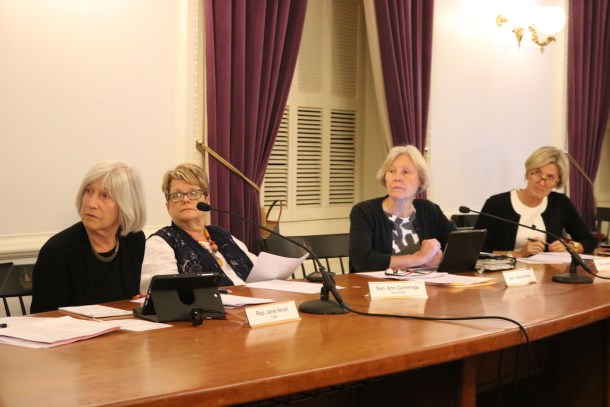
[T]he four chairs of the Legislature’s tax and budget committees informed the governor on Friday that they will not be attending an extraordinary E-board meeting this week, as they are on board with his estimate that an additional $11 million is on the table for negotiations.
The governor invited the chairs to the meeting last week to approve new revenue projections, in what a Democratic senator said was an effort to score political points and increase pressure on them to use some of the revenue to pay down property taxes and avoid a rate increase this year.
“Our position is that we generally concur with your assessment that at least $11,000,000 of additional revenues will come into the State General fund in Fiscal Year 2018,” the letter said, adding that the anticipated excess revenue had already been set aside in H.13, the latest budget bill.
“Because of this anticipatory action our view is that there is no need to meet before the close of year just weeks before the normal July revenue forecast cycle,” the letter said.
The first $12 million in surplus revenue (beyond the initial estimate of $34.5 million) is allocated in fiscal 2019 to offset personal income tax or corporate tax refund liabilities. Additional revenue beyond that will go into the teachers pension fund.
In a response to the committee chairs, Gov. Phil Scott’s secretary of administration, Susanne Young, said the administration did expect additional revenue beyond the agreed upon $11 million, and would keep the lawmakers updated with fresh figures.
“The actual surplus available above and beyond this conservative $11 million figure could very well increase,” Young wrote, adding that the administration would be “monitoring receipts closely” so that economists can offer updated projections.
“This will help inform all of us as we find a resolution to the issues remaining in the Special Session,” she wrote.
Young said that in lieu of the E-board meeting, the governor would be asking the administration’s economist to publicly present the new revenue projections on Tuesday.
The Legislature has now begun its fourth week in a special session called by Scott after he vetoed its initial budget bill, despite broad bipartisan support in both chambers. The distance between the Democratic majority and Scott’s administration has hardly changed.
The governor has promised to veto a second budget bill that was delivered to him on Friday, and the latest version of a related tax bill, which was meant to iron out some of the major differences, has instead moved further away from the governor’s insistence that there be no tax increases on Vermonters this year.
The administration is also frustrated that lawmakers are not embracing proposals to contain education costs in the coming years, either by pressuring districts to lower their staff-to-student ratios or by setting a spending threshold and imposing a penalty tax on districts that budget over a certain amount.
Democratic leaders argue that artificially buying down tax rates this year will only widen the distance between actual tax rates and what taxpayers contribute, setting both sides up for an even worse situation next year.
They have accused Scott of trying to govern on a credit card, and say that local voters should pay for the school budgets they passed on Town Meeting Day. Scott has argued that local voters did not vote to raise taxes when they voted to increase spending on their schools.
The two sides have to reach a deal by the end of the month or there will be no government funding.
