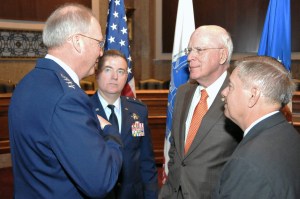
[A]ir Force Secretary Heather Wilson has told federal and local leaders that the Vermont Air National Guard has essentially one viable flying mission — the F-35 fighter jet.
Wilson told Sen. Patrick Leahy, D-Vt., in an interview last month at a Senate Appropriations subcommittee hearing that it was “highly likely” Vermont would lose the Guard base if Burlington doesn’t host the F-35.
Shortly after, Wilson reiterated her position in a letter to Burlington Mayor Miro Weinberger.
“If that decision were to be reversed, the Vermont Air National Guard would likely lose their flying mission upon the retirement of the F-16s,” Wilson wrote to Weinberger. “The Air Force is much smaller than it was at the end of the Cold War. We have fewer bases and fewer aircraft. As a result, some states no longer have flying missions for their National Guard and the competition to secure new missions is fierce.”
The Air Force secretary’s statements reassured longtime supporters of the F-35 who are hoping to close the book on what has been a prolonged and, at times, heated fight. City councils in three populous cities — Winooski, South Burlington and Burlington — near the Vermont National Air Guard base, have passed resolutions requesting that the Air Force reverse its decision to base the fighter jets in Burlington.
The first of 18 stealth jet fighter planes are scheduled to arrive in September 2019.
Wilson’s remarks echoed the contention of state officials that the Green Mountain Boys would lose their flying mission without the fighter jets. Vermont’s most prominent politicians, including the congressional delegation, the mayor of Burlington and Gov. Phil Scott have all been stalwart supporters of F-35 basing.
“The Air Force, the (congressional) delegation and many others repeatedly have warned that the F-16s based in Burlington are nearing the end of their service life, and no new F-16s will be acquired by the Air Force,” said David Carle, a Leahy spokesperson. “When aircraft reach the end of their lifetimes, they are either replaced or the base is closed. That is how the Air Force has always operated.”
But the secretary’s comments were seen in some quarters as a marked shift from past Air Force statements that the Vermont base could stay open without the F-35.
Retired Col. Rosanne Greco of South Burlington, who has been a leader of the opposition to the F-35, said Wilson’s statements were a substantial departure from previous Air Force policy on Burlington — and are the direct result of pressure from Leahy.
“I think the timing of Wilson’s statement is curious, and came because Sen. Leahy most likely — given his track record of direct involvement in the process –- requested the Air Force answer his questions,” Greco said.
As VTDigger has previously reported, Leahy had an outsize role in the basing process, and holds substantial sway over military policy as the ranking member of the Senate Defense Appropriations Subcommittee. In that role, Leahy has a say in the promotion and demotion of Air Force brass. A Pentagon official involved in the basing process told VTDigger that “the Air Force was forced into the Burlington decision” by Leahy.
Greco contends that the agency’s original Environmental Impact Statement made clear that a Vermont air mission would continue — even without the fighter jets. The Air Force said in its 2013 report that “if there is no F-35A operational beddown at Burlington, the current mission would continue.”
New records unearthed by Greco and an anti-F-35 group, Save our Skies, show that the idea that the Air Force would eliminate the Vermont Air Guard were “meritless.”
In one of those documents, a brief issued on behalf of Eric Fanning, the former secretary of the Air Force under Obama, military officials say that “had the Air Force not decided to base the F-35A at Burlington, the present F-16s could well have been replaced with other F-16s. There could have been any number of reasonable alternatives available to the Air Force on how to configure Burlington.”
Air Force lawyers also described predictions made by the Vermont Air Guard that the base would lose its mission without the F-35 as “unfounded speculation.”

On at least four occasions, senior government officials strongly advised against the selection of the Burlington International Airport as an F-35 base because of its proximity to residences, schools and hospitals. The Air Force drafted a Record of Decision selecting McEntire Joint National Guard Base in South Carolina.
In one email, an Air Force official said Burlington was initially given the least favorable score of red in regard to population exposed to plane noise. The official pointed out that the score was curiously upgraded to yellow after the scoresheet had been released to Leahy’s office.
Documents show that other Air Force officials openly expressed alarm as it became clear Burlington would be the likely pick.
“The results of the (environmental review) indicate Burlington is the wrong answer,” one official wrote in September 2013. “Why did the Air Force choose (Burlington) when the (environmental statement) clearly showed more people would be affected by the noise of the F-35?” another official wrote two months later.
Another official involved in completing Burlington’s environmental assessment bluntly told officials, “The EIS team is unable to craft justification language or rationale to continue supporting Burlington as the preferred alternative.”
Federal law requires that each state have a National Guard unit with a mission, so Vermont most likely would never see its unit to close. However, an alternative mission to flying — cybersecurity, for example — could be assigned to the Vermont guard by the Air Force secretary.
Meanwhile, Weinberger and Leahy have accused F-35 opponents of spreading misinformation by arguing that the Guard could fly retrofitted F-16s or cargo planes from Burlington.
While state and local officials in other parts of the country have succeeded in altering military missions, Vermont political leaders and Wilson have said that’s not possible in Vermont. They argue the F-16 is on its last legs and the F-35 is the future. And it’s clear, they say, that there are fewer fighter squadrons today than ever before. In her testimony before Leahy’s subcommittee, Wilson said there currently are only 56 American fighter squadrons, compared to 134 in 1991.
Delays in the development of the F-35 prompted the Air Force to announce in April that it would begin upgrading its F-16 fleet in order to extend the plane’s life through 2040.
Greco and volunteers with Save Our Skies have spent hundreds of hours poring over administrative records for what they say is further evidence that the basing process was improperly shaped by Leahy.
The group’s initial findings were sent to the Defense Department’s inspector general last month as part of a request to investigate senior Vermont Air National Guard members for what the group claimed was interference with an Air Force environmental study and violation of military regulations that ban politicking in uniform.