


[A] company trying to expand cellular telephone coverage in rural Vermont may have suffered a fatal blow with a decision by the state’s largest landline carrier to cut off Vanu CoverageCo’s access to most of its network.
CoverageCo late Friday filed an emergency petition with the state Public Utility Commission asking for an order that Consolidated Communications restore service to about 130 CoverageCo microcell sites, mostly along rural stretches of state highway. The commission agreed to hold a special hearing on Tuesday.
In addition to the restoration of service, CoverageCo asked the commission to issue orders “precluding Consolidated from discontinuing service to (CoverageCo’s) sites absent an order of the commission.”
The service disruption left several parts of the state without the ability of residents and motorists to call 911 in an emergency during the three-day weekend that marks the traditional start to the summer travel season. Included were stretches of U.S. Route 302 in eastern Vermont, and state Routes 100, 107 and 125 in the central Green Mountains, among others.
“The ability of residents and visitors to Vermont to obtain cell coverage in rural areas … is a matter of significant public safety concern in emergency situations requiring the ability to call 911 for help,” said Friday’s filing by CoverageCo lawyer David Mullet.
He added later, “Consolidated’s discontinuation of service leaves thousands of Vermonters, as well as visitors to the state, without access to cell service during the upcoming holiday weekend and beyond.”
Consolidated spokeswoman Angelynne Beaudry said Sunday morning she had no immediate comment, but would look into the matter.
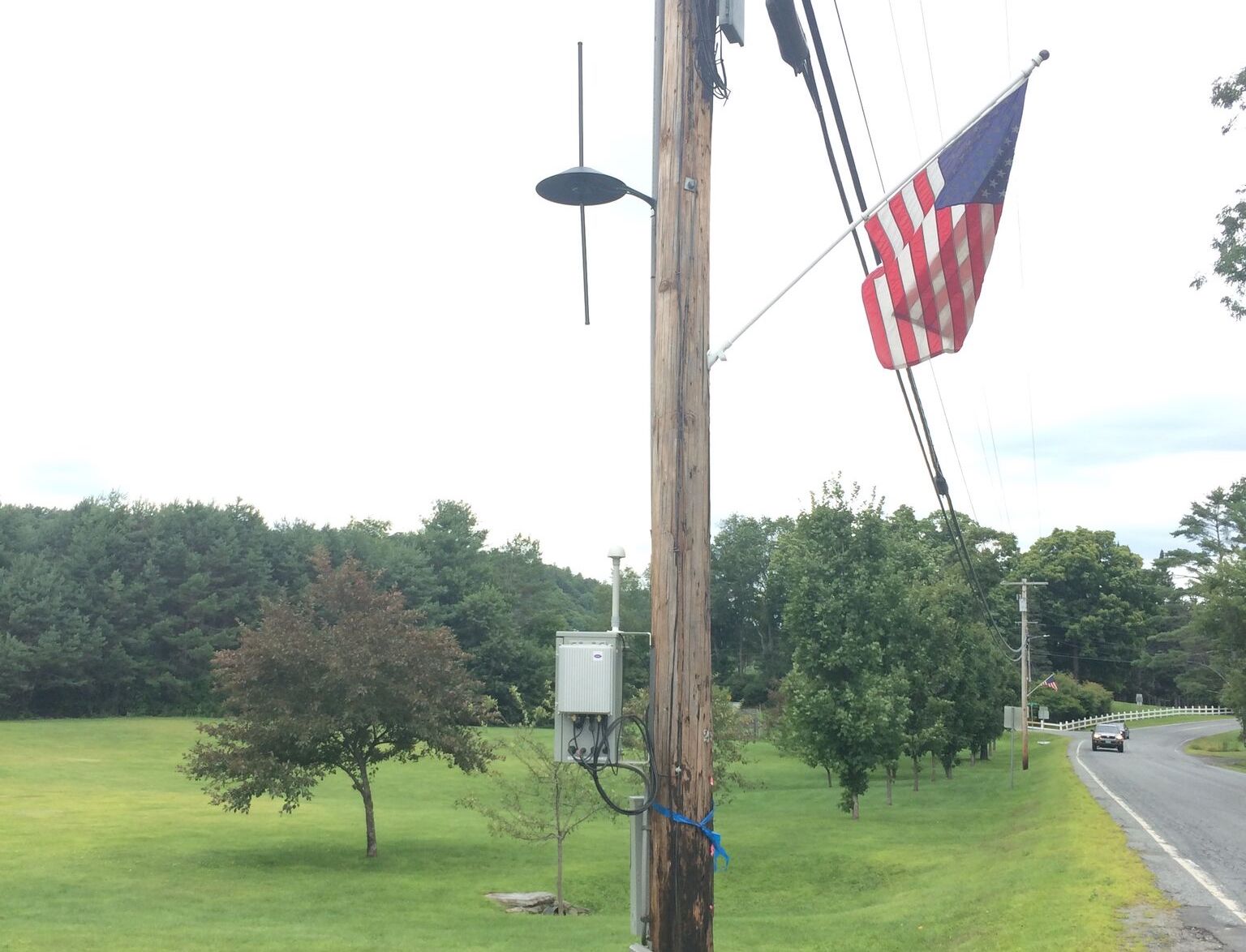
CoverageCo entered into a contract with the now-defunct Vermont Telecommunications Authority in 2012 to provide wireless telephone coverage in previously unserved and underserved areas with the use of short-range microcell technology. Its equipment would be attached to utility poles and other structures along roadways to deliver service to travelers and nearby residents and businesses. It built about 160 such sites before running into financial problems.
As designed, a call would go from a nearby cellphone to the microcell, then to the local landline network, which was taken over last year by Consolidated from FairPoint Communications. The call then would end up — with one big exception — being transferred to the cellular carrier to which the caller subscribed.
CoverageCo ran into financial problems, though. In some instances, its microcells along rural highways simply didn’t see enough traffic to pay their bills for electricity and for connecting to the landline network.
Another problem was that a major cellular carrier, AT&T, declined to sign up for CoveragCo’s service, denying it key revenue, though CoverageCo continued to provide AT&T customers with the ability to call 911. AT&T had resisted connecting with CoverageCo’s system because it relies on older, 2G technology, rather than the 4G technology, state officials have said. The earlier technology allows transmission of voice, texts and emails, but not more data-intensive transmissions like maps and video.
A third problem was that CoverageCo was being required to make payments supporting the state’s enhanced 911 emergency calling system.
Recently, though, CoverageCo’s fortunes appeared to be improving. AT&T agreed to sign on in late April. Lawmakers agreed to reduce or forgive the state’s monthly 911 charges, though with the dispute between the Legislature and Gov. Phil Scott over the state budget, that remains unresolved.
In Friday’s filing, CoverageCo said it had paid its May bill of about $8,275 to Consolidated in time and had offered to pay a June bill for the same amount early. It acknowledged it still had liabilities from past months when it had fallen behind, but said it could work with Consolidated on a plan to address those.
“Nothing in the granting of the requested relief precludes discussion between the parties regarding any past obligations,” Mullet wrote in the petition.
