


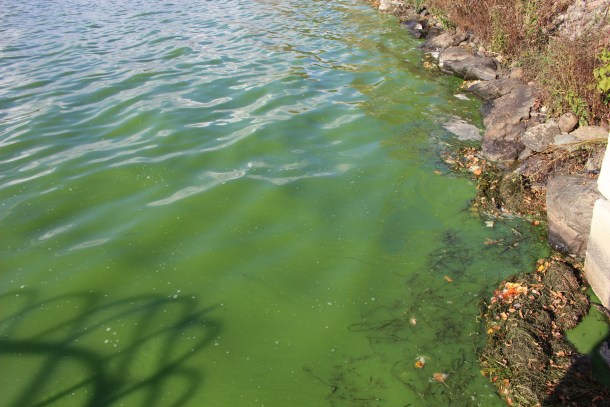
[C]yanobacteria blooms — responsible for what is becoming an annual return of oily green and toxic scum on the surface of Vermont lakes — are expected to become more common as the earth’s atmosphere warms, and according to a recent study the blooms themselves will further accelerate global climate disruption.
Published in the most recent issue of Limnology and Oceanography Letters, the study is the first to look at worldwide greenhouse gas emissions from lakes and reservoirs.
A combined effort by the Université du Québec à Montréal (UQAM), the University of Minnesota and the Environmental Protection Agency, the study focused on the three primary greenhouse gases: carbon dioxide, methane and nitrous oxide.
Previous studies have demonstrated that lakes and reservoirs emit all three gases, through various mechanisms. This study found that methane emissions outstripped by a significant margin that of the other gases.
“This analysis indicates that lentic systems are important sources of [greenhouse gases] driving climate change, but concludes that [methane] emissions may be of disproportionate importance due to their link with lake/impoundment productivity and the high potency of [methane] as a [greenhouse gas],” the study states.
The study found that emissions from lakes and ponds — “impoundments” — are equivalent to a fifth of the carbon dioxide emissions from global use of fossil fuels, and that lake emissions would “rise even further with the continued eutrophication of Earth’s lentic ecosystems.”
As the Earth’s atmosphere continues to warm, this effect will become still more pronounced, according to the study.
There is less methane emitted, but its impact is far greater than carbon dioxide. According to the study, methane’s warming effect on the Earth’s atmosphere is, by mass, between 28 and 34 times that of carbon dioxide.
Methane previously has been shown to be produced by the decomposition of submerged terrestrial plants, such as those submerged in the creation of reservoirs, impounded behind dams. The gas is a product of anaerobic decomposition, which occurs when bacteria break down organic matter in the absence of oxygen.
Cyanobacteria acts in lakes in much the same way as terrestrial flora under water — producing methane gas as a product of subaquatic biological processes breaking down the decomposing microorganisms.
As a result, the study says, cyanobacterial blooms in the world’s lakes and reservoirs are likely to drive up worldwide methane emissions. Those methane emissions in turn will speed the Earth’s warming, and increased warming will accelerate the process of eutrophication.
Methane by itself accounts for 75 percent of the total warming potential of greenhouse gases emitted by lakes and reservoirs, the study says. Carbon dioxide makes up another 23 percent, and nitrous oxide another 2 percent.
Although previous studies have shown a relationship between emissions and chlorophyll content (a proxy for cyanobacteria, according to the study) in lakes and reservoirs, this is the first study to apply those findings to lakes and reservoirs across the globe.
The study suggests lakes and reservoirs contribute substantially more to the warming of the Earth’s atmosphere than previously believed.
“We found that past estimates have been inaccurate and that the effects of aquatic GHG emissions on the atmosphere is nearly 20 percent that of fossil fuel emissions, but will increase as waters become more productive,” the study states.
