



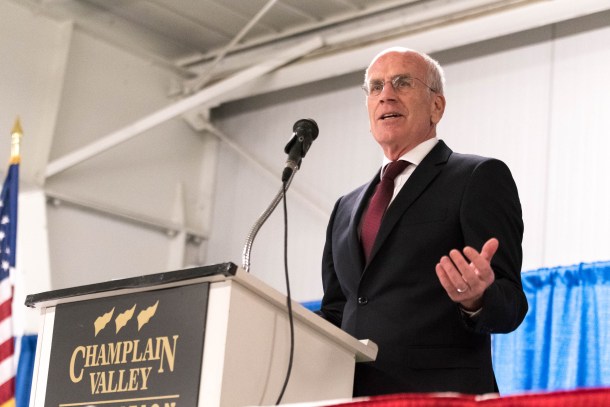
[W]ASHINGTON — Vermont’s congressman, U.S. Rep. Peter Welch, announced on Thursday that he will not vote for the farm bill in the House this week, saying the omnibus agriculture bill, once a model of bipartisan cooperation, has been hijacked by political interests.
“It’s a huge disappointment and a total abdication of our commitment to rural America,” Welch said of the farm bill.
The farm bill reauthorizes federal agriculture programs every four years. The legislation is expansive, affecting large- and small-scale agricultural producers, environmental initiatives, food security systems and more.
The legislation arrived on the House floor this week under a cloud of partisan division, with Democrats resolutely opposed to it.
A bid by some in the Republican caucus to attach a controversial immigration measure threatened to derail the bill completely, casting into doubt whether House leadership could secure the votes to pass it.
Most irksome to Democrats, including Welch, is a provision in the bill that would impose work requirements on recipients of the Supplemental Nutrition Assistance Program, known as SNAP or food stamps.
“We are going to pay for this so-called work requirement by taking money away from nutrition, paying bureaucrats and giving them the impossible job of putting people who are not able to work into jobs that don’t exist,” Welch said on the House floor. “Talk about cynical. That’s what this bill is.”
Those in favor of the provision argue that it will help propel people into the workforce.
The measure is unlikely to go anywhere in the Senate, where Democrats have sufficient power to block such a provision from advancing. The Senate is expected to work on its own version of the legislation later this month.
Welch said Thursday the SNAP change is just one reason why he will not vote for the bill, which historically has enjoyed support on both sides of the aisle.
Welch asserted that by pushing for the inclusion of changes to the benefit program, House Speaker Paul Ryan sabotaged negotiations on other provisions in the legislation.
“It really compromised the deliberations of the farm bill,” he said.
He said he found a number of other provisions in the legislation equally unpalatable.
The proposed bill cuts funding from a program that helps farmers make energy investments, which has been used by some Vermont farmers to purchase equipment like reverse osmosis systems for maple sugaring operations.
It also cuts funding for the Conservation Stewardship Program, which helps with land resource management.
Another area of concern for Welch is the part of the bill addressing organic agriculture, which he said could be undercut by the legislation.
Some in Vermont say there are provisions in the farm bill that are potentially advantageous to the state’s farmers.
Joe Tisbert, president of the Vermont Farm Bureau, said the legislation does include improvements in the Margin Protection Program, a milk price insurance program that promises to be an important source of support for dairy farmers. Dairies in Vermont have been struggling recently amid high feed costs and historically low milk prices.
Legislation passed by Congress earlier this year made some changes to make the program more inclusive and affordable. Tisbert said the proposals in the House bill would go further.
While acknowledging the more controversial aspects of the bill, Tisbert said the price support programs in the bill would be important to agriculture and the food system more broadly.
“Unfortunately the state of Washington right now is very partisan, and that always bothers us,” he said.
He said he is optimistic that Congress will advance legislation.
“The farm bill’s very important across the board and to have it just kind of float around there would not be good,” he said.
Vermont Agriculture Secretary Anson Tebbetts said the bill “builds on” programs to support dairy farmers. In addition to reducing barriers for farmers to get access to the Margin Protection Program, the legislation also would allow farmers to participate in multiple support programs under some circumstances.
Tebbetts said the bill includes provisions that would support farmers in undertaking conservation efforts on their land, including promoting access to nutrient recovery technologies.
Welch acknowledged that the legislation the House is considering this week does make changes to the program, but he said they fall short of addressing the problems facing farmers.
“In fact, while this an improvement over the current Margin Protection Program, what I’ve been hearing from farmers is they don’t have confidence in the current Margin Protection Program,” he said.
