


[T]he legislative session looks all but certain to stretch into next week, but when it eventually wraps up it likely will be without an education spending deal between legislators and Gov. Phil Scott.
The Scott administration has whittled its controversial staff-to-student ratio plan down to a task force that will work with individual districts to voluntarily reduce staffing, and a previously divisive statewide teacher health care benefit now has buy-in from all sides.
But the governor’s proposal to use $58 million in one-time funding to prevent an increase in property taxes next year has gained no popularity in the week since it was pitched, and looks likely to prevent any spending deal from taking shape before the session ends.
Few in the Legislature were willing to say on the record that they would be back next week, extending the session. However, House Minority Leader Don Turner, R-Milton, did not mince words at a GOP caucus.
“I’m going to say no way in hell to Saturday,” he said of the suggestion that legislators would come to work over the weekend. “We are not going to be done.”
Legislative leaders and the governor said they have not even been trying to reach a deal this week, although members of the administration have appeared at a few committee meetings at the Statehouse.
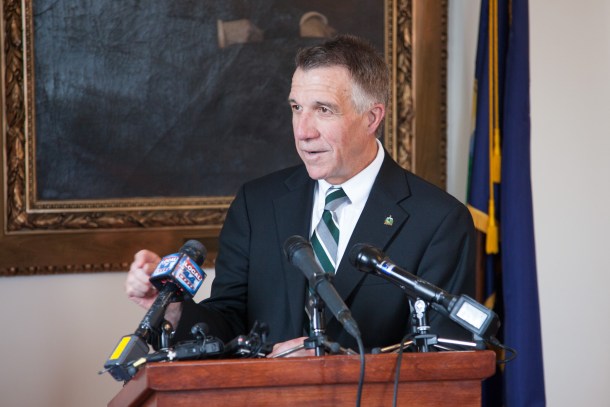
A bicameral conference committee spent Thursday afternoon hammering out a final legislative tax proposal as the governor held a press conference to say that he was dead set against any budget that includes any increase in property taxes, which it almost certainly will.
“This is no secret,” Scott said of his intention to veto anything with a new tax or fee. “So I’m a little bit surprised that they take such offense at the end to my saying that we’re not gonna raise taxes and fees. Now, we can talk about how we get there.”
Once the House and Senate come to an agreement on the major tax bill, H.911, they will still need to send it to the floor in each chamber for a vote. The same process must be completed to the budget, or the “big bill,” H.924, before they head home for the session.
And that’s assuming that legislative leaders are serious about leaving before striking a deal with the governor.
At the heart of the disagreement is Scott’s insistence that almost all of the unallocated money in the general fund go toward his plan to “revitalize” the education fund by pouring $58 million into it now, and paying that back over five years with various savings measures.
Democratic legislators say there are far better ways to spend the money, such as paying off pension liabilities and making improvements in areas like child care, services for disabled people and mental health treatment.
Scott said he was willing to compromise, but only within the general framework of his plan to spend less and save more on education. He said he was flexible on the length of the plan, for example. The current plan lays out a five-year roadmap.
The Joint Fiscal Office put out a scathing review of the governor’s spending and saving plan earlier this week, saying that savings projections of $300 million over five years were off by $100 million to $160 million. Scott said even with the most pessimistic projection the plan was worth doing.
When it comes to filling the $58 million hole in the education fund, Scott said increasing property taxes was simply not an option, rejecting the argument that voters agreed to pay that increase when they approved higher school budgets at Town Meeting Day.
“I fundamentally don’t agree,” Scott said. ”I’m not convinced that when they go into the booth that they’re contemplating having to pay a 7-8-9 cent rise in their estate property taxes. I don’t believe that.”
Scott said that both Speaker of the House Mitzi Johnson, D-South Hero, and Senate President Pro Tem Tim Ashe, D/P-Chittenden, had cancelled their meetings with him this week. He said he was open to rescheduling.
Johnson said she wants any negotiations to take place with the conference committee, but that the administration had not placed any commissioners into the conversation.
The speaker said she has been talking to both Ashe and Minority Leader Don Turner, R-Milton, but did not want to get ahead of the conference committee on policy negotiations.
Both Johnson, Ashe and other legislative leaders said a proposed law drafted by the administration was submitted far too late to be taken seriously.
“This is great, it should have been here Jan. 10,” said House Education Committee Chair Rep. David Sharpe, D-Bristol.
Johnson said the number that concerned her most was on the top of the first page: the date, May 9. Ashe said he hadn’t even seen the proposal yet.
Turner, the minority leader, started shopping a proposal on Thursday that he said could avoid a veto of the tax and budget bills.

That proposal would eliminate a broadly unpopular income surcharge from the tax bill, which was initially created to prevent a property tax increase. Instead, it would include enough one-time money to achieve stable taxes without that surcharge.
Beyond that, it is mostly a combination of ideas from the Scott proposal and cost-containment measures that have been part of legislative discussions, such as unpopular spending caps that were in Act 46 that penalized communities that spend above a certain amount on schools.
The governor’s plan would set an excess spending threshold of 119 percent of per pupil spending starting in fiscal 2020, which would tighten each year until 2024, when it would reach 110 percent.
Scott’s proposal also folds in major special education reforms developed in the legislature this session, and a statewide teacher health care benefit that he pushed hard last year to no avail.
A compromise on that statewide benefit is currently written was finalized in the Senate Education Committee on Thursday with backing from the Vermont NEA and the Vermont School Boards Association.
It would shift the negotiations on teacher health care from the local to state level, a move the administration believes will save tens of millions of dollars in the coming years.
Sen. Philip Baruth, D/P-Chittenden and chair of the education committee, said the related bills will sit in a folder on his desk as long as Scott plans to veto the budget and tax bills.
“No matter what we give him now, he plans to veto, so it doesn’t make sense to give him things he will sign and take off the table and ask for other things,” Baruth said.
Scott said during his press conference he wasn’t ready to make concessions until the Legislature started passing some of the bills that would create savings. “What have they passed,” he asked repeatedly when asked about finding middle ground.
The administration quickly backed down from its proposal to set a staff-to-student ratio, though it is still claiming $74 million in savings simply by creating a committee that facilitates staff reductions on a district-by-district basis.
Ashe, the Senate president, has said he has so little hope in reaching a compromise with Scott that he was not even going to bother scheduling a veto session to work out their differences.
Scott said on Thursday that legislators would be back this summer regardless.
“They can do what they want. If they decide not to have a veto session, I’ll call a special session,” he said. “It doesn’t matter to me.”
CORRECTION: A previous version of this story mistakenly stated that the Vermont Education Health Initiative and education organizations backed a bill titled H.858. They were part of a separate compromise on a statewide health care benefit, and VEHI and the unions are still at odds over a small piece of the deal.
