


Editor’s note: This article by Matt Hongoltz-Hetling was published by the Valley News on May 3.
ORANGE — Even as they expressed cautious optimism that Vermont’s latest invasive beetle is confined today to four towns, state and federal wildlife officials are feeling pressure to make a decision about quarantines that could have a major impact on Windsor County’s valuable stock of ash trees.
In March, teams of state and federal staffers documented Vermont’s first-known infestation of the emerald ash borer in four communities spanning three counties — Groton in Caledonia County; Barre and Plainfield in Washington County; and Orange in Orange County.
Now, two options are on the table as the pests threaten to emerge in a cool late spring: either a three-county quarantine or a statewide quarantine, each with different potential impacts on loggers and the public at large.
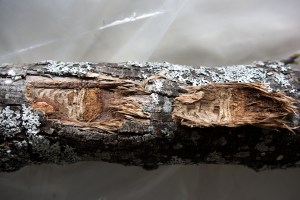
State entomologist Judy Rosovsky said on Wednesday that the destructive bugs, which have been found in 32 states, do most of their damage as larvae. While living beneath the bark, the larvae girdle their ash tree hosts, typically killing them in three to five years.
But the region is rapidly approaching the time when the fully developed ash borers emerge and take flight. The airborne adults can leapfrog from tree to tree, expanding the population’s range naturally by about one to two miles per year.
“We say flight season starts May 1. But it’s been cold,” Rosovsky said. “They probably won’t start emerging for another couple of weeks.”
After more than a month, scientists have completed a delineation survey intended to help identify the boundaries of the ash borer by walking the edges of known infested areas, as well as running down reports of public sightings made by phone and through the state website vtinvasives.org.
While the presence of the ash borer truly can’t be ruled out anywhere, Rosovsky said, the known infested area is confined to a single contiguous block across three Vermont counties. It is about five miles long from east to west, and three miles north to south, she said.
Because humans carrying infested wood unwittingly can spread the pest, officials are eager to get a quarantine in place before the adults show themselves.
One option is the three-county quarantine, which would make the movement of ash trees out of those counties more difficult for loggers. It also would add a layer of protection to ash trees in Windsor County and other Vermont counties that fall outside of the existing area of infestation.
The second option, a statewide quarantine, would allow for ash wood to be transported freely throughout the state and across state lines into neighboring statewide quarantine zones in New York and Massachusetts. That would make things easier for loggers in infested areas, but could hasten the spread of the ash borer throughout Vermont.
“In either one, there’s going to be economic loss for someone,” Rosovsky said.
Under state statute, the decision ultimately falls on the shoulders of two men, Vermont Secretary of Agriculture Anson Tebbetts and Commissioner Michael Snyder of the Department of Forests, Parks, and Recreation. But they likely will base their decisions on the recommendations of the Forest Pest Advisory Committee, which has representation from their agencies, the Vermont Agency of Natural Resources and the federal USDA Animal and Plant Health and Inspection Service.
That committee of nine met for two-and-a-half hours in Berlin, on Wednesday morning, discussing the pros and cons of the two types of quarantines, according to Rosovsky. It is up to the committee to advise Tebbetts and Snyder on possible next steps.
New Hampshire, which discovered the emerald ash borer several years ago, has quarantined by county in an effort to protect their ash trees, much of which are concentrated in Grafton County, where the insect has not been detected.
“If we (quarantined county by county), we would be trying to protect our southern ash, mainly in Windsor County,” Rosovsky said.
A statewide quarantine could be implemented with voluntary agreements from loggers to use best practices (such as using enclosed trucks) when transporting ash out of quarantined areas and through the rest of Vermont, she said.
Prized as the raw material for things such as furniture, bats and bows, ash trees are more prevalent in the county’s forests than in other areas of the state, according to Windsor County Forester A.J. Follensbee.
“It’s a pretty important tree,” he said on Wednesday.
Throughout the county, ash makes up about 7 percent of the total tree count, and in some areas, it comprises as much as 30 percent of harvestable stands.
“It’s valuable,” said Follensbee, in part because the emerald ash borer has significantly reduced the supply, driving up the market value of the wood. Loggers and foresters alike have expressed concern about the presence of the ash borer, and how a quarantine might impact their decisions. Follensbee said he’s received a flurry of calls from landowners who have found sickly looking ash trees on their property and expressed concern that it might be the ash borer.
“That’s good,” he said, noting that he has yet to document an infested ash in Windsor County. “We want to get those calls.”
Though Follensbee said a county-by-county quarantine does save Windsor and some other counties from exposure to the ash borer, he expressed confidence in the ability of officials to make the best decision for the state.
He said he expected that ash trees in the northern parts of Windsor County might have to be harvested within the next five to 10 years, while those in the southern parts have more time — unless humans accelerate the spread with infested firewood or cut ash.
Another factor that could depress the price of ash trees is a recent decision by China, which buys a lot of New England’s wood, to require U.S.-sourced wood to be debarked and fumigated.
“That presents problems, particularly to the ash industry,” said Rosovsky, in part because the quality of ash deteriorates as it dries out, and in part because there are only a couple of fumigation facilities in the Northeast.
A decision about which type of quarantine to implement is expected to be made sometime next week.
