

The House panel voted 6-5 to advance the bill. Now it goes to a vote on the House floor Thursday.
The legislation, which has been drafted over the course of two weeks, would change more than a century of case law around criminal attempts.
It would lower the threshold for what constitutes an attempt by allowing prosecutors to apply a “substantial step analysis” as opposed to proving an overt act as is currently required.
Read S.267 here.
The steps include: lying in wait, enticing a victim, casing out a site for the crime, collecting materials to be used to commit the crime, and engaging an accomplice.
Under the S.267, courts could hand down a life sentence for an attempted violent crime. Judges are allowed to hold suspects without bail.
As it stands, some lawmakers and prosecutors have argued, a would-be school shooter would have to be walking toward a school with a loaded gun in order for it to qualify as an attempt under current law.
“I think that we’ve managed to pass out a bill that addresses the underlying issues that we are trying to address,” said Rep. Martin LaLonde, D-South Burlington, who is reporting the bill to the full House.
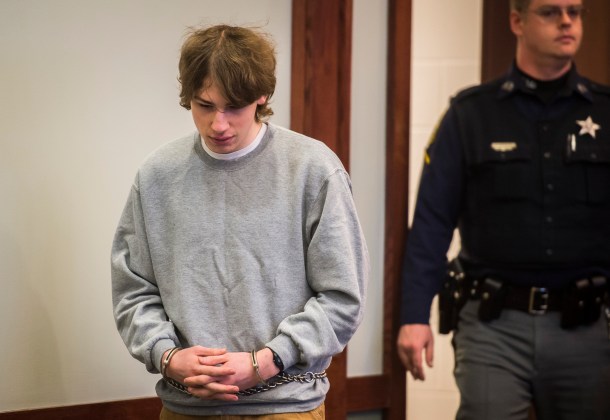
The Vermont Supreme Court decided on April 11 that the attempt charges against Jack Sawyer, 18, who was arrested for allegedly plotting an attack on Fair Haven Union High School, were not legally applicable to his actions. The court ruling encouraged the Legislature to revisit the criminal attempt laws.
Prosecutors have since dropped those felony charges, including attempted aggravated murder, and have brought two new misdemeanor charges. He now faces up to three years in prison, as opposed to life in prison under initial charges. He is now being held on $10,000 bail.
Just two days after the Supreme Court decision, Gov. Phil Scott asked the Legislature to pass new bills addressing the attempt issue within a week. Lawmakers have said the governor’s timeline was too short, but most agree that a change was in order.
Among those who opposed the new attempt language was Rep. Janssen Willhoit, R-St. Johnsbury, who is on the Judiciary Committee and works as a public defender.
“We were asking the wrong question,” Willhoit said after voting against the bill. Rather than look at why the attempt laws did not apply to Jack Sawyer, the committee should have been asking how the case could have been dealt with differently to reach a more satisfactory outcome, he said.
“With an isolated case and trying to figure out how to fix this, we have now created potentially an unbelievably broad attempt statute that has a much lesser threshold for attempt,” Willhoit said.
He took particular exception to the potential of a life sentence for attempting violent crimes. Under S.267, judges also have the discretion to hold suspects without bail.
LaLonde said reviewing past sentencing decisions showed that judges rarely applied maximum penalties in sentencing, and that he trusted the court’s discretion to only use severe penalties when appropriate given the facts at hand.
“I do understand there may be some consequences that we’d rather not have happen, but we have to see whether there’s going to be overcharging of attempt, if this gets through the process,” LaLonde said.
Judge Brian Grearson, the chief superior court judge, told the committee on Wednesday that regardless of how an attempt conviction came about, judges would look at the same factors when it came to deciding on sentencing.
“When we talk about attempt, or preparation or substantial steps, I think each case again is going to be more individualized in how far that person got, and how was the consummated offense prevented, what interrupted it, could be extremely important in the severity of the sentencing imposed,” he said.
Rep. Thomas Burditt, R-West Rutland, said he voted against the bill because of the risk of overcharging, and because the speed of the process.
“It’s going too fast, not that we don’t need something,” Burditt said. A separate domestic terrorism bill seemed like a more narrowly targeted response to the problems exposed by Sawyer’s case, he said.
“If we took the time things could be researched, you know witnesses and maybe those unintended consequences could be avoided,” Burditt said of the attempt law.
LaLonde said the committee had conducted a thorough process in drafting the law. During a few days of testimony, the committee had “heard from the people you need to hear from … and really thought about the different issues.”
“The bottom line is, I don’t think we’re just responding to one case,” he said. “Recent events were kind of like a flash of lightning that illuminated the legal landscape. And we’ve been able to see the holes in our laws and places where we have deficiencies.”
Redefining attempt
The biggest change in the new law is the introduction of “substantial step” to the definition of an attempt. In previous case law, attempt has been defined in Vermont through an overt act toward committing a crime.
The meaning of this has been illustrated by the arguments and decisions in Sawyer’s case, which have almost always cited a century-old case, State v. Hurley, in which a prisoner obtained the tools to saw out his prison cell, but was cleared of attempt charges because he never actually began sawing the bars.
In the case of Sawyer, the high court said that actions such as purchasing a shotgun and writing his alleged plans in a journal did not amount to an attempt.
Prosecutors who testified to the House Judiciary Committee illustrated the new legal standard by describing a span stretching from when someone conceives of a crime to when it is carried out. The new law allows police to intervene earlier in the development of a crime and makes it easier to prosecute an attempt.
Substantial steps, according to the new law, could include lying in wait for a victim, enticing the victim to the scene of an intended crime, scouting out the scene of a planned crime, unlawfully entering a place contemplated for the crime or soliciting an “innocent agent” to carry out part of the intended crime.
The step could also be possessing materials to be used in the crime — if they are specially designed for the crime or serve no other lawful purpose — or possessing, collecting or fabricating materials to be used in the crime near the contemplated scene, again with the caveat that there is no other lawful purpose for it.
If a defendant is found to have taken a substantial step toward committing a crime, they may show their innocence by proving that they abandoned their criminal effort in a “complete and voluntary” manner. If a suspect abandons the criminal action because of external factors — because someone else is watching or because police are approaching, for example — they can still be found to have committed an attempt.
In cases where the defendant is charged with attempting a “serious violent felony” — which includes murder, kidnapping, sexual assault and human trafficking — they may be sentenced up to the penalty for actually committing that offense. In the case of aggravated murder, that means a life sentence.
Lawmakers had considered dropping that sentence, but kept the possibility of life because of a constitutional provision that only allows defendants to be held without bail in cases in which they are charged with crimes that carry a potential life sentence, or if they committed a violent act and pose a danger upon release.
Vermont General Defender Matt Valerio said he could recall only two other examples in the past two decades where politicians rushed to change laws based on one case: new anti-terrorism laws passed after the September 11, 2001 attacks on the World Trade Center and new sex statutes written in 2008 after 12-year-old Brooke Bennett was raped and murdered by her uncle, Michael Jacques.
“I think it’s something we should avoid, changing the law based on one case,” he said.
