

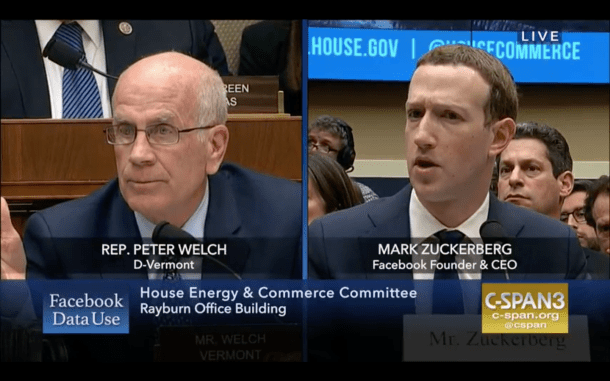
[W]ASHINGTON — When Facebook CEO Mark Zuckerberg appeared before a U.S. House panel Wednesday, Rep. Peter Welch, D-Vt., took a moment to turn the focus on lawmakers.
Zuckerberg, he said, acknowledged that Facebook made a mistake, and he has vowed to make changes to protect users’ privacy.
The apology wasn’t enough for Welch. “We’re at the point where the action will speak much louder than the words,” he said, addressing Zuckerberg.
Then Welch said that policymakers also bear some of the responsibility for failing to prevent situations online that end up compromising individuals’ personal information.
“This Congress has made a mistake,” Welch said. “This was foreseeable and inevitable, and we did nothing about it.”
Welch made his comments during Zuckerberg’s appearance before the House Energy and Commerce Committee. It was the Facebook CEO’s second day of public meetings on Capitol Hill this week.
Zuckerberg reiterated some of the points he made at a joint Senate committee hearing Tuesday, saying again that the company did not do enough to protect users’ data.
Under questioning from the committee, Zuckerberg repeatedly outlined some of the steps the company already has taken to improve privacy policies, along with efforts the company has made to moderate hate speech and fake accounts on the platform.

During the House hearing, some lawmakers focused on extracting details from Zuckerberg about how the company functions currently. One member pushed Zuckerberg to admit the company collects data on people who do not use Facebook.
Meanwhile, several other panel members asked the CEO about how the company moderates politically conservative content, raising concerns that people who have posted items supporting Trump or other conservative topics have been flagged.
When Welch got his turn to grill Zuckerberg, he rattled off a series of rapid-fire questions to see whether there is “common ground” on the company’s responsibility to protect users.
Zuckerberg agreed that consumers should be able to control their personal information and restrict with whom it is shared. Asked if consumers should be allowed to correct or delete information companies have about them, he said that area “might be more interesting to debate.”
When Welch suggested that a governmental agency should regularly define what constitutes personal information, Zuckerberg said he believed there should be a discussion about “some sort of oversight.”
“I think this is an area where some regulation makes sense. You proposed a very specific thing and I think the details matter,” Zuckerberg said.
It has been tricky for lawmakers to determine what the federal government’s role should be in regulating internet protections, Welch noted. He co-led a working group on online privacy rights in 2013 with Rep. Marsha Blackburn, R-Tenn., which heard from major tech companies including Google and Yahoo.
The group did not come to any consensus, he said. Some members objected to regulations because they believed they would stifle online businesses.
After the hearing, Welch said he felt Zuckerberg had effectively countered critics of regulation who say government involvement would chill innovation.
“He pretty much acknowledged there is a role for government,” Welch said.
Rob Williams, a professor of communications and media at the University of Vermont, said the country is at “a critical moment” regarding social media.
“It’s an interesting situation because anybody who understands the basics of Facebook’s business model knows that Facebook is in the business of harvesting our data to package it for profit,” Williams said.
The revelations about Cambridge Analytica have struck a chord with the public, Williams said, because they illustrate how freely third parties can gain access to personal information.
The hearings on Capitol Hill this week are a sign that attitudes toward privacy protections on social media companies are shifting, he said.
“This conversation is not about Mark Zuckerberg,” Williams said. “It’s about the future of social media as we know it.”
