


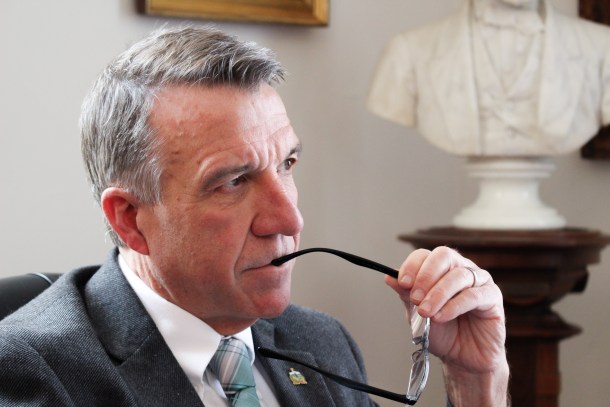
Gov. Phil Scott has stuck to his word on no new taxes or fees, to the frustration of lawmakers and lobbyists pushing bills with even the slightest scent of new costs to taxpayers.
But a senior administration official indicated on Friday that the governor might adopt a more flexible position when lawmakers return to Montpelier next year — after the upcoming gubernatorial election.
Asked whether the governor would “consider taxes and fees if he wins another term,” his spokesperson said: “The Governor will hold the line on taxes and fees for as long as he feels it’s the right thing to do for Vermonters.”
Administration Secretary Suzanne Young was invited by the House Committee on Natural Resources on Friday afternoon to speak about a clean water bill that the administration opposes, at least in part, because it contains a directive for a new fee.
Young told senators that if the economy were to continue to grow — there was $37 million in additional state revenue last year — and if there were no new taxes, the administration might reconsider its stance on revenue, and possibly agree next year to new fees for clean water efforts.
“If we can achieve the same goal this year we would expect more organic growth because we are improving our economic engine by giving taxpayers some relief from property taxes and income taxes,” she said. “If we achieve that goal next year we should be able to look at our revenues.”
Young said the administration would being working “in earnest” next year to identify a long-term revenue source for cleaning up Vermont’s lakes; the Environmental Protection Agency has given a deadline of mid-2019 for that decision.
“So it’s not a commitment to any particular idea that’s been put out to date, it’s not necessarily a per-parcel fee, but maybe it is,” Young said.
Scott has shrugged off criticism from his political opponents, and even prominent Vermont CEOs, that he should be more open to strategic investment in future growth through fees and taxes. He says voters facing some of the highest taxes in the country care more about keeping their earnings.
The administration also appears open to a new tax on electric transportation, proposed in a bill this year, though again, not this session. Scott’s chief of staff, Jason Gibbs, said on Thursday that Vermont needs to reckon with the shift to electrified transportation, and come up with a way to make up lost gas tax revenue.
“It is reasonable to ask the drivers of electric vehicles to pay their fair share for maintenance of roads and bridges, but we’re not going to support the creation of a new tax or fee in this legislative session,” Gibbs said.
As the governor gears up for campaigning, ahead of the August primary and November election, Gibbs said voters — even those who might have been disappointed by his support for new gun laws — would still appreciate his work keeping down the cost of living.
“An overwhelming majority of Vermonters…will recognize that Phil Scott is somebody who, for the first time that we can find anywhere on record, insisted that the Legislature pass a budget with no new taxes or fees, not once but twice,” Gibbs said.
Rebecca Kelly, Scott’s spokesperson, said Scott would continue to pursue pro-growth initiatives funded by existing resources, and clean water is no exception.
“While the Legislative majority’s first instinct always seems to be to establish a new tax on Vermonters, the Governor’s priority is to identify a long-term funding source without a new tax or fee,” she said.
