

Editor’s note: This commentary is by Scott Thompson, who represents Calais on the board of U-32 Middle and High School, though the views here are his own.
With education yet again in the crosshairs during this legislative session, we are hearing all about the urgent need for state intervention to contain costs. So how solid are a few test pillars of the state’s case?
Myth #1: Education property taxes are growing faster than Vermonters’ wages.

Over the past 10 years, and allowing for the havoc of the Great Recession, federal data show our education property tax increasing at roughly the same rate as total wages and salaries in Vermont.
Many influential people believe that our education system ought to be following a consumer business model, in which fewer customers (students) should cost less to service (educate). But reality does not always do us the courtesy of conforming to our wishes.
Data going back at least to the 1990s, collected by the Public Assets Institute among others, indicate that a social priority model is more likely to be at work here. As if guided by instinct, we seem naturally to allocate a consistent percentage of the economy to education: society’s primary means of self-renewal.
Just as we do not automatically cut police budgets when fewer crimes are committed, we tend to maintain a steady rate of education spending even if student numbers are in decline. This happens not because of any policy directive, but as though an invisible hand were coordinating hundreds of independent decisions that are separately tailored to local realities.
Education property tax is not growing faster than Vermonters’ wages and salaries in the aggregate. It is true, however, that many individual Vermonters are seeing their personal tax bills increase faster than their wages. This is a serious problem — but it concerns fairness in distributing the tax burden, not the tax burden itself. The Legislature recognizes the problem, and I wish our legislators success in setting it right.
You, dear reader, may legitimately feel that we are paying too much for public education. You may advocate different methods to fund it. These and other points of view are eminently worthy of consideration in depth. But no one may claim as fact that school spending is unsustainable in our economy.
Myth #2: Income-sensitized voters with too little ‘skin in the game’ are irresponsibly driving up school budgets.
The 2014 Picus report (p. 7) gives this tale both its standard formulation and a gentle debunking: “there is little evidence … that low-wealth districts … choose to become high-spending districts.”
The Federal Reserve’s 2016 Survey of Consumer Finances, whose data on components of wealth are beautifully rendered in graphic form at Visual Capitalist, undercuts any lingering plausibility the idea might have had. Taxpayers at the lower end of the net worth spectrum have plenty of skin in the education tax game, even if they are income-sensitized — far more skin, it turns out, than the very wealthy.
Moreover, how strange it is to fear that less wealthy voters will gang up to hijack the process and tax both themselves and the better-off for the public good. Stranger still is the notion that the state must force these voters back in line by inflicting fiscal pain as punishment for having the temerity to support a decent school budget.
“It’s time for state policymakers to take over,” we are told, evidently because town democracy, while committed to frugality, has not yet buckled under pressure to join the state cult of austerity. Is it not reason instead for pride that town democracy has so far refused to give up on solidarity amidst the messy, difficult human reality we share?
Myth #3: Cutting education budgets is the key to making Vermont affordable.
The governor acknowledges that other costs besides taxes make it harder for many Vermonters to get ahead. “As a matter of principle,” he says, “I don’t believe any of these costs should be growing faster than wages.”
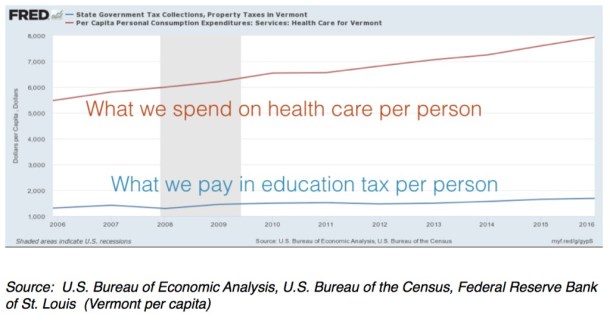
Education taxes may not be growing faster than total wages and salaries in Vermont, but health care costs sure are. And health care costs already amount to four or five times the education tax total.
Let’s imagine that state policymakers do take over and decree a rise in student-staff ratios from 4:1 to 5:1 over five years, as the governor suggests. School budgets are ultimately cut by 20 percent, some 3,000 school jobs are eliminated, taxes go down by 20 percent, and happy days are here again.
Or are they? In each of those five years, the projected increase in health care costs alone will more than eat up the savings to Vermont’s economy from a year of school budget cuts. What will we have accomplished then, except to show beyond any doubt that school spending was never the real problem in the first place?
State government is good at counting stuff, especially money. Keeping track of money is vitally important, but in isolation it is also profoundly cynical — in Wilde’s sense of knowing the price of everything and the value of nothing.
Still the outlook is not entirely hopeless. As an example of what government is potentially capable of doing, the governor in his budget speech floated a proposal for school-based dental care, a visionary plan that takes account of the realities of health, social class, school, and life as we live it.
How about for starters we hear more from whoever it was that came up with this idea? Let the voice of our messy, difficult, wondrous human reality ring out louder in state policymaking, and we will stand a better chance of truly improving our lot.
