

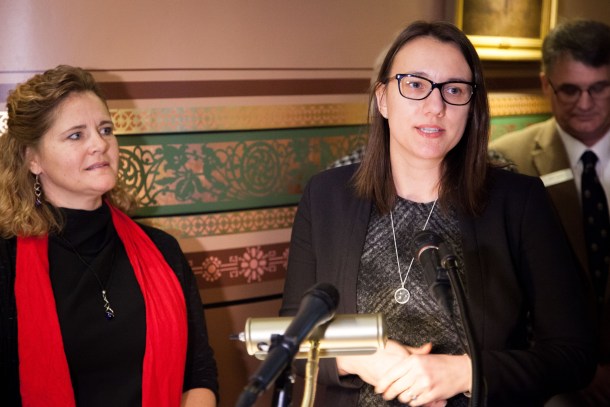
[R]ep. Susan Buckholz, D-Windsor, remembers going to the grocery store with her mother, and how her mother would cry from the stress of trying to figure out how she was going to afford to pay for Buchholz and her seven siblings to eat.
Buckholz said the memory has shaped her and the way she looks at wages.
“The miracle was she always did it,” Buckholz told a press conference in the Statehouse on Tuesday. “But that put a fear in me stayed for a long time, to know that it was possible.”
Buckholz and 15 other Vermont lawmakers are choosing to live on minimum wage this week in a campaign organized in part by the group Rights & Democracy to highlight the financial hardships of living on the wage.
The challenge started on Tuesday. Each participant has been given between $147 and $274 to last one week — the amount varies according to whether they are single, married or have a roommate. The money will have to pay for food, transportation, child care, debts, medical expenses and entertainment. The amounts reflect the take-home pay per week after taxes and housing expenses for a minimum wage employee working 40 hours per week.
“It’s time for me to put my money (or lack of, in this case) where my mouth is,” said Rep. Barbara Rachelson, D-Burlington, who also is participating. “I wish every legislator had to do this as part of their orientation.”
The United States has one of the lowest minimum wages of the world’s economically advanced democracies. Low wages factor into everything from growing income inequality to high rates of child poverty.
Absent any action at the federal level, there has been a push in recent years to enact minimum wage reforms at the state and municipal levels.
A bill, S.40, increasing Vermont’s minimum wage to $15 over six years was passed by the Senate in February.The House Committee on General, Housing and Military affairs will take up the bill this week.
The Senate version of the bill increases the state’s lowest wage to $11.10 per hour in 2019, $11.75 per hour in 2020, $12.50 per hour in 2021, $13.25 per hour in 2022, $14.10 per hour in 2023 and then finally to $15 per hour in 2024.
Increasing the minimum wage to $15 has been called a “great experiment” by some economists.
Conservatives have tended to warn of dire economic consequences, including job losses and steep price hikes. Progressives say increasing the wages of the lowest-paid workers will stimulate the economy and ultimately save taxpayers money.
A University of California Berkeley study by minimum wage economist Michael Reich and others, found that cities that have increased wages to $15 an hour — such as Chicago, Los Angeles, Oakland, San Francisco, San Jose, Seattle and Washington, D.C. –have experienced little to no effect on employment overall.
Meanwhile, a study by economist Ekaterina Jardim and others at the National Bureau of Economic Research in Seattle found that the higher wage actually drove employers to reduce hours, which had a negative impact on individual workers’ overall wages.
The Vermont Legislature’s economist, Tom Kavet, has predicted that while a third of Vermont’s workforce would benefit from the increase in their current hourly wage to $13.25 by 2022, around 3,000 jobs, employing 1 percent of the state’s workforce, would be lost.
Joyce Manchester, a senior economist in the Legislature’s Joint Fiscal Office, said Kavet’s prediction was based on earlier proposed hourly wage increases of less than $15, so the number of jobs lost could change.
Gov. Phil Scott has used Kavet’s estimates to justify his opposition to increasing the minimum wage.
Democrats in the Legislature dispute the findings, among them Senate President Pro Tem Tim Ashe, D-Burlington, who said even if some jobs were eliminated as a result of the wage increase, there will never be a shortage of minimum wage work in the state.
Lawmakers at Tuesday’s press conference said the current minimum wage is simply too low and needs action.
In Vermont, the cost of living for a single adult is around $12.32 per hour, according to Massachusetts Institute of Technology’s database of livable wages. For a single parent of one child that increases to $25.92. The minimum wage, at $10.50, is less than half that.
The cost of living is even higher in metropolitan Burlington — $12.85 an hour for a single person and $27.42 for a single parent with one child, according to the database.
House Majority Leader Rep. Jill Krowinski, D-Burlington, said an increase in minimum wage and paid family leave are of vital importance to working families.
“I’ll check my expenses and follow a strict budget for the week, but I know how this is going to go,” she said. ”I am not going to make it work, that’s why I am supportive of the House doing its work on the minimum wage bill.”
