


The search keeps widening in scope, from an isolated woodlot into the adjacent forestland, from the town of Orange toward Groton and Washington, from Orange County into Caledonia and Washington counties.
“We have some suspects that we’re following up on,” Barbara Schultz, Forest Health Program manager for Vermont’s Department of Forests, Parks and Recreation, said in a recent interview. She laughed, ruefully, when it was suggested that this sounded like a manhunt.
“It is a little like that,” she said. A beetle-hunt.
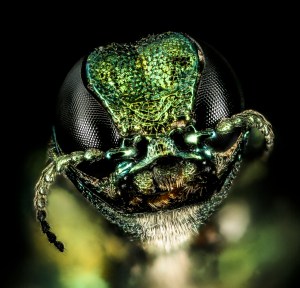
The suspect in question is the emerald ash borer, a green buprestid, or jewel, beetle, from the temperate regions of Asia — China, Mongolia, the Korean Peninsula.
For a few weeks in the late spring and summer, its description would be something like “bright metallic green, about a third of an inch long.” But it is in its larval stages that the beetle does its damage, eating its way through the inner bark of the ash tree, cutting the tree’s lifelines, blocking water and nutrients. Trees infested by the borer are usually dead within three to five years.
Agrilus planipennis was first found in the United States in Michigan in 2002 — though it is believed to have been around for a decade before that. It has been devastating the ash groves of North America ever since. Tens of millions of ash trees have succumbed. In February, Vermont joined 31 other states, and several Canadian provinces, with emerald ash borer infestations.
The search underway in central Vermont is a “delineation survey,” the first step in the state’s “action plan” for dealing with the borer. Vermont’s plan has been in place for years, because the beetle’s arrival has been seen as inevitable. New York state, the surrounding New England states, and the province of Quebec all have infestations.
If anything is a surprise, it is that it took so long.
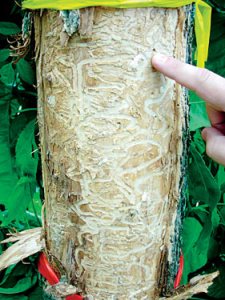
At a public meeting in Barre last week, representatives from the state’s Department of Forest, Parks and Recreation and the Agency of Agriculture, Food and Markets, as well as specialists from the U.S. Forest Service and the USDA, said the survey will answer the question that has been on many minds since a consulting forester first noted — and photographed — a dying ash tree in a remote woodlot: How bad is it?
“That’s our first question,” Schultz said. “What does this infestation look like? Is it just a few properties, or is it over a wider area?”
It is still early to say, but the news is not encouraging. The evidence indicates the beetle has been around awhile, Schultz said, and it is not isolated to Orange. “That much is clear from the condition of some of the trees,” she said. “The infestation has been here several years.”
“That’s how it goes with emerald ash borer infestations,” she said. “It generally takes several years before an infestation is detectable.”
It is partly because the beetle operates under the cover of the tree’s bark, and the initial damage is usually near the base of the tree’s crown — too high to be easily noticed. In fact, the first sign of trouble often is the appearance of woodpeckers in unusual numbers, and by the time they’ve arrived, it’s too late.
The survey is being conducted on a grid system — every square representing a square mile of land — and it will be largely a matter of following the damage, along roadsides, in parks and state forests and on private woodlots.
The ash tree is ubiquitous in northern hardwood forests — 5 percent of Vermont’s trees are ash — and it is an especially valuable tree in forestry. It is used in construction and cabinetry — and for everything from shovel handles to baseball bats to wooden spoons.
How long it will take to complete the initial assessment will depend in part on the results, Shultz said. Evidence of the beetle in one town will trigger a new search in adjacent towns. They more evidence of infestation, the wider the search. The goal is to have the survey finished, and the quarantine decisions made, by May 1, she said.
A quarantine is the second phase of the plan. Both the necessity of a quarantine, and how it would be implemented, were addressed at the Barre meeting. The point of quarantines is to isolate the infestation as much as possible, Schultz said, to help slow the spread, and to buy time.
Even when a quarantine is in place, ash trees can be harvested and processed — at certain times of year, under certain conditions — specifically during the “nonflight” season in the cold months. As conditions warm, in late May and into the summer months, the beetles emerge. Females live for about six weeks, and usually lay around 60 to 80 eggs, though some can lay as many as 200.
“Quarantine is a hurdle,” Schultz said, not a blanket ban. “Quarantine doesn’t mean you’ll never sell another ash log.”
There are ways of combating the beetle that the state will be exploring. There is the biological approach, which involves attempting to establish a local population of the small Asian wasp species that are the beetles’ only predator. It is already in wide use, including in New Hampshire and Massachusetts, with mixed results.
“They’ve been widely introduced, and appear to be having an impact on the levels of emerald ash borer,” Schultz said.
There is also the chemical approach, using insecticides. A number of these remedies have been shown to be effective but the treatment only helps healthy trees, and the insecticides require reapplication every few years. It’s a valid approach for so-called high value trees, in landscapes and in city parks, but not a practical solution in a forestry environment, Schultz said — there are simply too many trees. At the moment there are no proven means to control the emerald ash borer in forests.
One of the uses of the insecticides will be to maintain a population of ash trees that live long enough to produce seeds — 10 years — “to help the next generation get started,” Schultz said. “The next generation is our glimmer of hope in terms of perpetuating the ash tree.”
Because while the emerald ash borer is a pretty thorough tree killer, she said, it’s not necessarily 100 percent. “If it’s 99 percent fatal, that means there is still 1 percent still standing. And that is a lot of ash trees.”
When the beetle appeared in Michigan, almost nothing was known about it. It hadn’t even been studied in its native Asian habitat. “People said at the time that what was known about the emerald ash borer would fit on a page,” Schultz said.
“There was a lot to learn,” she added. “Just six years after that, it was found in Montreal. Ten years after that, we know a lot about the emerald ash borer, and we’ll know even more five years from now. The longer we can keep this insect from spreading, the more opportunities we’ll have to address it, with the best knowledge we have.”
