

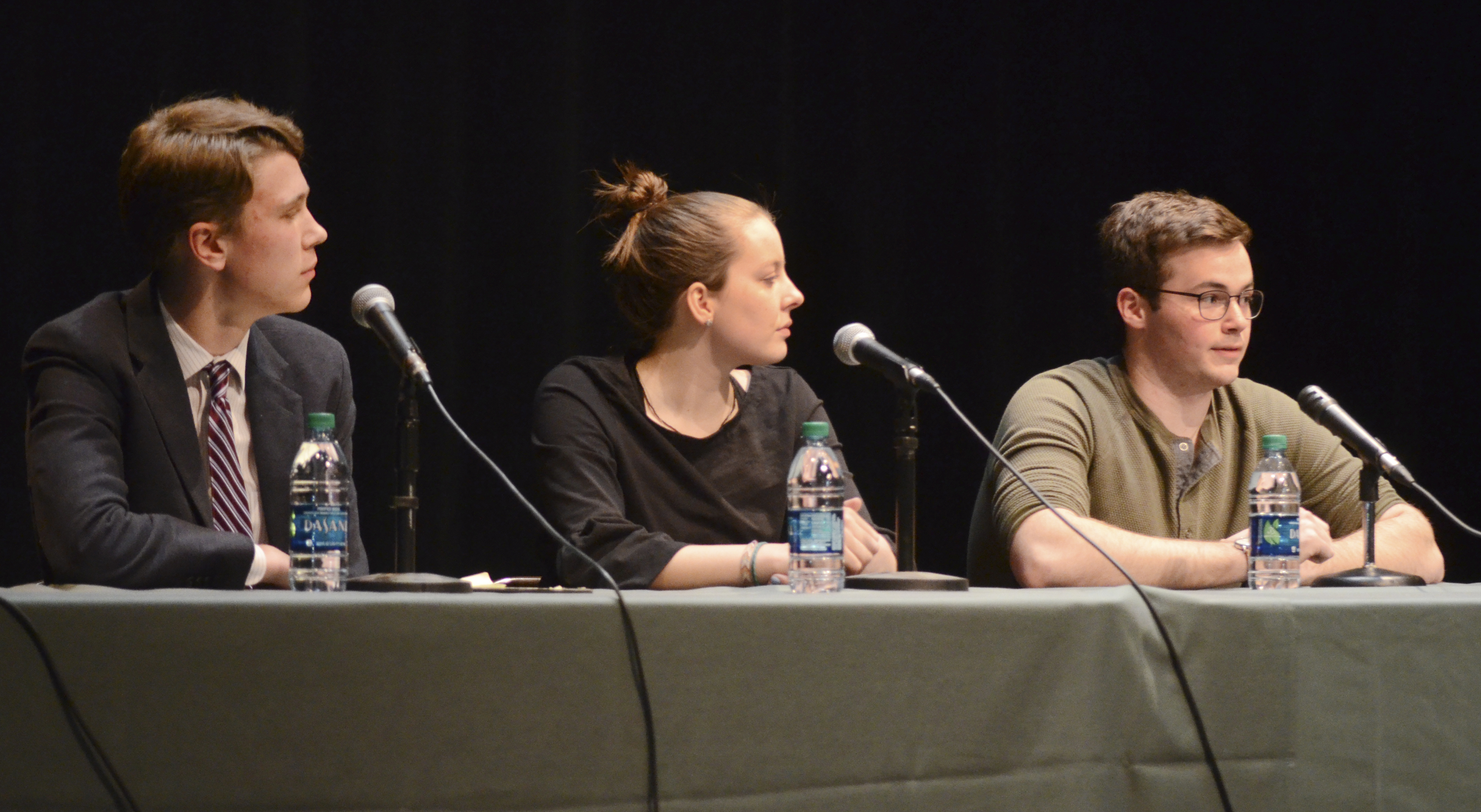
[B]ENNINGTON — Nearly 100 people turned out for a wide-ranging panel discussion on gun violence and safety in schools Monday during a forum at Laumeister Art Center at Southern Vermont College.
Audience participants and panelists debated aspects of gun legislation — at times passionately — and heard from students and education officials, lawmakers, police officers and mental health experts over the course of the two-plus-hour event.
Students Katharine Liell and Tyler Jager of Burr and Burton Academy and Griffin Gourd of Long Trail School set the tone by describing living all their lives with the reality of gun violence in schools.
“I think I can say we grew up with it,” said Jager, who was born in 2000, one year after the mass killing in Columbine High School in Colorado.
“So, I haven’t gone a year of my life without living in the age of school shootings,” he said.
Gun violence in schools “has kind of grotesquely unified our generation,” Liell said.
Referring to the Sept. 11 terrorist attacks of 2001 and other tragic events, she said “the first big landmark event like that for our generation was Sandy Hook [Elementary School in Connecticut in 2012].”
Gourd said he and his peers have “always grown up with lockdown drills” as a regular part of student life while the number of mass killings in schools escalated over the past two decades.
“That was so normal growing up,” he said, “but now that I look back on it, it is actually horrifying.”
“The lack of action [to address gun violence] over the past 10 years has made me very angry,” said Jager, adding that he supports several legislative changes, including tighter background checks for gun purchases and bans on military-style weapons.
The discussion, which was recorded by CAT-TV and will be replayed, was sponsored by the Bennington Banner and the Manchester Journal. Greg Sukiennik, Vermont managing editor for New England Newspapers was the moderator.
Proposed legislation
Sen. Dick Sears, chairman of the Vermont Senate Judiciary Committee, described aspects of the four bills currently before the Legislature involving gun control and/or school safety issues.
The Bennington Democrat said his focus has been on keeping firearms away from people who’ve become an extreme risk to themselves or others. A bill he sponsored, S.221, is aimed at removing guns from someone “exhibiting those red flags” before harming others or, much more often, attempting suicide.
“I think we should focus on who should have guns,” Sears said.

Those issues are extremely difficult to deal with, he said, not only because of the range of starkly differing opinions on gun rights that lawmakers must consider, but also because of constitutional protections against unreasonable searches and seizures.
“So any law that we write has to be constitutional,” he said.
Other panelists, who took turns explaining their roles in dealing with safety issues, included Southwest Vermont Supervisory Union Superintendent Jim Culkeen; school safety coordinator Vic Milani; United Counseling Service executive director Lorna Mattern; Lt. Timothy Mozzer and Det. Lt. Reg Trayah of the Vermont State Police; and representing the Scott administration, Education Secretary Rebecca Holcombe, Public Safety Commissioner Thomas Anderson and Department of Mental Health Commissioner Melissa Bailey.
Anderson and Holcombe described the state’s response to school violence, which has been a cooperative one for their respective departments and one that has evolved over the past 20 years.
“It’s not a static process; this is a dynamic process,” Anderson said, with school and public safety personnel working to adapt to new circumstances, approaches and new technology.
School safety doesn’t just cover gun violence, the officials said, but fires, vehicle accidents, floods or other serious threats to students and staff members.
“This is an all-hazards approach,” Holcombe said.
Today, schools work with local police to periodically assess site safety and discuss and plan for crisis situations, Anderson said. The Vermont School Safety Center and its website also provide information for school officials and others.
Holcombe said she remembers being a teacher when the first efforts to respond to school violence were being developed. “We have learned as we’ve gone along,” she said.
As with students who have grown up with school killings in the news, Holcombe said safety concerns have become a reality all educators have on their minds as well.
Milani described emergency response plans now in place in local schools, the regular assessment of possible threats and development of protocols for responding to a given situation, such as a school lockdown.
He said drills are common in modern school systems as is staff training, including how to establish a “secure perimeter,” with locked doors and monitored entrances.
Mozzer, commander of the State Police barracks in Shaftsbury, said that despite a tendency to remember only those incidents that end tragically, there is much “that we do right” in Vermont every year to make schools safe.
Increasingly, new technology helps officials and police better monitor school campuses, he said, and site assessment and the development of crisis plans and police training have “come a long way” since the Columbine killings.
‘Say something’
Referring to a recent alleged plot to commit a mass shooting at Fair Haven Union High School, Trayah said that was stopped “because somebody said something.”
The State Police detective said he and those he works with would rather investigate multiple reports that prove unfounded than have one become a tragic reality.
“Please don’t hold that inside,” he said, of any reports or rumors of a pending act of violence. When there is a possible threatening situation involving a student, “we still have an obligation to educate that child,” Culkeen said, which he called “a tremendous challenge” for school districts.
Districts “could use some assistance with that,” he said, referring to legislation under consideration.
Mattern said United Counseling Service has staff members based at eight schools in the county and at 15 doctor’s officers, offering a chance for people to express concerns about a situation that could end in violence or self-harm.
The national debate
Beyond a focus on school security and safety, the general issue of gun control legislation stirred the most debate later in the program, with a number of speakers in the audience arguing for or against various laws being considered. At times, speakers were interrupted with shouts of disagreement.
Kevin Hoyt, a local hunting enthusiast and advocate of education in the use of firearms, spoke about his views against gun control, sometimes debating directly with others in the audience.
He argued that gun control efforts have failed and that “gun-free zones” in schools haven’t stopped school shootings. But Hoyt insisted that training and arming teachers might prove effective in ending the problem.
Sukiennik said the panel discussion was in response to the killings at Marjory Stoneman Douglas High School in Parkland, Florida, and later calls from Gov. Phil Scott for local and state officials to focus on school safety issues and site assessments by police.
