

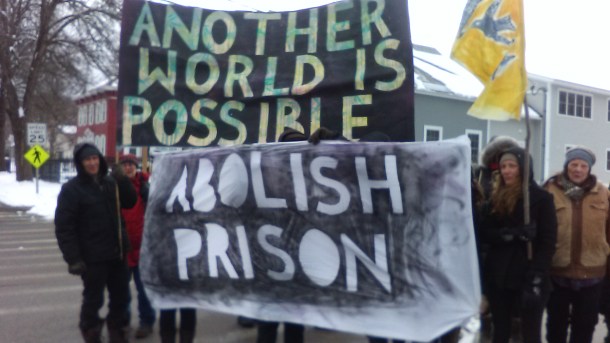
WATERBURY – A group of protesters marched Saturday along South Main Street in Waterbury, in a display of opposition to a proposed new prison complex in the state and to express outrage over three officer-involved fatal shootings in Vermont in six months.
The contingent of about 20 people carried signs that said “Another World is Possible” and “Abolish Prison” and marched to the beat of kitchen utensils banging on pots, pans and metal trash can lids.
Around noon, the group turned off South Main Street and onto State Drive, home of the headquarters of the Vermont State Police.
“People are here to help move the conversation forward on alternatives to the police state and incarceration in prisons,” said Eric James, an organizer of the protest.
“We see there is a real lack of services and programs to address the root causes that, I think, have driven the situation where people are in a distressed situation and the police choose to use force.”
After making a brief stop in front of the state police headquarters, which was closed on Saturday, its parking lot empty, the protesters returned to a livelier and more visible location on the corner of South Main Street and State Drive, where they displayed their signs to passing motorists.
James said the group came together mainly through “word of mouth” and online communications.
“We don’t think that this demonstration is going to be the end all, by any means,” James said, “but a step along the way of building community power and relationships where we could actualize a different society that’s not based on violence or the threat of violence.”
There have been three fatal officer-involved shootings in the state in the last six months, all involving Vermont State Police.
On Sept. 1, last year, five members of a police tactical team opened fire and killed 32-year-old Michael Battles during a [standoff in Poultney[, after he pointed a weapon — later determined to be a BB-gun — at officers from a second-story window in his home. Police were attempting to arrest him on a felony aggravated domestic assault charge.
On Jan. 16 this year, nine officers, including eight members of the Vermont State Police, fired on 32-year-old Nathan Giffin, a robbery suspect who was holding what also turned out to be a BB gun.
Giffin had fled to a sports field at Montpelier High School after robbing a nearby credit union. Police said he made threatening and suicidal statements, and moved toward the officers before they opened fire.
On Feb. 11, a Vermont State Police trooper and Richmond Police Department corporal shot and killed Benjamin Gregware, 43, of Sheldon.
Police said Gregware, who had made suicidal statements, had pulled to the side of Interstate 89 in Bolton, and gotten out of his vehicle. He held a gun to his own head refusing repeated orders to put it down as traffic passed on the interstate.
Prosecutors found the officers justified in the use of deadly force in the shooting in Poultney. Reviews and investigations remain underway in the Montpelier and Bolton shootings.
State Trooper Christopher Brown, a member of the state police tactical team, fired shots in all three deadly shootings. Brown has since been taken off the special unit.
‘The fact that one officer could have shot three people is pretty frightening,” said Karen Bixler of Bethel, one of the protesters Saturday.
“First of all, any police officer who has been involved in one fatal shooting, in one shooting, should be off the beat and in therapy for awhile,” she said. “Nobody can process that on their own.”
Following the fatal shooting in February in Bolton, Brown, who was also involved in a non-fatal shooting in 2015, was placed on paid leave pending the outcome of the latest investigation, which could last several months.
In past cases, state police policy allowed troopers involved in shootings to return to duty after at least three days on paid administrative leave.
“This decision is not an indication of any wrongdoing by Trooper Brown, but merely a change in the way the state police will now manage our response to officer involved shootings as it relates to the health and well-being of our members,” Col. Matthew Birmingham, director of the Vermont State Police, said last month at a press conference following the shooting in Bolton.
Birmingham has also said that state police are contracting with an outside consultant to review policies and procedures in such cases.
“One fatal shooting is too many in my opinion. These are very challenging, complicated and tragic events,” the colonel said. “As the director, I don’t want any fatal shootings to happen, but that’s not realistic.”
A Scott administration plan released earlier this year for a 925-bed prison and health complex in Franklin County drew strong opposition from the protestors, particularly the part of the proposal calling for a private company to build the prison complex and lease it back to the state.
The plan appears to lack support and is seen as unlikely to advance this year, but how it will fare in the future remains unclear.
James said Saturday that incarceration punishes people who may be dealing with a variety of issues, from poverty and mental health concerns to abuse and drug addiction.
“It doesn’t address the root causes,” he said of the proposal to build a prison complex.
