


Before it became the vehicle for universal background checks and increasing the legal age to purchase guns, Senate bill S.55 had a fairly simple purpose: clear the way for the state to get rid of hundreds of abandoned or unlawful guns currently in storage.
While the initial aim of S.55 was straightforward, figuring out how to sell guns that have come into the state’s possession — handed over following the death of the gun owner, for example, or seized by law enforcement officers after a crime — has been far from simple.
Treasurer Beth Pearce, whose office is currently responsible for such sales, has repeatedly raised liability and cost concerns related to the state getting into the business of selling guns. Officials say no treasurer has ever exercised the authority to sell weapons back onto the market.
So the guns keep piling up.
“The treasurer deals with abandoned property, but doesn’t want to be selling guns,” said Sen. Jeanette White, D-Windham, who is on the Senate Judiciary Committee, which drafted the bill. “Why it was ever assigned to the treasurer, I don’t know.”
Sen. Dick Sears, D-Bennington, the committee chair and the bill’s sponsor, said during a hearing on S.55 that Pearce approached him last year about dealing with the growing stockpile.
“Over 1,100 firearms are stored somewhere in Montpelier at a tremendous expense to the state to rent this place, and the state could actually make money by selling those firearms,” Sears said.
“And what happens is it all kicks back to the locals — who are supposed to deliver their firearms to the Vermont Department of Public Safety — because there’s no room. So you have your local police storing firearms that they can’t get rid of,” he added.
The new law would remove the treasurer from the process of dealing with guns in state possession and instead transfer oversight to the Department of Buildings and General Services. BGS Commissioner Chris Cole was unavailable for comment this week.
Public Safety Commissioner Tom Anderson said the state was storing 1,145 firearms seized, abandoned or otherwise obtained by the state, but only 410 of them would be affected by S.55 — and that some of those firearms could be destroyed rather than sold. He was not sure how much it was costing the state.
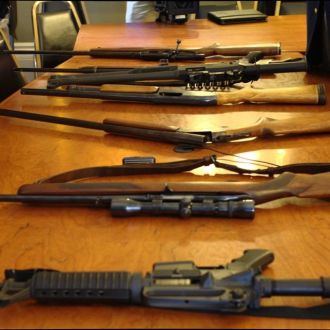
The other guns are being held as evidence or were obtained through relief from abuse (RFA) orders that are not subject to the new law, he said. Firearms that are “unlawful per se” — guns that have been illegally modified or have scratched off serial numbers, for example — will not be sold. Guns used in homicides are also precluded from sale.
Anderson said the existing statute “just wasn’t very good” because it failed to say anything about how the state should deal with abandoned firearms. “It wasn’t clear what to do with these firearms. This clears up the ability to get rid of abandoned guns,” he said.
In an email sent to Anderson in January, Pearce said she was unable to support the sale of firearms held by the state until a series of concerns were addressed. Those concerns included who would be responsible for transporting the firearms, testing them, storing them and filling out related forms — and how much it would all cost. She also raised liability concerns:
- What would the State use for guidelines to determine a gun’s safety and who makes that determination? And at what cost?
- Who is responsible for ensuring firearms are functioning properly? We were told by DPS staff in 2015 that this would be a burden on the Forensic Lab and would potentially open up the State to liability should something malfunction after the sale. And at what cost?
- Is there a liability to the State if firearms sold by the State are used in a future crime?
“The Treasurer’s Office needs to have a much better understanding of the cost and safety issue, as well as estimated value, before any determination regarding sale could take place,” Pearce says in the email.
Anderson said his department replied to Pearce’s questions “to the extent it was able.” The Department of Buildings and General Services was determined to be better equipped to oversee the sales — a change Pearce’s office agreed with in an email exchange with Anderson.
“S.55 attempts to deal with potential liability issue by requiring that sales of any firearms be only to a Federal Firearms Licensee,” Anderson said in an email to VTDigger. “Because BGS is the state agency responsible for the sale of surplus property, it is the more appropriate agency to deal with these sales.”
In a telephone interview, Anderson said concerns about the cost of testing and registering guns before they were sold would also be transferred to the licensed dealers that purchased the firearms from the state.
“Once BGS figures out how to do this, they would be sold as a lot,” he said. “Whether it works out this way remains to be seen.”
Now that S.55 has become the vehicle for universal background checks, its passage is uncertain. Gov. Phil Scott has yet to say whether he will sign the bill if it passes the House and reaches his desk.
Sears said the firearms storage issue needed to be dealt with, whatever the fate of S.55.
“In the event that the governor vetoes it, I think it’s important to have underlying the bill, the firearms storage piece, somewhere in the law to take care of this problem. ‘Cause it is a huge problem,” he said. “I don’t think the general public realizes it’s a problem, but it’s a huge problem for the Department of Public Safety as well as local police departments.”
