

Photo by Cory Dawson/VTDigger
BURLINGTON — A new committee will soon start taking requests to rename campus buildings at the University of Vermont.
Late Thursday, UVM board of trustees Chair David Daigle sent a campus-wide memo detailing plans for the committee that would start a renaming process. The plans come about two weeks after anti-racism protests subsided. Student activists called for the renaming of campus buildings they say are named after eugenicists, among other demands.
The committee, which will be staffed by four trustees — including one student trustee — and four faculty members, was selected by Daigle. They have not scheduled their first meeting, according to university spokesperson Enrique Corredera.
The committee will use a protocol created by Yale University in 2016 to take building renaming requests, evaluate them, and ultimately make a recommendation to the full board.
“I have every confidence that going forward this will be a fair, thorough, and careful deliberative process,” Daigle wrote.
The Yale protocol was established after campus protests to revisit a decision not to rename one of the Ivy League school’s residential colleges, Calhoun College, named after the nation’s seventh vice president and white supremacist John Calhoun.
The process eventually led to Yale renaming the college last year after Grace Murray Hopper, a Yale alumnus, pioneering computer scientist and Navy rear admiral.


Under the Yale criteria, a building will only be renamed if the legacy of a building’s namesake was or still is at odds with the university’s mission, or was significantly contested when the person lived. If the person’s legacy played a substantial role in forming the university community, that will also be considered, according to the criteria.
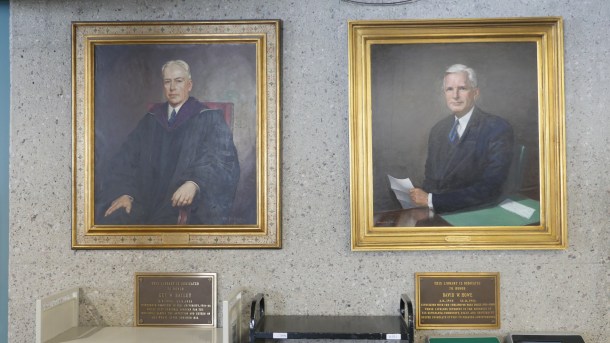
Student protesters sent administrators a list of demands, and negotiations have been ongoing since protests subsided. As part of those demands, the students asked for the renaming of Bailey/Howe Library and of George Perkins Hall.
The building’s namesakes have ties to the university’s eugenics movement, they have said. A request for comment sent to leaders of NoNames for Justice, the student group leading the protests, was not immediately returned Friday.
Yale renaming committee members worked for months to create a preponderance of evidence to prove Calhoun’s views were controversial at the time, and ultimately recommended the college’s renaming.
Perkins, Bailey, Howe and Eugenics
Though UVM’s renaming committee will likely do a similarly exhaustive review of historical records should they be asked to rename the buildings, an initial review of the available information shows that at least two of the three men whose names are on UVM buildings are indirectly connected to the eugenics movement.
Eugenics is the study of human racial progress through selective breeding, as soberly defined by Nancy Gallagher, a UVM graduate and author of “Breeding Better Vermonters: The Eugenics Project in the Green Mountain State.”
What began as a “way of lifting humans toward greater perfection,” as described by biologist Ernst Mayr, was perverted into rationale for mental testing, sterilization of the “unfit,” and was later used as part of the scientific rationale for racial purification in Nazi Germany.
Vermont politicians also used eugenics to underpin a 1931 law targeting “idiots,” “imbeciles,” “feeble-minded” or “insane’ persons.” Ultimately, 253 “unfit” people were sterilized in Vermont from 1931 until the last sterilization in 1957.
George Perkins, one of the building namesakes that students are targeting, was a natural sciences professor at UVM and later served as dean of the College of Arts and Sciences from 1907 to 1932.
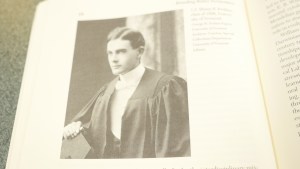
It was Perkins’ son Henry who was the de facto face of Vermont eugenics. Gallagher’s book mentions the elder Perkins only as a supportive father, and makes no mention of his specific support nor his dismissal of the eugenics pseudoscience his son championed.
After a Black Lives Matter flag was stolen from a campus flagpole last year, student activists — many who were involved in the more recent protests — also attempted to get Perkins Hall renamed.
At the time, university officials largely dismissed the demand to rename the building.
“To our knowledge, there is no evidence that George Perkins was involved in the eugenics movement in any way, nor is there information indicating that the subject of eugenics was taught in what is now Perkins Hall,” the officials wrote.
During most of the pre-WWII era in which Henry Perkins was active in the eugenics movement, it was largely viewed as a legitimate science.
“Nearly all the familiar authors of Perkins’ textbooks promoted eugenics, eventually serving as authors and advisors of eugenics organizations or authors of books and articles on this new ‘human biology’,” Gallagher wrote.
Vermonters at the time were largely unconcerned with the eugenics movement, Gallagher wrote.
The only significant source of dissent toward eugenics came from Irish and French-Canadian Catholics, who at the time were largely poor and disenfranchised, and were likely guided by a 1930 report from Pope Pius XI, who condemned eugenics and any form of family planning that “interfered with the body’s natural functions.”
The scientific community’s support for eugenics began to wane in 1935, when a report for the American Neurological Association found no scientific justification for eugenic sterilization.
Guy Bailey, half of the namesake for the Bailey/Howe Library, was a contemporary of Perkins. He graduated from UVM in 1900, and served as its president from 1914 until his death in 1940. During his presidency, he served on Henry Perkins’ Eugenics Survey Advisory Committee — the first privately funded research project at UVM.
Bailey, like the elder Perkins, appeared to neither condone nor stifle eugenics research and practice at UVM and in Vermont.
“Bailey served on the Eugenics Survey Advisory Committee in name only,” according to an entry on Bailey in an online collection of eugenics documents.
Guy Bailey was the original namesake for the library, which was completed in 1960 and called simply the Guy Bailey Library. It wasn’t until 1980, after the completion of a major expansion named after former Burlington Free Press publisher and UVM alumnus David Howe, that the library received the name generations of students now know it by.
VTDigger could find no links, indirect or otherwise, between David Howe and the eugenics movement.
Howe led the Burlington Free Press for nearly four decades, having started at the newspaper in 1921, and serving as its publisher from 1929 until 1961, according to a 1980 pamphlet announcing his name being added to the library. He was a fighter pilot in World War I, and founded two local radio stations, WJOY and WQCR, now called WOKO.

