


[W]ASHINGTON — Vermont officials say the tariffs President Donald Trump announced Thursday on steel and aluminum could have impacts across Vermont’s economy — from cars to craft beer.
Trump issued a proclamation setting tariffs of 25 percent on steel and 10 percent on aluminum, which will go into effect in 15 days.
Canada and Mexico, which are currently in the middle of the process of renegotiating the North American Free Trade Agreement with the United States, are initially excluded from the new tariffs.
The move won cheers from the American steel and aluminum manufacturing sector. The AFL-CIO, a powerful nationwide union, lauded Trump’s proposal last week as “a great first step toward addressing trade cheating.”
Many economists and politicians across the spectrum are concerned about the fallout from Trump’s move, which could trigger a trade war.
Gov. Phil Scott acknowledged Thursday that the new tariffs could impact breweries in the state — many of which package their brews in aluminum cans.
“I would think it would have an adverse effect on the pricing of our products,” he said at a press event on Vermont’s craft beer industry,
The move, Scott said, could impact costs of “many different products” in the country. He noted that some of the president’s advisers have indicated that they disagree with the move, and said he is hopeful that “cooler heads will prevail.”
“I think when you enter that world, that game, you’re playing with pretty high stakes,” Scott said. “So we’ll see. I hope they know what they’re doing.”
Scott also is concerned about the impact on the U.S. relationship with Canada. He has urged Vermonters to contact the federal government in support of NAFTA.
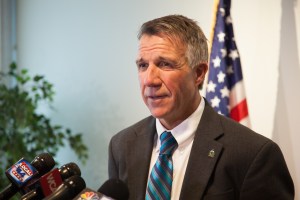
“Our largest trading partner is Canada, so we don’t want to do anything to alter the balance in that respect,” he said.
Ted Brady, Vermont deputy commerce and community development secretary, said the new tariffs will likely hurt manufacturers in Vermont, who are already struggling. Consumers will also see prices go up, he said.
“There’s no apparent upside to the proposed steel and aluminum tariffs to Vermonters or Vermont businesses,” Brady said.
Businesses in Vermont were considering how the tariffs could impact them. Cheray MacFarland of Citizen Cider, a Burlington-based hard cider brewery, said that the company uses American-made steel tanks and aluminum cans.
“We’re not really sure how these will impact us as of now, but hopefully not too much considering we are using companies already making American steel,” MacFarland said.
The national Brewers Association warned last week that the tariffs are expected to increase the cost of aluminum used by many small brewers.
University of Vermont economics professor Art Woolf said that the impact on consumers will be very small — an extra penny on a canned good, perhaps. However, he said the cumulative impact across the economy will be significant.
“Businesses do all sorts of things to try to shave a penny off of the price of a product,” he said.
Woolf said the tariffs mark a major shift in philosophy from previous administrations dating back decades. “It goes against what the United States has been fighting for and taking a leadership position on ever since World War II,” he said.
Woolf said it is unlikely that any products that other countries impose retaliatory tariffs on would directly impact Vermont, as those tariffs are typically selected strategically to exert pressure on key political figures. European Union officials have raised the possibility of imposing tariffs on bourbon or Harley Davidson motorcycles — products from the home states of Senate Majority Leader Mitch McConnell and House Speaker Paul Ryan.
Economist Tom Kavet said the biggest concern for Vermont is how the tariffs will impact the U.S. relationship with Canada. Though Trump’s proclamation does not include Canada initially, there is the potential tariffs would be put in place later.
About 40 percent of Vermont’s exports go to Canada, he said, and a trade war would be “very damaging” to the state.
“It’s easy for these things to cascade in negative ways,” Kavet said. “It’s easy for there to be a back and forth tit for tat.”
Kavet also said there is the potential for “collateral damage” on Vermont’s economy from retaliatory tariffs.
Vermont’s congressional delegation appeared split over the president’s move.
Rep. Peter Welch, D-Vt., and Sen. Patrick Leahy, D-Vt., raised concerns about the impacts of the new tariffs.
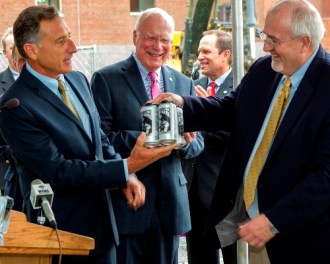
“There’s a real issue that the president is attempting to address,” Welch said in an interview Thursday.
Chinese practices have flooded the global steel market, which has been damaging to the U.S and other countries, Welch said. However, he critiqued the president’s “blunt instrument” approach, which he said could bring retaliatory action.
“I think is in the long run going to be ineffective and perhaps counter-productive,” he said.
Leahy said that the president’s “chaotic jumbling of tweets, slogans and unvetted ideas” does not support American steel and aluminum manufacturing. He said Vermont’s economy relies on a good trade relationship with Canada, and the move could endanger that.
“This is not a carefully crafted recipe for fair trade; it’s a sloppily concocted recipe for failed trade,” he said.
Sen. Bernie Sanders, I-Vt., however, has voiced support for Trump’s tariffs.
Sanders’ spokesperson did not respond to multiple requests for comment Thursday afternoon on the president’s move.
In an interview with the Daily Beast earlier this week, Sanders indicated openness to Trump’s proposed tariffs.
“We need to fundamentally rethink our trade policies and move to fair trade rather than just unfettered free trade,” Sanders said in that interview. “So Trump is identifying a problem. Certainly China’s role in dumping an enormous amount of steel, not only in the United States, but all over the world, is very very clear. It has to be dealt with.”
However, Sanders said he supports a “more comprehensive” approach than the one the president was taking.
Cory Dawson contributed to this report.
