


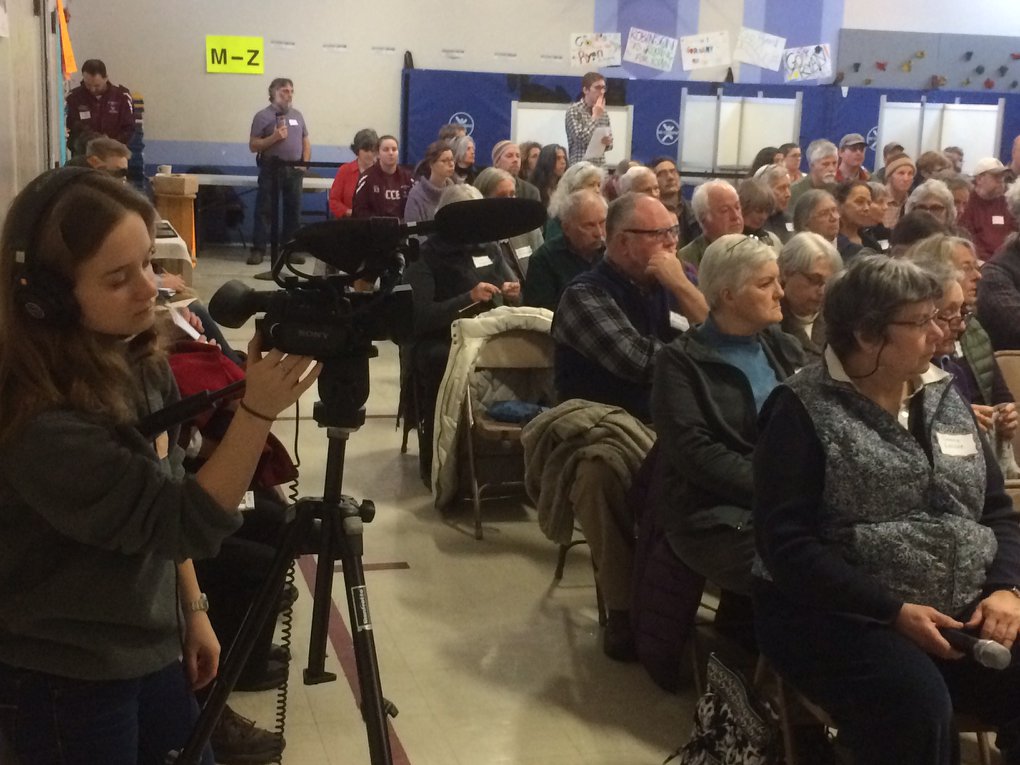
[A] cohort of Vermont college students revived a decades-old Town Meeting Day tradition this week, examining dozens of Vermont towns to see just how democratic they really are.
Using a “democratic index” developed by longtime UVM political science professor Frank Bryan, the students sought to determine the most democratic towns by adding the turnout rate to the participation rate at the meetings.
For decades until his retirement in 2013, Bryan sent his students to communities around the state to conduct their research. The revered educator retired in 2013.
“This is just a really important examination of democracy,” said Richard Watts, a University of Vermont professor and director of the Center for Research on Vermont. “Vermont really is a laboratory.”
Watts directed the UVM students’ research, while Rich Clark, director of the Castleton Polling Institute, and David Plazek of Northern Vermont University organized students from their campuses.
The towns that were studied had to have a floor vote, and many were communities that Bryan’s students had visited before, Watts said. Students released data on 32 towns, but more of their findings will be compiled in the coming weeks.
The tiny town of Belvidere in Lamoille County retained its crown as the most democratic town, according to the students data. With a population of 348 and 234 registered voters, Belvidere drew 39 people to its town meeting. Of those, 28 participated at least once.
Sophomore Adrian Burnett, 22, was the lead organizer for the UVM students and was attending his first town meetings for the project.
“It was definitely cool to see people being involved in a way that’s not typical in politics elsewhere,” said Burnett, who collected data in Westford and Underhill.
One consistent trend in Bryan’s research is that the larger the town, the less democratic it tends to be. Burnett, however, noticed that the smaller Westford was less democratic than Underhill, which had nearly twice the turnout.
But that difference proved to be an outlier, Burnett said. “Overall that trend still stands.”
Junior Olivia Jangen, 20, a Massachusetts native, said she observed a deep sense of equality at the town meetings, the first she had attended.
“There was no sense of hierarchy in the way they were run,” Jangen said. “It wasn’t as if the selectboard members were somehow higher up, it was more of an open conversation between the whole community.”
Towns discussed the typical issues — the town budget, money for libraries, police departments, Jangen said. Residents in Belvidere spent nearly a half hour deciding how to upgrade access to the town gravel pile.
“So many other issues came up, I wondered if it would be beneficial to meet more often than once a year,” Jangen said.
Belvidere is Nate Lague’s hometown. Lague, 23, said that he’s gone to the Belvidere town meeting nearly every year. “There’s a lot of really engaged citizens because it’s such a small, tight-knit community,” the UVM senior said.
Access to the gravel pile in Belvidere is key for a rural northern town with long dirt driveways, he said.
“They were thinking about putting in a motion sensor so people have access all the time,” Lague said. “It’s a very, very local issue.”
Students say they are proud to continue the work Bryan started.
“On a national scale, democracy is changing in many ways, so looking at how this tradition is still going on, is really important. So it feels good really being involved in that,” Burnett said.
Here is a map of towns surveyed by the students. The most democratic towns are darker green.
Hear more about Town Meeting Day research on this week’s Deeper Dig podcast:
