

[S]o it turns out that even in Vermont, The Establishment rules.
Assuming that there is such a thing as The Establishment, and understanding that if there is, Vermont’s version is, at the very least, singular.
That’s a polite way of saying peculiar.
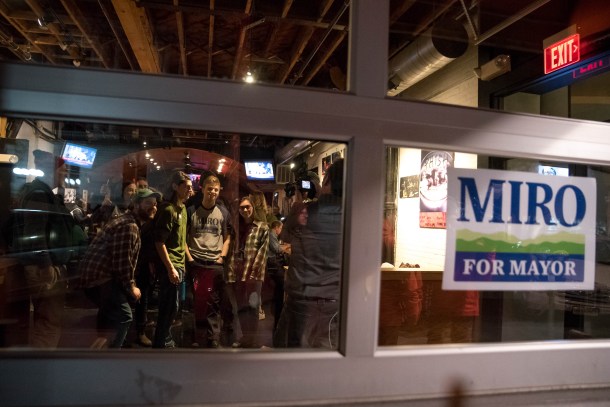
For instance, The Establishment’s most obvious victory on Town Meeting Day Tuesday was the re-election of Burlington Mayor Miro Weinberger.
It wasn’t the only one. All around the state, Vermont voters generally opted against change. They approved their local school budgets (135 of the 140 districts reporting results to the Superintendents Association Wednesday afternoon). They re-elected most incumbents, including all the Burlington City Councilors who sought re-election.
As always, there were a few exceptions. Two Hartford selectboard members were defeated by newcomers. Shelburne voters rejected joining a Chittenden County regional dispatch center (six other municipalities favored it).
By and large, though, Vermont voters indicated they were satisfied. The rest of the country may be in a foul political mood, but if Tuesday’s results are any indication, Vermonters are just fine keeping the status as quo as it is.
But certainly the Burlington mayor’s race was the most visible triumph of The Establishment, both because it took place in the state’s largest city and because, unlike Weinberger’s last race in 2015, this time he had an opponent with some political potential.
It isn’t just that Carina Driscoll’s step-father is Sen. Bernie Sanders. It’s also that she’s been elected to office before — to the city council and the state legislature. She could raise some money. She knows how to campaign.
All of which got her 35 percent of the vote. A respectable showing, but not enough to win. Weinberger won. He was the incumbent. He had more money. He had the support of most of the business community. Because he is a Democrat, he had the support of the Democratic Party. Although he is a Democrat, he had the support of Burlington’s most prominent Republican, State Rep. Kurt Wright, who lost to Weinberger six years ago.
Weinberger, in short, is The Establishment.
Some establishment. In almost every other American town, Weinberger would be considered slightly left of center-left. He favors universal health care, a higher minimum wage, aggressive action against global warming. So why was he often designated as the most conservative of the three candidates, with Driscoll and the other challenger, Infinite Culcleasure, described (by Vermont Public Radio at least) as “running to his left?”
One reason is that in some places these days — and Vermont is one of those places — left and right are often distinguished as much by style and demeanor as by public policy positions. Weinberger is a reasonably affluent fellow with degrees from both Yale and Harvard. Even when he’s being informal, he’s reserved if not downright buttoned-up. He made his money as a real estate developer, and as mayor he has favored lots of real estate development.
It isn’t that Driscoll isn’t an affluent businessperson, too. She is. But her degree is from the University of Montana, and she managed (being part of Bernie Sanders family didn’t hurt here) to portray herself as standing a bit outside the mainstream.
“City Hall is not listening to us, and is catering to private interests instead of working for the people who live here,” she said, separating herself from…well, from The Establishment.
Culcleasure, much less affluent and with a troubled past, did not have to make any effort to separate himself from it.
It isn’t that both challengers didn’t have meaningful differences with Weinberger. But most of them were over process, not specific policies. Both of them wanted fewer decision made at City Hall, more in the neighborhoods.
As she conceded Tuesday night, Driscoll said Burlington voters were “concerned that people were feeling disenfranchised from the process and not feeling included.” Culcleasure called for granting more “community decision-making power” to Neighborhood Planning Assemblies.
There is nothing unreasonable about proposing a more decentralized governing process. Whether it is the left-of-center approach is debatable. Hyper-local can be hyper-reactionary. Decisions made by the duly elected officials at City Hall are often more progressive than those made by activists in a single neighborhood. American history is replete with examples of the more liberal policies coming from the broader, more cosmopolitan, political jurisdictions. “offbeat,” or “rebellious” is not a synonym for “left-wing.”
It just seems that way in Burlington.
Burlington’s endorsement of its mayor was limited. His 48 percent of the vote, while comfortably ahead of Driscoll, was shy of a majority. So his victory, while substantial, was not a ringing endorsement of his leadership.
The results quickly inspired conjecture that had Culcleasure, who got 16 percent of the vote, not been in the race, Driscoll might have won.
Maybe, but if history is any guide – and it’s the only guide – some of the Culcleasure voters would have stayed home had he not been on the ballot. A few would probably have voted for Weinberger.
There was, to be sure, one major exception to Vermont’s Town Meeting Day embrace of The Establishment. Nothing has been more pro-establishment in the state for years than devotion to the Vermont Air National Guard and support for the F-35 jet fighters scheduled to be based in Burlington starting next year. Every governor, U.S. Senator, member of Congress, and prominent businessperson has supported the Guard and bringing the F-35s to town. So does Weinberger.
Burlington voters just said they’d rather not.
Did the voters defy The Establishment? Or in Burlington, is being anti-establishment the established position?
