


[W]ASHINGTON — Standing outside the Capitol on a bright, late-winter day, a Red Sox hat shielding his eyes from the sun, Rep. Peter Welch reflected on what many have deemed to be a unique moment in the country’s politics on guns.
“The debate has totally changed,” he said in an interview last week.
In the days following a shooting at a Florida high school that killed 17, students there have led a nationwide groundswell of teenagers calling for tighter gun laws.
Dick’s Sporting Goods announced it would stop selling AR-15s, and some retailers raised the age for gun purchase from 18 to 21. And at a meeting with a bipartisan group of lawmakers, President Donald Trump said he would support an expansion of background checks and raising the age for some firearm purchases.
In Vermont, Gov. Phil Scott called for reforms and lawmakers moved swiftly last week to advance significant gun-control measures — including a previously controversial universal background check provision in the Senate.
Despite calls across the aisle in Washington to consider changes to federal gun laws, there is no clear path forward for legislation in Congress.
However, the three members of Vermont’s congressional delegation — all longtime politicians from a state with a tradition of limited gun restriction — have all said that they support a suite of firearm reforms.
Eric Davis, political science professor emeritus at Middlebury College, said in a phone interview the push for changes to federal gun laws is plainly linked to the rise in mass shootings, such as the 2012 killing of 28 children and adults at an elementary school in Newtown, Connecticut.
Events like that have changed the political context of gun policies for Leahy, Welch and Sanders, said Davis.
“When all three of these people first became active in politics, you didn’t see the kinds of mass shootings that have been all too frequent,” he said.
Democrats in Washington are favoring measures that would expand background checks for gun purchases, closing loopholes that don’t require checks before sales at gun shows and online. They are pushing for banning assault rifles, limits on high-capacity magazines, and other proposals.
Also in play in Congress is a narrowly tailored Republican-led measure that would tighten the national background check database system.
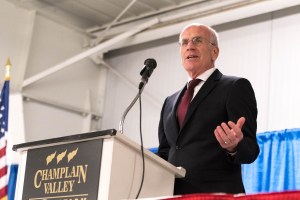
Welch heard survivors of the Marjory Stoneman Douglas High School shooting speak to the House Democratic Caucus last week. In their presentation, the Parkland, Florida, students called for legislation to ban assault rifles, require universal background checks and limit high capacity magazines.
“They had a wonderful message that when they present it, it seems to have more credibility than when members of Congress or others express it,” Welch said.
Welch said he’s observed the National Rifle Association becoming “more extreme” since his arrival in Washington a decade ago. He previously led the Vermont Senate.
“I think what’s really, really changed is the NRA has gone from being an advocacy group that protected Second Amendment rights for sportspeople to basically an arm of the firearms industry,” Welch said.
According to campaign finance records, Welch received an “unsolicited” $1,000 donation from the NRA in 2008. He has since donated that sum to the gun-control group headed by former Rep. Gabby Giffords, D-Ariz., who was critically wounded in a 2011 assassination attempt that left six people dead.
In an interview last week, Sen. Patrick Leahy, D-Vt., said he was impressed by the tide of calls from teenagers to address gun control.
“I haven’t seen anything like this since I was a student and (there was) mobilizing against the Vietnam War,” he said.
Leahy said he hopes the renewed student activism will have a “similar energy” to the Women’s March early last year, which he said helped him with some initiatives in the spending package he was involved in negotiating.
When Leahy headed the Senate Judiciary Committee, he oversaw an effort to reform gun laws in the aftermath of the Newtown school shooting. The package ultimately floundered in the Senate.
He said he believes the political climate is different today than it was five years ago. If the students’ momentum continues, he said, “maybe it’ll break down the power of the gun lobby.”
Leahy’s political coffers have also been linked to pro-gun groups.

In a review of campaign finances last month, Leahy aides discovered a total of $9,000 in donations to his leadership political action committee — a fund that is not directly related to his personal campaign — from the NRA and the National Shooting Sports Foundation between 2008 and 2012. The senator directed that sum be donated to groups supporting gun control, according to a statement from his office.
Leahy has urged lawmakers to come together on the issue in recent public remarks, and he is hopeful that Republicans will support some of the measures under discussion.
“The only thing I worry about is, I worry that they pass some cosmetic thing,” he said.
Sen. Bernie Sanders, I-Vt., has taken a vocal position on the issue since last week, calling on the Senate floor for strengthening background checks, an assault weapons ban, expanding access to mental health treatment and restricting people convicted of domestic violence offenses from gun possession. He also met with students from Parkland last week.
The Parkland students went through an unbelievably traumatic experience. But because they are prepared not just to mourn, but to stand up and fight back, I think it’s possible we are going to see real change. pic.twitter.com/izHPdzA4cl
— Bernie Sanders (@SenSanders) February 27, 2018
As he walked from the Capitol through a small park to the building where his office is located last Wednesday evening, Sanders spoke of the meeting the president had with lawmakers a few hours earlier.
“The problem with Trump is that he changes his mind every day,” Sanders said. “But if he is serious about wanting to move forward with gun-safety legislation, I think that’s great.”
Sanders’s record on gun policies has attracted scrutiny, particularly since his 2016 presidential bid.
Gun policy was a issue in the 1990 election for Vermont’s sole House seat, when Sanders defeated the incumbent Republican Peter Smith.
Smith favored gun control legislation. Smith’s son, Ben Smith, wrote that stance was a “prominent” factor in his father’s defeat in that election in a commentary last week.
Davis, the Middlebury professor, said firearms policies were one of many factors that led to Sanders’s victory in the 1990 race.
“My sense was that guns were an issue on which Bernie didn’t really have much to say until he became a presidential candidate,” Davis said.
Sanders’ record on guns was a target of Hillary Clinton during the 2016 campaign, when he was criticized for policies early in his career that were deemed too moderate. Clinton’s camp particularly focused on his votes on background check provisions in the 1993 Brady bill.
Some advocates for gun control measures characterized his position as “erratic” during the election.
Asked about his position on gun laws over the years, Sanders pointed out he has supported a ban on assault weapons for years, dating back to his first bid for Congress three decades ago.

“Possibly one of the reasons I lost that election is that my view — this is 1988, 30 years ago — is that we should ban assault weapons,” Sanders said. “And the gun folks said, well you could vote for the Democrat, you could vote for the Republican, but you don’t want to vote for Bernie Sanders.”
Sanders defended his record, saying he believes he has been “strong and consistent” on guns.
“I don’t apologize to anybody in terms of, you know, my record coming from a rural state which has virtually no gun control,” he said, striding out briskly to cross Constitution Avenue as the pedestrian light counted down to zero.
Spokesperson Josh Miller-Lewis said in a follow-up that Sanders supported “the overwhelming majority” of the Brady Bill. However, Sanders favored creating a computerized system for background checks, rather than the waiting period system in the bill, which Miller-Lewis said did not require background checks in some instances.
“The system Bernie voted for was the genesis of our current background check system,” he said.
The campaign finance tracking organization OpenSecrets.org reported that Sanders received $11,129 from gun rights supporters in the 2016 election, when he was ran for president. In the same election cycle, he received $74,219 from gun-control groups.
Miller-Lewis said the figures from OpenSecrets were “a little bit misleading,” pointing to the methodology the organization uses. The calculation takes into account money donated by political action committees as well as individuals associated with industries.
