

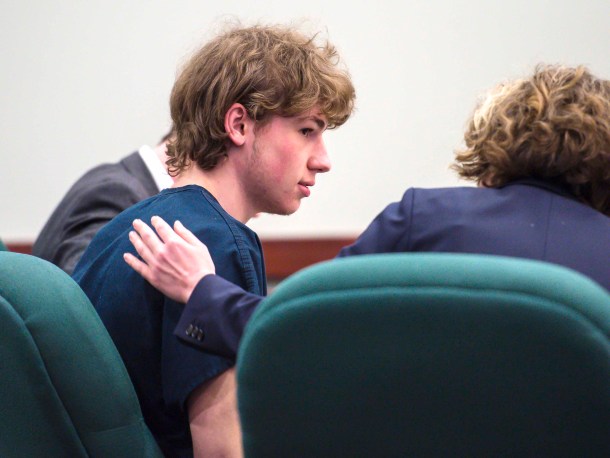
RUTLAND — The attorney for a former student accused of plotting to shoot up the high school he’d attended told a judge on Friday she will file a motion to dismiss the case on the grounds that prosecutors lack enough evidence to support the charges.
Prosecutors called police and school officials to the stand over a two-day court hearing they said showed that Jack Sawyer, 18, of Poultney, had detailed plans and had taken steps to implement them with the intention of causing “mass casualties” at Fair Haven Union High School.
The hearing, which started Tuesday and continued Friday in Rutland Superior criminal court, was to determine whether Sawyer should be held without bail pending trial on the four felony charges against him, including attempting first-degree murder and attempted aggravated murder. He has been held since his arrest in February.
Sawyer has pleaded not guilty to the charges. If convicted, he could face the rest of his life behind bars.
The hearing concluded Friday without a ruling by Judge Thomas Zonay.
Instead, the judge asked attorneys on both sides to file additional legal briefs by Monday, March 12, over whether Sawyer should continue to be held without bail pending trial.
Kelly Green, Sawyer’s public defender, told Zonay she intended to file another motion prior to that one. On Monday, March 6, Green said in court, she would submit a motion to the dismiss all the charges against her client.
Green said because her client is 18 and is being detained in an adult jail, time is of the essence.
Judge Zonay said a motion to the dismiss is a separate matter from the issue of whether Sawyer could continue be held without bail.
He told the defense attorney that while she could “certainly” file a motion to dismiss, filings on the matter of her client’s continued detention would be due March 12.
Green, speaking outside the courtroom after the hearing, repeated her intention to file a motion to the dismiss the charges against her client.
Earlier this week, the head of her office, Defender General Matthew Valerio, said in an interview with VTDigger that Sawyer had been “overcharged.”
“The Vermont Supreme Court has been clear, there is a big difference between planning, or preparing, to make an attempt, and attempting a crime,” Green said outside the courtroom. “The state has to have evidence that he attempted these crimes, I haven’t heard a word of it.”
She gave an example of two men in a “scuffle” on the street. One of the men picks up a rock and the other man picks up a bottle from the trash, she said. The man with a bottle then raises the bottle over his head as if he is about to strike the other man.
“The Supreme Court has said in a case like that, that’s not an attempted assault, that’s preparing to make an attempt, but it’s not an attempt,” she said. “An attempt would be taking a swing, an attempt would be throwing the bottle, that would be an attempt at an assault.”
Green then added of her client, “What he did was he prepared for an attempt, he did not actually attempt. That’s a big difference. This child is looking at life in prison without parole, think about that.”
Rutland County State’s Attorney Rose Kennedy, who is prosecuting the case, declined comment on Green’s intention to file a motion to dismiss the charges against Sawyer.
Kennedy has previously said she stands by the charges, and will argue the case in the courtroom, not in the media.
An attempt by Kennedy to introduce a video of the interrogation of Sawyer by Vermont State Police detectives last month led to debate between the attorneys at the start of Friday’s hearing, with Zonay again saying he would issue a later ruling on the matter.
That dispute centered on whether the entire video should be entered into evidence, rather than clips played in court by the prosecutor.
Kennedy balked at introducing the entire video because, she said, the names of students and one teacher on a reported kill list Sawyer had made would then be publicly available.
The prosecutor said she was still working to determine how to redact the video, adding that if the names were released publicly it could cause “trauma to people on the list.”
Kennedy added, “We were trying to save them from that trauma.”
Green countered the entire video should be admitted, unredacted, or not at all.
Zonay ordered the video submitted under seal, giving both sides until later next week to present arguments supporting their positions before issuing a ruling.
Vermont State Police Detective Sgt. Henry Alberico, who took part in the questioning of Sawyer at the state police in barracks in Rutland last month, provided the only testimony Friday.
‘Red flags’ seen in 2016
During testimony earlier in the week, police and school officials testified about “red flags” they had seen in Sawyer from 2016 when they began a “threat assessment” to address concerns raised by his behavior when he was still a student at the school.
The concerns including an apparent fascination with the 1999 massacre at Columbine High School in Colorado, evidence of which included a school report he had written on the topic and his use of the image of one of the killers on a Facebook page.
However, before the “threat assessment” could be completed, witnesses testified, Sawyer, diagnosed with anxiety and depression, had left the school. His parents had enrolled him in a residential treatment boarding school in Maine.
Earlier this month, according to witnesses, Sawyer returned to Vermont, and was living in a car.
He was arrested two weeks ago by police after authorities said they received messages exchanged over Facebook between Sawyer and a friend from New York in which Sawyer talked of shooting up Fair Haven Union High School.
In a clip of the interrogation by state police that was played in court Friday, Sawyer talked of wanting to eclipse the number of people killed in previous school shootings. He specifically mentioned the 2007 mass shooting at Virginia Tech that killed 32 people.
Alberico also talked of a notebook Sawyer kept, titled, “Journal of an Active Shooter.” The detective said Sawyer kept the diary so authorities would know why he did the shooting after he had carried it out.
The detective also testified that Sawyer talked about carrying out the shooting this school year so some of the students he went to school with would be killed.
Later, when questioned by the detectives about his school shooting plan, Sawyer is videotaped saying of his former schoolmates, “If they died, great, but it wasn’t necessary.”
His first target, though, Sawyer told the detective, would have been the school resource officer, Scott Alkinburgh, a corporal in the Fair Haven Police Department. Sawyer said he would have taken out Alkinburgh first because he was the only person at the school who could possibly have stopped him.
Sawyer also told the detective that he had planned to carry out the plot on Apr. 20, the same date as the Columbine massacre. However, he said, that when he went online to check the school calendar he realized that Fair Haven high school was on spring break that week.
That’s when, he told the detective, he moved the date up to March 14. Two other dates, March 15 and March 16 wouldn’t work, Sawyer said, because his online check of the school’s calendar had revealed those were “in-service” days and classes would be out.
Sawyer also talked, in one of the clips played by the prosecutor, of his intention to follow through on his plan, telling the detective that once he decides to do something “there’s no backing out.”
Sawyer added, “I’m patient.”
Green, in her questioning of Alberico, selected other excerpts from the journal, including those in which Sawyer wrote about driving 100 mph into a wall to kill himself to make all thought running through his head stop.
It was also raised, during the questioning of Alberico, that Sawyer was under guardianship by his parents. When Sawyer was at the police barracks he was told his parents were there, but he agreed to continue to be questioned alone by detectives.
Even though his parents had guardianship over him, police say that the 12-gauge shotgun he purchased at Dick’s Sporting Goods in the days prior to his arrest was legally obtained and that Sawyer had passed a background check.
Sawyer also told detectives he had planned on buying an AR-15 rifle and a 9mm handgun, though the purchases were never made. He did say he bought $500 in Bitcoin, but a drop in the market in the online currency had delayed his plans to buy the handgun until it rebounded.
As she had done in cross-examining police and school officials earlier in the week, Green asked Alberico a series of questions and received similar responses.
“He talked about conducting surveillance of the school resource officer, right,” Green asked Alberico.
“Yes,” the detective replied.
“You have no evidence whatsoever that he actually conducted any surveillance, correct?” the defense attorney asked.
“Correct,” Alberico said.
“There is no witness that you’re aware of that saw him in the school hallway with a gun,” Green asked.
“Correct,” Alberico said.
“Or saw him in his car parked in the school parking lot?” the defense attorney asked.
“Correct.”
“In fact, nobody even saw him, has seen him in Fair Haven,” Green said to Alberico.
“I don’t know, it’s possible,” the detective said.
“You’re unaware of any witness … anyone who has seen him in Fair Haven?”
“Correct,” Alberico said.
“He never pointed a gun at anyone to your knowledge?” Green asked.
“To my knowledge, he did not,” the detective replied.
Kennedy, the prosecutor, later had Alberico read another excerpt from Sawyer’s journal in which he wrote, “I’m just good at lying and making things seem okay.”
The prosecutor then questioned the detective about Sawyer’s plans to shoot up the high school in Fair Haven.
“Did he admit to you that he was capable of fooling people, but that the thoughts and that the plans still exist,” Kennedy asked Alberico.
“He did,” the detective said.
