


Rough Landing is a special series and podcast on the debate over basing F-35 fighter jets in Burlington. Read Part 1, Part 3, and Part 4.
[M]any adjectives have been used to describe the F-35 stealth fighter jet scheduled to arrive at Burlington International Airport next year, and few of them are flattering.
The F-35 program has been pilloried in the national press as “flawed” and “failed.” It’s been called a “nightmare,” “a mess” and “a trillion-dollar mistake.” And just last month, a Bloomberg report bluntly stated: “The Pentagon Isn’t Happy with the F-35.”
Sen. John McCain, a longtime military stalwart, has been a consistent critic of the Joint Strike Fighter program over its years of development delays and cost overturns that continue to this day.
“The F-35 program’s record of performance has been both a scandal and a tragedy with respect to cost, schedule and performance,” the Arizona Republican said when he chaired a 2016 Senate Armed Services Committee hearing on the F-35.
In 2013, the Defense Department inspector general determined that the plane’s main developer, Lockheed Martin, was inadequately overseeing the F-35’s development, which “may result in nonconforming hardware, less reliable aircraft, and increased cost.”
A more recent Pentagon report, issued in January, found that Lockheed Martin failed to share crucial maintenance and development data with the government for a year, creating a large backlog of information about the plane’s challenges that required additional scrutiny.
It’s been 20 years since the F-35 fighter jet was proposed as a key component in the Army, Navy and Air Force arsenals, and little has gone smoothly. It is now the most problem-plagued, expensive weapons system in U.S. history, expected to cost taxpayers more than $1.5 trillion by the time it is fully implemented.
While watchdogs have been documenting cost overruns and development delays for the F-35 since at least 2000, the federal government has never wavered in its support of the program. With so much time and money already invested, some have deemed the flawed plane as “too big to fail.”
Burlington selected
 Soon the first Air National Guard squadron of F-35s is set to arrive in Vermont — another controversial decision that the government has steadfastly stood by. Burlington was selected from among 83 potential basing sites despite complaints that the Air Force did not properly consider the extreme noise the jets would generate in densely populated communities around Burlington International Airport.
Next year, the Air Force is scheduled to begin replacing the current fleet of 18 F-16s with 18 more-advanced, significantly louder F-35s. While community groups have opposed the program, state and local leaders continue to enthusiastically back the basing decision, arguing it will preserve up to 1,100 jobs.
The F-35 faces a renewed challenge next week, when Burlington voters consider a ballot resolution asking the City Council to request cancellation of the planned basing. Backers of the advisory proposal argue the Air Force can still change course, citing instances in which controversial basing decisions have been reversed and other types of aircraft substituted. However, Vermont’s adjutant general, Maj. Gen. Steven Cray, says “there is no alternative mission being planned for the Vermont Air National Guard.”
Although there is little agreement about the potential impact of the Town Meeting Day voting, even the most ardent backers of the F-35 have acknowledged persistent developmental delays.
The entire fleet was grounded in 2013 after a crack was found on an engine turbine blade. A year later, an engine-valve fitting problem halted flights. Last July, the Air Force grounded a quarter of its F-35 fighters after pilots experienced oxygen deprivation while in flight.
Final push
In an unprecedented move, the F-35 production and development phases are being conducted simultaneously, and the Air Force recently deployed its first fleet of F-35As — the same model scheduled to come to Burlington — for an overseas mission around the Korean peninsula.
Planes purchased by allies have also been shipped out. But last November, deliveries of the F-35 were halted after it was discovered that Lockheed Martin was not applying a protective primer layer to prevent corrosion.
That same month, a recently delivered F-35 made an emergency landing at a base in Okinawa, Japan. And less than a month later, an F-35 from the same fleet lost a two-foot-wide panel during a routine mission near the island.
視聴者提供ってあるけど絶対マニアだろこれ pic.twitter.com/gvfS9bOhRx
— さいとぅーん (@satwoon_msdf174) November 30, 2017
In January, the Department of Defense’s operational test and evaluation director issued a scathing report that identified more than 1,000 deficiencies with the plane’s functionality. The F-35 cannot reliably shoot straight, or deploy its bomb-aiming mechanisms correctly, the report found. It said pilot ejection safety also remains an issue, and the plane has serious cybersecurity vulnerabilities.
The plane’s Engine Ice Protection System — which would almost certainly be crucial for New England flights — was also found to be faulty. Facing problems, the military appears to have abandoned the ice program altogether, instead “changing the technical orders to require pilots to shut down the aircraft if icing conditions are encountered on the ground.”
“The operational suitability of the F-35 fleet remains at a level below service expectations and is dependent on workarounds that would not be acceptable in combat situations,” the January report reads. “Reliability growth has stagnated.”
Praise from military leaders
Despite these myriad issues, the F-35 retains the backing of powerful military and political leaders — from Sen. Patrick Leahy, D-Vt., to President Donald Trump, who voiced enthusiasm for the program last fall after previously criticizing the cost.
Military officials across the services continue to laud the F-35 as the most advanced aircraft ever. In a House Armed Services Committee hearing last year, Marine Lt. Gen. Jon Davis said that in air exercises, the jet fighter completely dominated its enemies.
“We had a scenario out there that was 20 versus eight. Twenty bad guys against eight good guys,” Davis said. “In those eight, good guys were four Marine F-35Bs. Basically, the 20 guys had a very bad day — I will leave it at that.”
Davis, the deputy commandant for aviation, said the majority of the kills came from the F-35s.
Air Force Maj. Gen. Jerry Harris Jr., described a similar situation involving the F-35A in which it produced a 20-1 kill ratio. “The airplane is doing exactly what we need it to do.”
 In a sense, Burlington will be a testing ground for the F-35. The airport is planning for the planes to begin arriving next year — a year earlier than initially projected. In what some view as an effort to quell political criticism, Lockheed Martin has accelerated production despite lingering development challenges.
The Pentagon recently announced that because of delays, the F-35’s final stage of development — called “initial operational test and evaluation” — won’t begin until late next year, at about the time the jet fighters are expected to arrive.
Brig. Gen. Joel Clark of the Vermont Air National Guard told VTDigger in an email that the fleet coming to Burlington is currently being manufactured and will include Block 3F software.
The Block 3F software has been racked with technical bugs. The January Defense Department report found that the 3F software was, among other things, unable to show pilots the geographical coordinates loaded onto a bomb. The F-35, unlike its predecessors, is highly automated with software controlling many tasks. This month the military announced new software that “will prevent pilots from flying into the ground.”
The next generation of U.S. fighter jets will also have thousands of fewer flight hours than those that preceded them. When the first F-16s arrived in Burlington in 1986, the plane had been rigorously tested and tweaked over the course of more than 1 million flight hours. The F-35, on the other hand, is estimated to arrive in Burlington with less than a fifth of the hours recorded by the F-16, largely because of the technical problems that have halted flights over the years.
Flight hours trimmed
Initially, Air National Guard officials estimated that the F-35 fleet would have 750,000 flight hours by the time the planes began arriving in Burlington. That initial estimate has been slashed, and the military now says the plane will have roughly 186,000 flight hours by the time it’s rolled out in Burlington next year.
But some argue that even that estimate is too high. As of November, the entire fleet had just under 60,000 hours, and the specific F-35 model coming to Burlington had flown just 33,754 hours, roughly half of what is required to hit what’s called “a crucial maturity mark.”
In 2013, after activists pushed the military to release flight hours, one Air Force official handling civic outreach wrote to colleagues that “the flight hours issue probably needs some sort of answer, too, even if the answer is really vague, as in ‘We have confidence in the safety of the F-35, which will be fully operational by the time it is proposed to be based in Burlington.’ ”
Detailed questions submitted to Lockheed Martin and the Air Force for this article — including requests for up-to-date flight hours — went unanswered. The Vermont Air National Guard directed questions about flight hours to the Air Force.
When the Air Force released its final Environmental Impact Statement (EIS) in 2013 on potential F-35 basing at Burlington, its authors wrote, “There have not been enough flight hours to accurately depict the specific safety record for this new (plane).”
The authors suggested that were the F-35 to have an established safety record, it would be comparable to the F-22, a plane that was the subject of a damning 2012 report by CBS 60 Minutes. That report featured two pilots who claimed the planes deprived them of oxygen and were unsafe to fly. The F-22 has also experienced 15 Class A mishaps — the military’s most severe kind — two of which killed pilots.
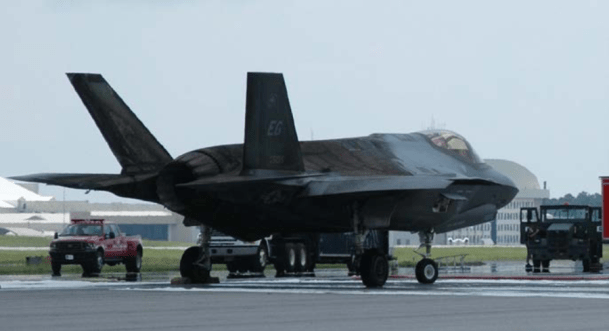
While the F-35 lacks the hours required for a reliable flight record and has many documented issues — including lack of oxygen for pilots — there have been no fatal crashes reported by the military. The plane has, however, suffered three Class A mishaps — defined as causing at least $2 million in damage to the aircraft or loss of life or injury to the aircrew.
Two of those mishaps occurred with the F-35A, the model coming to Burlington. One happened in 2016, when tailwinds sparked an engine fire in Idaho. The other happened in 2015, when an F-35 caught fire after an engine stalled during takeoff at Eglin Air Force Base in Florida. The pilot stopped the plane roughly 8,000 feet down the 11,987-foot runway and safely exited, according to the official crash report.
Were a similar issue to occur in Burlington — where the runway is only 8,320 feet long — a pilot would have to improvise and act quickly to avoid calamity.
Worst case scenario
Burlington International Airport has hosted a military installation since 1946, and records indicate it has only experienced one fatal military accident in its history. In 1965, an F-89 jet fighter that experienced an onboard fire crashed in a cornfield near Taft’s Corner in Williston, about three miles from the airport. The pilot and his navigator were killed.
While the likelihood of an F-35 crash is extremely low, the devastation wrought by such a mishap could be cataclysmic. The key factor is the proximity of a concentrated population to a crash site. In addition, the F-35’s makeup of composite parts and materials could result in a rapid spread of flames that would be difficult for firefighters to control.
 While older planes, like the F-16, are largely built from materials like aluminum and steel, the F-35’s entire exterior is composed of lightweight composite materials, like Kevlar and graphite. Once burned, these materials break up into highly toxic fumes that also provide fuel to a fire. While the F-16 has roughly 3 percent composite materials, the F-35’s composite makeup is estimated to be more than 40 percent. (Large commercial airliners contain even higher composite levels than the F-35, though these jets have sterling safety records.)
The F-35 also carries 18,000 pounds of fuel, more than double what the F-16 can hold. If a pilot is required to dump fuel in an emergency scenario, the military instructs the person to unload it “over large bodies of water as much as possible,” raising the specter of a massive discharge over Lake Champlain.
As a stealth aircraft designed to be invisible to radar detection systems, the F-35 receives frequent coats of a special composite material that poses additional challenges should the plane catch fire.
The smoke produced from a burning F-35 would contain microscopic fibers and plastics known by the Air Force to be carcinogenic, mutagenic and toxic. According to a number of military studies, such materials could inflict permanent lung and neural damage, and even death, if inhaled.
Depending on the seriousness of a possible crash, the time of day and the direction of the wind, this toxic smoke could be carried into parts of Burlington, South Burlington and Williston.
There are multiple Air Force studies produced over the years detailing the serious health effects from inhaling smoke from these composite materials.
“Various metals and low observable coating materials have the potential to pose significant health risks in the terms of toxic gases (including carcinogenic materials) when they are burned,” reads one Air Force memo. Another study states: “When damaged by fire, explosion, or high-energy impact, composite materials pose unique environmental, safety, and health hazards in all phases of a mishap response.”
Basing decision unprecedented
According to Pierre Sprey, a weapons analyst who helped develop the F-16, the F-35 basing in Burlington is unprecedented and therefore establishes unique safety challenges for the community.
“Based on my extensive experience in this area, I am aware of no stealth-coated aircraft that are based in heavily populated neighborhoods in the United States,” Sprey said in an affidavit filed as part of an unsuccessful federal case challenging the Burlington basing. “The F-117, the F-22, the B-2 are all operated out of bases that are outside of heavily populated areas. The other Air Guard sites proposed for the F-35 are all outside of heavily populated areas.”
There are detailed plans in place for the Air National Guard’s Fire Department to deal with a plane fire in which composite materials are in the mix. While a request to speak with Air Guard fire officials went unanswered, South Burlington Fire Chief Doug Brent said he had complete confidence in the Guard’s capability to fight an F-35 fire, adding that officials are aware of every composite material present in the planes.

South Burlington and other neighboring municipal fire departments have cooperative agreements with the the Guard’s firefighters. Brent said his department expects to receive additional training once the F-35s arrive, but acknowledged that his fighters don’t have the technical expertise to fight such a complex fire on their own.
In reviewing the environmental impact of bringing F-35s to Burlington, the Air Force indicated “a significant event could occur,” though crash risks were not substantially addressed in the military’s Environmental Impact Statement. After opponents of the Burlington basing began asking questions about a composite crash, Air Force officials emailed back and forth over exactly what the risks were, describing public concerns as “legitimate.”
Area of risk
Yet despite these increased risks, the Air Force sees no reason for increased preparation or public awareness.
“Although these risks could be significant, they do not necessarily require any special procedures not currently being followed,” reads an Air Force memo on composite materials. The memo later says there is “no data to suggest the general public would be at risk outside of the cordoned area of an accident site.” However, it does not detail how extensive such an area could be.
Using available federal safety guidelines for the toxic chemical chlorine, the weapons expert Pierre Sprey estimated that a serious F-35 crash could create a 10-mile toxic radius if a crash were to occur during the day. At night, under different atmospheric conditions, smoke could travel even farther, up to 40 miles by Sprey’s estimate.
In an interview, Sprey acknowledged that the F-35 has had no spectacular crashes. But he said the plane is still quite new, and the Air Force has been extremely careful during early tests, limiting speed to “a few Gs” and avoiding intense flight maneuvers.
“The way this airplane has been flown so far is atypical,” Sprey said. “Once the F-35 starts being used for more operational tests, like training for dog fights or weapons deployment, it could become considerably more dangerous from a crash point of view.”
Sprey recently concluded an analysis of the current state of F-35 development, and he said significant development issues remain.
“The problems of the airplane keep getting worse and worse,” Sprey said. “The more they test it, the more they find to fix. They put Band-Aids on top of Band-Aids, but then they test the Band-Aids, and the Band-Aids don’t work.”
Read Part 1, Part 3, and Part 4 of our special series on the F-35 debate, and listen to the Rough Landing podcast.
