

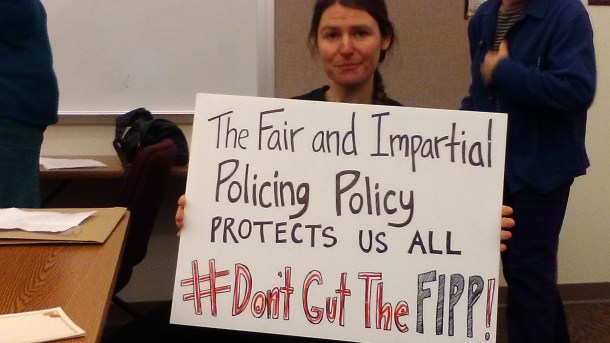
A Senate panel is asking for a delay in the implementation of anti-bias policing policy after hearing from advocates who argue it doesn’t go far enough to protect undocumented immigrants.
Members of the Senate Government Operations Committee on Tuesday agreed to send a letter to the Vermont Criminal Justice Training Council asking to push back the implementation deadline of the Fair and Impartial Policing policy.
“By statute all law enforcement agencies must adopt and implement either the model policy or one that is in compliance by March of this year,” the letter reads. “Given the fact that there is still disagreement and that there are a number of court cases in the offing that address some of these issues, we would ask that the implementation date be extended to May 1.”
The letter continued, “We are not taking a position on the contents of the policy but are simply asking for a bit more time to try to resolve the outstanding issues.”
Brandon Police Chief Christopher Brickell, the training council’s chair, said in an email Tuesday that he wanted to see the letter from the committee before commenting.
Will Lambek, an organizer for the human rights group Migrant Justice, has advocated to remove exceptions in the policy that allow law enforcement in Vermont to share information about undocumented immigrants with federal authorities in certain situations.
“We hope that the council would listen to the Legislature and delay implementation,” Lambek said Tuesday afternoon. “When we asked that they delay implementation back in December, their response was, ‘We can’t because the Legislature has given us a timeline.’ Now, the Legislature has given a new timeline.”
Sen. Jeanette White, D-Windham, head of the Senate Government Operations Committee, said the council had told her they have agreed that they would look at the letter, but haven’t made a commitment to delay implementation of the policy.
The Fair and Impartial Policing policy was adopted late last year by the Vermont Criminal Justice Training Council. The Legislature last session passed a measure calling for the development of that policy to ensure the state was in compliance with federal law. Failing to comply with federal law could put federal funding for law enforcement agencies in the state at risk.
The legislation also called for all law enforcement agencies in the state to adopt it by March 1, or submit a policy of their own that is deemed by the state attorney general’s office to be in compliance with federal law.
Advocacy groups for undocumented immigrants, including Migrant Justice and the Vermont chapter of the American Civil Liberties Union, spoke at a Senate committee meeting last month and urged panel members to consider pushing back that implementation date.
They said they were seeking more time to talk to the Vermont Attorney General’s Office about a handful of changes they would like to see made to the policy to provide needed protections for undocumented immigrants. The Attorney’s General’s Office has a seat on the council.
Assistant Attorney General David Scherr, representing the Vermont Attorney General’s Office on the council, testified before the Senate committee last month. He told members that he wasn’t sure more time would help resolve the differences between the parties.
“Both sides worked really hard to see where the other side was coming from and to accommodate wherever we could,” Scherr said.
However, he added that he was not opposed to talking again with the advocates for the undocumented immigrants.
In one example of the differences between the parties, advocacy groups had asked for a policy under which Vermont law enforcement would not share information about crime victims or witnesses with federal immigration authorities unless the individual consented.
However, council members have said that language calling for such a prohibition is a “clear violation” of federal law.
The council’s version states that law enforcement agencies “should communicate that they are there to provide assistance and to ensure safety, and not to deport victims/witnesses.”
The council’s policy also states that when considering whether to contact federal authorities, police agencies in the state “should remain mindful that their enforcement duties do not include civil immigration enforcement” and that law enforcement’s mission in the state is “to serve all Vermonters, including immigrant communities, and to ensure the trust and cooperation of all victims/witnesses.”
Lambek, in testifying before the committee last month, talked about the importance of having clear lines drawn in the policy regarding communications between local law enforcement and federal agencies.
He spoke of an incident in August in Franklin County where a sheriff’s deputy sought assistance from U.S. Border Patrol after a traffic stop of two undocumented immigrant farmworkers, a father and son. They both ended up spending six months in jail, and have since been deported, according to Lambek.
Jay Diaz, staff attorney with the Vermont ACLU, said Tuesday that he was pleased with the committee’s decision to send the letter asking to delay the implementation of the policy.
“It’s also beneficial to law enforcement,” Diaz said, “in that, if changes are going to happen or if court cases are going to give us some indication of where the courts are going that are going to answer our questions, then they don’t have to change their policies all over again.”
