

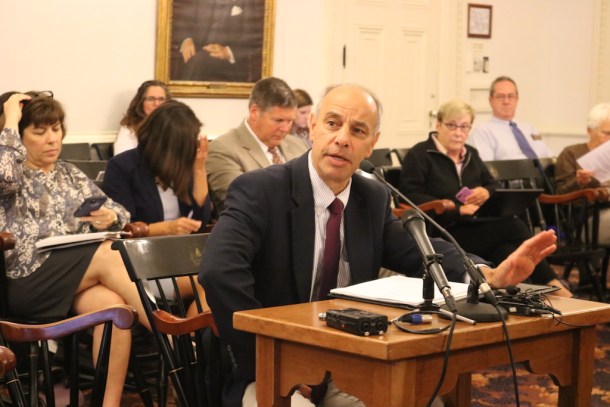
Finance Commissioner Adam Greshin said on Monday that a proposal moving through the Legislature to overhaul the state’s education funding formula does not adequately address the administration’s desire to control school spending in fiscal 2019.
The lawmakers sponsoring the bill say there are built-in cost-control measures in their plan, and have signaled they are open to finding ways to save on special education.
The Scott administration wants more, having presented lawmakers with a list of 18 ways to save on education, from a statewide health care system for school employees, reducing the staff-to-student ratio over time and consolidating schools. It remains unclear where the administration and legislators will find common ground.
Greshin said that reducing special education spending alone is unlikely to suffice, and that a state employee health care plan should be part of the package.
“That should be part of the mix,” Greshin said, adding the issue has been studied by a commission and was ready to become a bill. “It is locked and loaded. A statewide health care contract is ready to go.”
House Speaker Mitzi Johnson began a public campaign last week for a proposal promising to slash homestead property tax in half as part of what would be the most significant education spending reform in two decades. To fill the gap, revenues from property tax would be replaced by creating a tiered education income tax and directing 100 percent of sales tax revenues to schools.
Greshin said the administration’s position remains, that adjusting the funding formula without additional measures to reduce spending is a non-starter. He said people would quickly see the savings on one tax canceled out by increases on another.
“This is not a tiny little surcharge on your income tax. This is serious money and you think the average Vermonter is not going to notice that, really?” he said.
Taxpayers with incomes under $47,000 would be exempt from the new tax; taxpayers in higher brackets would pay a graduated education tax on income over $47,000. Someone making $50,000, for example, would pay 1.35 percent on $3,000.
The Scott administration has said it would like to see between $75 million and $94 million in savings to make up for an $80 million deficit in Vermont’s education fund for fiscal 2019.
Rebecca Kelley, Scott’s spokeswoman, said that figure could be reduced, because the actual increase in school budgets looks to be about 2.5 percent, as opposed to the projected 3.5 percent. But she said there still need to be safeguards to prevent taxes from going up.
The Scott administration is focused on both filling the hole in the education fund and not raising taxes in fiscal 2019. But Rep. Scott Beck, R-St. Johnsbury, said work on that goal needed to begin last spring, and their proposal does offer some immediate tax relief.
Members of the House say their plan does that by setting base per-pupil spending at about $13,000, and then providing incentives to encourage local fiscal restraint. Districts that spend less than the base figure will see tax cuts, while those that spend more will see their taxes go up.
Rep. David Sharpe, D-Bristol, who chairs the Education Committee, said, “The real cost containment is in the tax bill.”
Greshin told House Education Committee members last week that similar cost containment mechanisms in the past have provided only momentary budget relief before spending begins creeping back up.
The need to control spending on special education appears to be a rare point of agreement in the debate. It was included in the governor’s “laundry list” of proposals, and would be the focus of lawmakers going forward, said Sharpe.
He said his committee was looking into a “census block grant” that would create far more savings than the special education cuts proposed by Scott. “UVM identified between $70 and $80 million dollars in savings. That is where the real money is,” he said of special education funding reform.
The “Picus report,” a widely cited study of Vermont’s education spending, found that the state was spending about $140 million more than it needs to on special education.
House leader Johnson said the new funding formula combined with a special education proposal should be enough to meet the governor’s demands.
“When you look where we spend money, special education is the place where we probably spend more than is needed for best practices,” she said. “So I think the special ed bill will be a substantial piece of the cost containment proposal.”
Sharpe said he was open to considering a state employee health care system, but only as a secondary matter after discussing special education and an education tax overhaul. He said he had no appetite for mandating student-to-staff ratios, as proposed by Scott.
“We looked at ratios five years ago — ratios are extraordinarily difficult to wade into especially when thinking about mandating from Montpelier to local school districts,” he said, adding that Act 46, an education reform bill passed in 2015, needed time to have its desired impact.
“That process needs to play out and we will look at what ratios look like after the full implementation of the school district consolidation law,” Sharpe said.
Greshin said Act 46 was moving the state in the right direction, but at a “glacial pace.”
Scott’s office said the governor was anxious to cut spending this session, and had started the discussion in the fall in an attempt to avoid a drawn-out session or veto threats to achieve his goal.
“We hope it won’t come to that,” said Kelley, his spokeswoman. “We hope we can work together and close this gap.”
